Iranian opposition abroad finds new voice amid protests

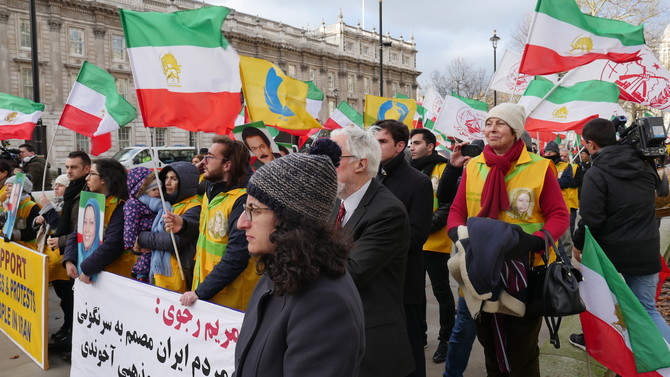
Daily demonstrations have been held outside the Iranian Embassy in London. (AN Photo)
Updated 08 January 2018
Follow

Iranian opposition abroad finds new voice amid protests

LONDON: Iranian opposition groups in the West have been vocal in their calls for the overthrow of the regime during the recent widespread protests across Iran. 
Daily demonstrations have been held outside the Iranian Embassy in London while supporters at a rally on Thursday organized by the National Council of Resistance of Iran (NCRI) and its affiliate The People’s Mojahedin Organization of Iran (PMOI) echoed protesters’ chants of “down with Khamenei, down with dictators” opposite the UK prime minister’s residence.
Headquartered in France, the PMOI, which is also known as the Mojahedin-e Khalq (MEK), claims to be the Iranian government in exile. Founded in 1965 in opposition to the shah, it has a chequered past in the UK, Europe and the US, where it was designated a terrorist organization until being delisted in 2008, 2009 and 2012 respectively.
Laila Jazayeri, director of the Association of Anglo-Iranian Women in the UK, which is under the NCRI/PMOI umbrella, said: “The fact that the PMOI was named among designated (terror) groups was the work of the Iranian regime. It was part and parcel of a political deal, part of an appeasement policy.
“It is time for change and it is time for all Western leaders to wake up to the reality and stop tying their fate to a regime that has no future.”
Before the Iranian revolution in 1979, the group conducted bombing campaigns against the shah’s regime, and then against the theocratic government during the 1980s and 1990s. They also attacked American targets and supported the seizure of the US embassy in Tehran shortly after the revolution.
Its stance changed after the US-led invasion of Iraq in 2003, with the group claiming to have renounced violence and lobbying for support against the Iranian government among Western parliamentarians and building relationships with politicians in the Europe and the US.
Majid Rafizadeh, an Iranian-American political scientist and president of the International American Council, described the “paranoia with which the Iranian regime officials constantly speak about the group at home, including the most recent appeal to the French president by Hassan Rouhani, in which he blamed the MEK for its role in the unrest that has engulfed Iran over the past eight years.
“The Iranian regime has spent hundreds of millions of dollars to demonize the PMOI and portrayed it as a group without popular support,” Rafizadeh, an Arab News columnist, added.
Some experts in the UK and US questioned the PMOI’s relevance after decades in exile.
“They have a support base in London, Paris, Washington, but to really become viable as a national alternative to the Islamic Republic they would need to do a lot more to attract people to their cause,” said Alex Vatanka, a senior fellow at the Middle East Institute and the Jamestown Foundation in Washington.
“They have their hardened core supporters, but that is not going to cut it as far as becoming a really viable alternative.
“History tells us that the Iranian opposition are immensely fragmented — they have a proven record of not getting along. That just helps the Islamic Republic,” he added.
Speaking to Arab News at a rally in London, Azadeh Hosseini, a member of the Anglo-Iranian Teachers Association, said: “We’re here to be the voice of the Iranian people and express our support for the National Council of Resistance of Iran and the PMOI, who have been striving for peace and democracy in Iran since the Iranian regime came into power.”
“Unfortunately Western governments have been very late in condemning the actions of this regime,” she said.
Protesters at the rally in London represented “Iranian people from all walks of life inside Iran,” Jazayeri said, adding: “The PMOI has been after regime change for the last four decades.”
The PMOI’s former association with Saddam Hussein during the 1980s, when the group conducted raids into Iran during the latter stages of the Iran-Iraq war, alienated many Iranians, some of whom see them as “betrayers of the nation” according to Clement Therme, researcher fellow for Iran at the International Institute for Strategic Studies.
But Rafizadeh said they remain “the largest and most organized opposition group outside and inside Iran.”
“Regardless of what one might think of the group, the MEK is a major player in Iran. It cannot be dismissed. Not only have they roots within Iranian population, but they also have the organizational power, which makes them a leading player in any change in Iran.”


Family of Palestine Action hunger-strike detainee warn she could die 

Updated 35 min 58 sec ago
Follow

Family of Palestine Action hunger-strike detainee warn she could die 

  • Teuta Hoxha, among 8 people held on remand for over a year, has not eaten in 43 days
  • Campaigners slam treatment of pro-Palestine prisoners on hunger strike 

LONDON: A Palestine Action prisoner in the UK could die if the government does not step in over her hunger strike, her family have warned, amid claims that authorities have been “deliberately negligent” in the treatment of other detained hunger strikers.

Teuta Hoxha, 29, is on day 43 of her strike, having been held on remand in prison for 13 months over charges relating to a break-in at an Israel-linked arms manufacturing facility in August 2024. 

She is one of eight people on hunger strike who were detained for their part in the incident at the Elbit Systems UK site.

Her sister Rahma said she can no longer stand to pray, and suffers from headaches and mobility issues. 

“I know that she’s already instructed the doctors on what to do if she collapses and she’s instructed them on what to do if she passes away,” Rahma, 17, told Sky News.

“She’s only 29 — she’s not even 30 yet and nobody should be thinking about that,” Rahma added. “She’s been on remand for over a year, her trial’s not until April next year and bail keeps getting denied.”

The eight hunger strikers charged over the Elbit Systems break-in, who deny all charges against them, are demanding an end to the operation of weapons factories in the UK that supply Israel.

They are also calling for Palestine Action, which is banned in the UK, to be de-proscribed, and for their immediate bail.

They are not the only members of Palestine Action in prison carrying out hunger strikes. Amu Gib, imprisoned over a break-in at a Royal Air Force base earlier this year, was taken to hospital last week, having not eaten in 50 days. 

Gib was initially denied access to a wheelchair after losing mobility, and campaigners said it was “completely unacceptable” that this had led to a missed doctor’s appointment, adding that Gib was also denied access to the vitamin thiamine.

Campaign group Prisoners for Palestine said: “At this trajectory, the hunger strikers will die unless there is urgent intervention by the government.

“It is completely unacceptable and deliberately negligent to pretend the hunger strike is not happening, or to dismiss the prisoners’ demands.

“They are in the custody of the state, and any harm that comes to them is a deliberate outcome of the government’s negligence and the politicisation of their detention.”

A relative of Gib told The Independent: “We wouldn’t know if Amu is in a coma or had a heart attack. I’m the next of kin and it’s on Amu’s medical record that I am to be contacted in the event of their hospitalisation.

“But it’s been complete agonising silence for 57 hours. I’m furious and outraged that the prison was withholding thiamine from the hunger strikers, without which they are at high risk of brain damage.”

The treatment of the hunger strikers has drawn high-profile criticism, with Dr. James Smith, an emergency physician and lecturer at University College London, telling The Independent that they “are dying” and would require specialist medical help.

Around 900 medical professionals in the UK have written to government ministers David Lammy and Wes Streeting urging them to facilitate medical treatment for the strikers.

Jeremy Corbyn, former leader of the governing Labour Party, posted on Instagram that he had visited Gib in prison.

Seven hunger strikers have so far been hospitalized since Nov. 2, when the first prisoners began to refuse food.

Jon Cink and Umar Khalid both ended their strikes for medical reasons, having been hospitalized, while Kamran Ahmed told the Sunday Times last week that dying for his cause would be “worthwhile.”

He added: “Every day I’m scared that potentially I might die. I’ve been getting chest pains regularly … There have been times where I felt like I’m getting tasered — my body’s vibrating or shaking. I’ll basically lose control of my feelings.

“I’ve been scared since the seventh day when my blood sugars dropped. The nurse said: ‘I’m scared you’re not going to wake up (when you go to sleep). Please eat something.’

“But I’m looking at the bigger picture of perhaps we can relieve oppression abroad and relieve the situations for my co-defendants … Yes, I’m scared of passing away. Yes, this may have lifelong implications. But I look at the risk versus reward. I see it as worthwhile.”

Under UK law, time limits are set out for those in custody awaiting trial to prevent excessive periods in pre-trial detention.

But UK Prisons Minister Lord Timpson said in relation to the Palestine Action detainees: “These prisoners are charged with serious offences including aggravated burglary and criminal damage.

“Remand decisions are for independent judges, and lawyers can make representations to the court on behalf of their clients.

“Ministers will not meet with them — we have a justice system that is based on the separation of powers, and the independent judiciary is the cornerstone of our system.

“It would be entirely unconstitutional and inappropriate for ministers to intervene in ongoing legal cases.”

Rahma says her sister calls her from prison every day, despite her predicament, to help with her studies.

“Our mother passed away when I was really young. Teuta took care of me and my siblings and made sure to read us bedtime stories.

“She’s always there for me and even from prison, she’s helping me do my homework and revise for exams.”

Rahma added: “My sister is a caring and loving person It feels like the state has taken a piece of me.”

She continued: “The only form of resistance she has is her body and that’s what she is using against the state.”