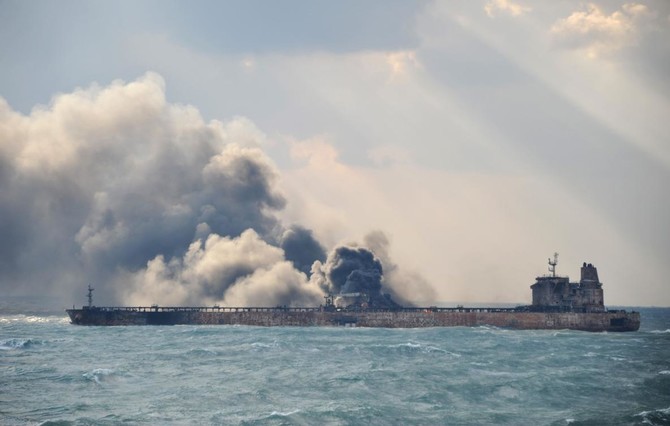
TEHRAN: The Iranian company whose oil tanker burst into flames after a collision in the East China Sea says there is still hope of finding survivors as 31 crew members remain missing and rescue efforts continued on Wednesday.
As the stricken Sanchin still lists after colliding with the Hong Kong-registered freighter CF Crystal late Saturday, a spokesman for National Iranian Tanker Co. told The Associated Press in Tehran that rescuers “likely” will find survivors.
“Since the vessel’s engine room is not directly affected by the fire and is about 14 meters (46 feet) under water, there is still hope,” spokesman Mohsen Bahrami said late Tuesday. “We are persistently working to put out the fire and rescue possible survivors.”
The body of one of the 32 crew members has been recovered and taken to Shanghai for identification, Bahrami said.
Mahmoud Abuli Ghasemabadi, the brother of missing Iranian sailor Ehasan Abuli Ghasemabadi, said he and other families remained hopeful for good news.
“I ask countries that are in that region and can offer any assistance to help us deal with this situation as soon as possible,” Ghasemabadi said.
The Panamanian-registered Sanchin had a crew of 30 Iranians and two Bangladeshis, Chinese state media reported. The 21 members of the Crystal’s all-Chinese crew were rescued.
What caused Saturday’s collision in the East China Sea, 257 km off the coast of Shanghai, remains unclear.
The Sanchi was carrying 136,000 metric tons (150,000 tons, or nearly 1 million barrels) of condensate, a type of ultra-light oil, according to Chinese authorities.
South Korean petrochemical company Hanwha Total Co., a 50-50 partnership between the Seoul-based Hanwha Group and French oil giant Total, said in a previous email to the AP it had contracted the Sanchi to import Iranian condensate to South Korea.
The tanker has operated under five different names since it was built in 2008, according the UN-run International Maritime Organization. The National Iranian Tanker Co. describes itself as operating the largest tanker fleet in the Middle East.
It is the second collision for a ship from the National Iranian Tanker Co. in less than a year and a half. In August 2016, one of its tankers collided with a Swiss container ship in the Singapore Strait, damaging both ships but causing no injuries or oil spill.


![]()
Iran firm says there may be survivors from tanker crash
Iran firm says there may be survivors from tanker crash


Latest updates


© 2026 SAUDI RESEARCH & PUBLISHING COMPANY, All Rights Reserved And subject to Terms of Use Agreement.