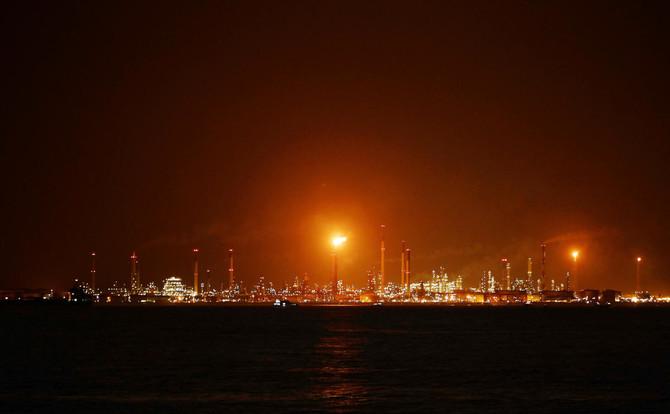
SINGAPORE: Eleven men were charged in a Singapore court on Tuesday over their part in an alleged oil theft at Shell’s biggest refinery, court documents showed.
Police in the island-state, Asia’s main oil trading hub, said earlier on Tuesday they had detained 17 men and seized millions of dollars in cash and a small tanker during their investigations into a theft at the Pulau Bukom industrial site.
Royal Dutch Shell, which first reported the theft to authorities in August, said in a news release that the arrests included “a limited number of Shell employees” and that it anticipated “a short delay in the supply operations at Bukom.”
Nine Singaporeans were charged over the theft and two Vietnamese nationals were charged with receiving stolen goods, transferred from Pulau Bukom to a small oil tanker named Prime South, charge sheets showed.
Shipping data from Thomson Reuters Eikon showed the Prime South was shipping fuel between Ho Chi Minh City, Vietnam, and Singapore for the past 30 days.
Those arrested by police during raids on Sunday, all men, ranged in age from 30 to 63. Police said the six who had not been charged were still under investigation.
The court documents seen so far allege three incidents of gasoil theft: on November 21, 2017, of more than 2,322 tons valued at S$1.277 million (SR3.6 million); and on January 5 and 7 this year of a combined 2,062 tons of gasoil valued at S$1.126 million.
Both Vietnamese nationals were charged with receiving gasoil on January 7, at wharf 5 on Bukom island, the documents show.
Police said they also seized S$3.05 million in cash and the 12,000-deadweight-ton tanker.
They have also frozen the suspects’ bank accounts, the police said.
Bukom is the largest wholly owned Shell refinery in the world in terms of crude distillation capacity, according to the company’s website.
Shell declined to say how much oil had been stolen. The charge sheets specified gasoil as the stolen commodity and listed varying amounts for each man charged. Shipping and oil refining have contributed significantly to Singapore’s rising wealth during the past decades.
The Southeast Asian city-state is one of the world’s most important oil trading hubs, with most of the Middle East’s crude oil passing through Singapore before being delivered to the huge consumers in China, Japan and South Korea.
Singapore is also Southeast Asia’s main refinery hub and the world’s biggest marine refueling station.
Shell is one of the biggest and longest established foreign investors in Singapore. Its oil refinery on Bukom island, situated 5.5 kilometers to the southwest of Singapore, is the company’s biggest such facility in the world, with a processing capacity of 500,000 barrels per day.
Southeast Asia is a hotspot of illegal oil trading. In some cases, oil has been illegally siphoned from storage tanks, but there have also been thefts at sea.
The Regional Cooperation Agreement on Combating Piracy and Armed Robbery against Ships in Asia (ReCAAP) says that siphoning of fuel and oil at sea in Asia, including through armed robbery and piracy, saw sharp increases between 2011 and 2015.
There has been a modest decline since then, although the organization said in a quarterly report that oil theft was still “of concern,” especially in the South China Sea, off the east coast of Malaysia.
The stolen fuel is generally sold across Southeast Asia, offloaded directly into trucks or tanks at small harbors away from oil terminals.

Singapore charges 11 men over Shell oil heist
US and Ukraine reach consensus on key issues aimed at ending the war but territorial disputes remain
- Russia continues to assert maximalist demands, insisting that Ukraine relinquish the remaining territory in Donbas that it has not captured, an ultimatum that Ukraine has rejected
KYIV: The United States and Ukraine have reached a consensus on several critical issues aimed at bringing an end to the nearly four-year conflict, but sensitive issues around territorial control in Ukraine’s eastern industrial heartland, along with the management of the Zaporizhzhia nuclear power plant, remain unresolved, Ukraine’s president said.
Volodymyr Zelensky spoke as the US showed the 20-point plan, hammered out after marathon talks in Florida in recent days, to Russian negotiators. A response is expected from Moscow on Wednesday, Zelensky said.
The Ukrainian president briefed journalists on each point of the plan on Tuesday. His comments were embargoed until Wednesday morning. The draft proposal, which reflects Ukraine’s wishes, intertwines political and commercial interests to safeguard security while boosting economic potential.
At the heart of the negotiations lies the contentious territorial dispute concerning the Donetsk and Luhansk regions, known as the Donbas. This is “the most difficult point,” Zelensky said. He said these matters will be discussed at the leaders level.
Russia continues to assert maximalist demands, insisting that Ukraine relinquish the remaining territory in Donbas that it has not captured — an ultimatum that Ukraine has rejected. Russia has captured most of Luhansk and about 70 percent of Donetsk.
In a bid to facilitate compromise, the United States has proposed transforming these areas into free economic zones. Ukraine insists that any arrangement must be contingent upon a referendum, allowing the Ukrainian people to determine their own fate. Ukraine is demanding the demilitarization of the area and the presence of an international force to ensure stability, Zelensky said.
How the Zaporizhzhia nuclear power plant, the largest plant in Europe which is under Russian occupation, will be managed is another contentious issue. The US is proposing a consortium with Ukraine and Russia, with each party having an equal stake in the enterprise.
But Zelensky countered with a joint venture proposal between the US and Ukraine, in which the Americans are able to decide how to distribute their share, presuming it would go to Russia.
“We did not reach a consensus with the American side on the territory of the Donetsk region and on the ZNPP,” Zelensky said, referring to the power plant in Zaporizhzhia. “But we have significantly brought most of the positions closer together. In principle, all other consensus in this agreement has been found between us and them.”
A free economic zone compromise
Point 14, which covers territories that cut across the eastern front line, and Point 12, which discusses management of the Zaporizhzhia plant, will likely be major sticking points in the talks.
Zelensky said: “We are in a situation where the Russians want us to leave the Donetsk region, and the Americans are trying to find a way so that it is ‘not a way out’ — because we are against leaving — they want to find a demilitarized zone or a free economic zone in this, that is, a format that can provide for the views of both sides.”
The draft states that the contact line, which cuts across five Ukrainian regions, be frozen once the agreement is signed.
Ukraine’s stance is that any attempt to create a free economic zone must be ratified by a referendum, affirming that the Ukrainian people ultimately hold the decision-making power, Zelensky said. This process will require 60 days, he added, during which time hostilities should stop to allow the process to happen.
More difficult discussions would require hammering out how far troops would be required to move back, per Ukraine’s proposal, and where international forces would be s tationed. Zelensky said ultimately “people can choose: this ending suits us or not,” he said.
The draft also proposes that Russian forces withdraw from Dnipropetrovsk, Mykolaiv, Sumy, Kharkiv regions, and that international forces be located along the contact line to monitor the implementation of the agreement.
“Since there is no faith in the Russians, and they have repeatedly broken their promises, today’s contact line is turning into a line of a de facto free economic zone, and international forces should be there to guarantee that no one will enter there under any guise — neither ‘little green men’ nor Russian military disguised as civilians,” Zelensky said.
Managing Zaporizhzhia power plant
Ukraine is also proposing that the occupied city of Enerhodar, which is connected to the Zaporizhzhia power plant, be a demilitarized free economic zone, Zelensky said. This point required 15 hours of discussions with the US, he said.
For now, the US proposes that the plant be jointly operated by Ukraine, the US and Russia, with each side receiving dividends from the enterprise.
“The USA is offering 33 percent for 33 percent for 33 percent, and the Americans are the main manager of this joint venture,” he said. “It is clear that for Ukraine this sounds very unsuccessful and not entirely realistic. How can you have joint commerce with the Russians after everything?”
Ukraine offered an alternative proposal, that the plant be operated by a joint venture with the US in which the Americans can determine independently how to distribute their 50 percent share.
Zelensky said billions in investments are needed to make the plant run again, including restoring the adjacent dam.
“There were about 15 hours of conversations about the plant. These are all very complex things.”
A separate annex for security guarantees
The document ensures that Ukraine will be provided with “strong” security guarantees that mirror NATO’s Article 5, which would obligate Ukraine’s partners to act in the event of renewed Russian aggression.
Zelensky said that a separate bilateral document with the US will outline these guarantees. This agreement will detail the conditions under which security will be provided, particularly in the event of a renewed Russian assault, and will establish a mechanism to monitor the ceasefire.
This mechanism will utilize satellite technology and early warning systems to ensure effective oversight and rapid response capabilities.
“The mood of the United States of America is that this is an unprecedented step toward Ukraine on their part. They believe that they are giving strong security guarantees,” he said.
The draft contains other elements including keeping Ukraine’s army at 800,000 during peace time, and by nailing down a specific date for ascension to the European Union.
Elections and boosting the economy
The document proposes accelerating a free trade agreement between Ukraine and the US once the agreement is signed. The US wants the same deal with Russia, said Zelensky.
Ukraine would like to receive short-term privileged access to the European market and a robust global development package, that will cover a wide-range of economic interests, including a development fund to invest in industries including technology, data centers and artificial intelligence, as well as gas.
Also included are funds for the reconstruction of territories destroyed in the war.
“Ukraine will have the opportunity to determine the priorities for distributing its share of funds in the territories under the control of Ukraine. And this is a very important point, on which we spent a lot of time,” Zelensky said.
The goal will be to attract $800 billion through equity, grants, loans and private sector contributions.
The draft proposal also requires Ukraine to hold elections after the signing of the agreement. “This is the partners’ vision,” Zelensky said.
Ukraine is also asking that all prisoners since 2014 be released at once, and that civilian detainees, political prisoners and children be returned to Ukraine.