Singapore, Dubai and Macau to oust ­London as third most ­popular city ­destination

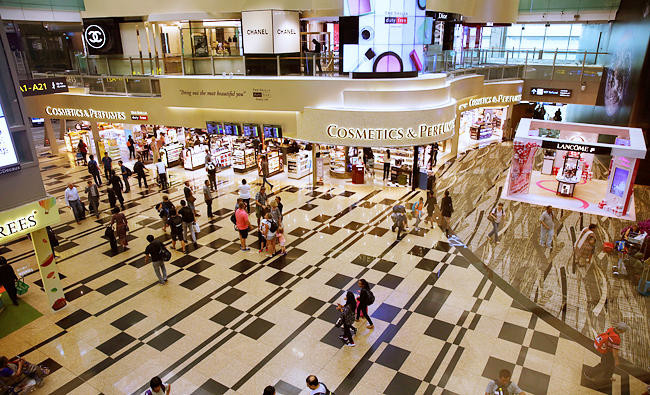
Duty free shops are seen at Changi airport in Singapore, in this October 20, 2017 photo. (REUTERS)
Updated 07 November 2017
Follow

Singapore, Dubai and Macau to oust ­London as third most ­popular city ­destination

LONDON: Singapore, Dubai and Macau will push London from third to sixth place in the world’s 100 most popular city destinations for global and regional airlines by 2025, Euromonitor said on Tuesday.
Singapore will replace London with 30 million trips in eight years' time, said the report. Hong Kong will remain in front with Bangkok second, Macau fourth and Dubai moving up from sixth to fifth with 26.7 million trips, ahead of London with an anticipated 25.8 million trips. Hong Kong currently boasts 25.6 million trips but by 2025 will increase that number to more than 44 million trips.
The report said that in 2017 Dubai is still by far the largest destination in the MEA region, but Saudi Arabia has three cities in the top ranking.
The Hajj is a major draw for arrivals to the country, but the Kingdom is looking to expand its appeal.
The Post-Umrah Programme, noted the report, is an initiative that allows pilgrims to convert their Umrah visas into tourist visas, allowing them to extend their stays. “Better dispersion should also come with the first high-speed train between Makkah and Medina, set to launch in 2018,” it said.


Using space science to protect Saudi Arabia’s environment

Updated 9 sec ago
Follow

Using space science to protect Saudi Arabia’s environment

  • Kingdom is harnessing satellite technology to forecast disasters, boost agriculture

RIYADH: Learning space science has delivered significant environmental benefits worldwide, helping many countries better understand and manage climate challenges. 

Saudi Arabia is now taking steps not only to explore the galaxy but also to invest in future generations who can apply space science to pressing environmental issues at home.

Last November, the Space Academy, part of the Saudi Space Agency, launched a series of seminars designed to enhance knowledge and develop skills in space science and technology, with a particular focus on Earth observation.

Running for nearly a month, the program formed part of a broader strategy to nurture national talent, raise scientific awareness, and build data capabilities that support innovation and research across the Kingdom.

Developing space sector can eventually help reduce some of the critical climate issues such as drought and air pollution. (AFP)

As efforts to strengthen the sector continue, important questions remain: How can space science translate into tangible environmental benefits? And how large is the global space economy?

In an interview with Arab News, Fahad Alhussain, co-founder of SeedFord, highlighted the scale of the opportunity and its environmental impact.

“To be frank, the slogan that we always use in space is that ‘saving the Earth from the space.’ It is all about this,” Alhusain told Arab News.

“You can recall a lot of related environmental issues like global warming, related to forests, related to the damage that happens to the environment. Without space, it would be almost impossible to see the magnitude of these damages.”

According to Alhussain, satellites have transformed how experts observe environmental changes on Earth, offering a comprehensive view that was previously impossible.

“By collecting data and using satellites… You can better analyze and measure so many things that help the environment,” said Fahad Alhussain. (Supplied)

He said that “the transformation of technology allows even the non-optical ways of measuring, assessing, and discovering what is going on in the environment … you can even anticipate fire before it happens in the forest.”

“You can detect the ice-melt down, you can get huge amount of information and can see it through the weather maps…there is a huge section in the economy for the environment,” Alhussain commented.

A 2022 report by Ryan Brukardt, a senior partner at McKinsey & Company, published by McKinsey Quarterly, found that more than 160 satellites currently monitor Earth to assess the impacts of global warming and detect activities such as illegal logging.

Brukardt cited NASA as an example of how advanced satellite tools are used to track environmental changes, including shifts in ocean conditions, cloud cover, and precipitation patterns. He also noted that satellite data can help governments determine when immediate action is needed, particularly in response to wildfires.

FASTFACT

Did You Know?

  • Satellites collect massive amounts of data, and AI is used to help interpret this information more efficiently and predict future outcomes.
  • The global space economy surpassed $600 billion in 2024 and is projected to exceed $1 trillion by 2030.
  • Saudi Arabia has established three key entities: the Supreme Space Council, the Saudi Space Agency, and the Communications, Space, and Technology Commission.

Beyond disaster response, satellites offer vital insights for agriculture. According to Brukardt’s report, scientists can use space-based data to monitor crop development and anticipate threats to harvests, such as drought or insect infestations.

These wide-ranging applications explain the rapid growth of the global space economy. 

According to World Economic Forum research, the sector is projected to reach $1.8 trillion by 2035, nearly tripling from $630 billion in 2023.

A deeper understanding of space and its applications offers Saudi Arabia, and the world, better tools to anticipate climate challenges, protect ecosystems, and safeguard biodiversity. (Supplied)

For Saudi Arabia, expanding space science capabilities could help address the country’s arid conditions by monitoring desertification and identifying sources of air pollution. Early detection of droughts, heatwaves, and crop stress could support more effective environmental planning and response.

Space-based data could also play a critical role in tracking environmental changes in the Red Sea and surrounding coastal ecosystems, strengthening marine conservation efforts and supporting the Sustainable Development Agenda.

As Alhussain emphasized, advancing knowledge in space science and satellite technology enables experts to measure environmental damage accurately and predict disasters before they occur, allowing for more effective responses.

By investing in space science education and research, the Kingdom can build national expertise, strengthen environmental protection policies, enhance food and water security, and contribute to global efforts to combat climate change—while also benefiting from the rapidly expanding space economy.

Ultimately, a deeper understanding of space and its applications offers Saudi Arabia, and the world, better tools to anticipate climate challenges, protect ecosystems, and safeguard biodiversity.

“By collecting data and using satellites, you can better analyze and measure so many things that help the environment,” said Alhussain.
“There will be patterns where you can warn people, scientists and decision makers to do something about it.”