CAIRO: The decision by Egypt’s former prime minister not to run in presidential elections deprives the race of its most serious challenger to Abdel Fattah El-Sisi.
Egypt will hold a presidential vote at the end of March, the election commission said on Monday.
While he has not yet announced his candidacy, El-Sisi is widely expected to stand and win the third presidential election in Egypt since the uprising that toppled Hosni Mubarak in 2011.
Ahmed Shafiq said on Sunday he would not be running — reversing a pledge that he would take part.
The ex-air force commander said he did not consider himself “the best person” to fill the position.
“Given that he came in second place in Egypt’s 2012 presidential race, I believe Shafiq was going to be a strong contender,” Amr Hashem, political analyst at the Ahram Center for Strategic Studies, said.
“He was a heavyweight candidate for many factors, and his presence could have made the election season a hot one. But due to all the pressure on him lately, his withdrawal was somehow expected.”
“With his withdrawal, it is likely that no other candidate would be able to potentially make a strong standing in competition with El-Sisi,” Justin Dargin, an expert on the Middle East from Oxford University, said.
After narrowly losing a presidential election to Muslim Brotherhood candidate Mohamed Mursi in 2012, Shafiq fled to the UAE where he has lived ever since and disappeared from Egypt’s political scene.
During that time, Shafiq was tried in absentia on corruption charges, but was eventually acquitted.
He returned to the limelight last month when he announced his intention to run in the elections and return soon to Egypt to start his campaign.
A few hours later, Al Jazeera aired a video in which Shafiq said he was not allowed to leave the UAE and criticized the UAE for meddling in Egypt’s affairs.
Despite claims by Shafiq’s lawyer and his party that the video was leaked to the Qatari-owned TV network, Shafiq was reportedly given 48 hours to leave the UAE.
His arrival in Egypt was surrounded by controversy and Shafiq took part in a phone interview with a popular TV show, during which he said he was OK.
His appearance on Al Jazeera placed him in hot water, with some accusing him of collaborating with the Muslim Brotherhood and Qatar, considered enemies of the Egyptian state.
The 76-year-old former aviation minister was the last prime minister to hold office under Mubarak.
Announcing on Twitter his decision to withdraw, he said that his time back in Egypt had led him to reconsider the decision.
“My absence of more than five years perhaps distanced me from being able to very closely follow what is going on in our nation in terms of developments and achievements despite the difficulty of the conditions,” he said.
“I have seen that I will not be the ideal person to lead the state’s affairs during the coming period. Thus, I have decided not to run in the upcoming 2018 presidential elections.”
“It was expected that he would reconsider his intention to run. There were several factors that played a role,” Dargin said.
“And, even if Shafiq did run, it appears that with the Egyptian body politic, he is not nearly as popular as El-Sisi, seeing that his years away from Egypt left him out of touch with the enormous changes that occurred since the revolution.
“It would be expected that even if Shafiq did run, El-Sisi would still dominate the polls because of his popularity and the respect garnered since he ascended to the presidency.”


![]()
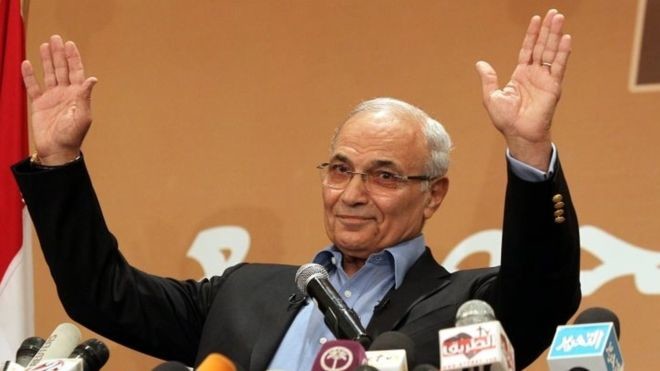
Shafiq’s election withdrawal deprives El-Sisi of only serious rival
Shafiq’s election withdrawal deprives El-Sisi of only serious rival

Latest updates


© 2026 SAUDI RESEARCH & PUBLISHING COMPANY, All Rights Reserved And subject to Terms of Use Agreement.