

Sahel crisis: UN refugee agency wants ‘immediate international action’

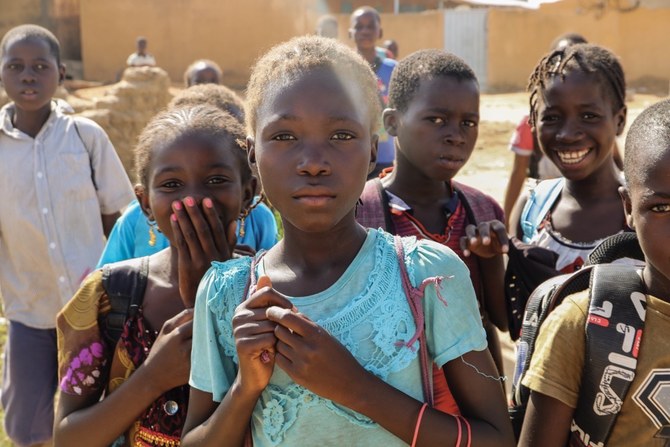
Extremist violence in Burkina Faso has displaced more than 2 million people. (AP/File)
Short Url
Updated 07 June 2024
Follow

Sahel crisis: UN refugee agency wants ‘immediate international action’

  • Security situation is volatile, forcing people to flee their homes in search of safety, says UNHCR spokesman

GENEVA: The UN has called for immediate international action to prevent
further forced displacement of civilians in Africa’s troubled Sahel region, which is witnessing a worsening humanitarian crisis.

More than 3.3 million people have been forced to flee their homes in Burkina Faso, Mali and Niger over the past four years due to conflict exacerbated by climate change, said the UN refugee agency UNHCR.
“This staggering forced displacement of civilians demands immediate international action to prevent it worsening,” Alpha Seydi Ba, the UNHCR spokesman for West and Central Africa, told a media briefing in Geneva.
“The security situation in the central Sahel is volatile, forcing people to flee their homes in search of safety and protection.”
The region has been caught in a spiral of extremist violence for years.
Since 2012, Mali has been ravaged by different groups affiliated to Al-Qaeda and Daesh, as well as by self-declared self-defense forces and bandits.
Burkina Faso, one of the world’s most volatile and impoverished countries, witnessed two military coups in 2022.
“The UN Refugee Agency is deeply concerned about the fast-growing humanitarian crisis in the Sahel region,” said Ba.
He said women and children were particularly vulnerable to exploitation, abuse and trafficking.
Meanwhile the lack of adequate shelter, clean water and sanitation was exacerbating the poor conditions faced by displaced people, while persistent insecurity prevented many from returning home.
Over the last four years, while 2.8 million people have been displaced from their homes in Burkina Faso, Mali and Niger but remained within their own countries, a further 550,000 people have fled abroad.
“The increase in cross-border movement underscores the deepening of the crisis and the continued necessity to respond to needs in the Sahel by investing in protection, assistance and durable solutions,” said Ba.


US, Japan hold joint air exercise after China-Russia patrols

Updated 2 sec ago
Follow

US, Japan hold joint air exercise after China-Russia patrols

TOKYO: Japan said Thursday it held a joint air exercise with the United States in a show of force, days after Chinese-Russian patrols in the region and following weeks of diplomatic feuding between Tokyo and Beijing.
The Japanese joint chiefs of staff said Wednesday’s exercise with the US Air Force was conducted in “an increasingly severe security environment surrounding our country.”
Tokyo said Wednesday that two Russian Tu-95 nuclear-capable bombers flew a day earlier from the Sea of Japan to rendezvous with two Chinese H-6 bombers in the East China Sea, then conducted a joint flight around the country.
Japan said that it scrambled fighter jets in response.
Prime Minister Sanae Takaichi angered Beijing last month by suggesting that Japan would intervene with military force in any Chinese attack on Taiwan.
Thursday’s announcement by Japan’s chiefs of staff said: “We confirmed the strong resolve of Japan and the United States not to allow any unilateral change of the status quo by force, as well as the readiness of the Self-Defense Forces and the US military.”
In a separate statement it said that the “tactical exercises” over the Japan Sea involved two US B52 bombers, three Japanese F-35 fighter jets and three Japanese F-15s.
The joint exercise came as the United States criticized Beijing for the first time on Wednesday after Chinese military aircraft locked radar onto Japanese jets on Saturday.
The J-15 jets from China’s Liaoning aircraft carrier twice locked radar on Japanese aircraft in international waters near Okinawa, according to Japan, which scrambled jets in response.
“China’s actions are not conducive to regional peace and stability,” a US State Department spokesperson told AFP on Wednesday.
“The US-Japan Alliance is stronger and more united than ever. Our commitment to our ally Japan is unwavering, and we are in close contact on this and other issues.”
Fighter jets use their radar for fire control to identify targets as well as for search and rescue operations.
Tokyo also summoned Beijing’s ambassador following the radar incident, over which the two countries offer differing accounts of events.
Japan said it scrambled its F-15 jets because it was worried about possible “airspace violations.”
Guo Jiakun, spokesman for the ministry of foreign affairs, accused Japan Wednesday of sending the jets “to intrude into the Chinese training area without authorization, conduct close-range reconnaissance and harassment, create tense situations, and continue to maliciously hype up the situation.”
Takaichi’s comments about intervening in any Taiwan emergency enraged Beijing as China claims the self-ruled island as its own and has not ruled out seizing it by force.
Tokyo was forced to deny a Wall Street Journal report that said US President Donald Trump had advised Takaichi not to provoke China over Taiwan’s sovereignty.
But Tokyo is apparently frustrated at the lack of public support from top officials in Washington and has urged the US to be more vocal, the Financial Times reported on Sunday.

- ‘Regrettable’ -

NATO chief Mark Rutte said on Wednesday that the radar incident and the joint Chinese-Russian patrols were “regrettable,” Japan’s Defense Minister Shinjiro Koizumi said on X.
The statement followed a 15-minute video conference between Rutte and Koizumi, the defense ministry said in a statement.
Rutte “affirmed that security in the Indo-Pacific and Euro-Atlantic regions is completely inseparable,” Koizumi said.
South Korea said Tuesday that Russian and Chinese warplanes also entered its air defense zone, with Seoul also deploying fighter jets that same day.
Beijing confirmed later on Tuesday that it had organized drills with Russia’s military according to “annual cooperation plans.”
Moscow also described it as a routine exercise, saying it lasted eight hours and that some foreign fighter jets followed the Russian and Chinese aircraft.