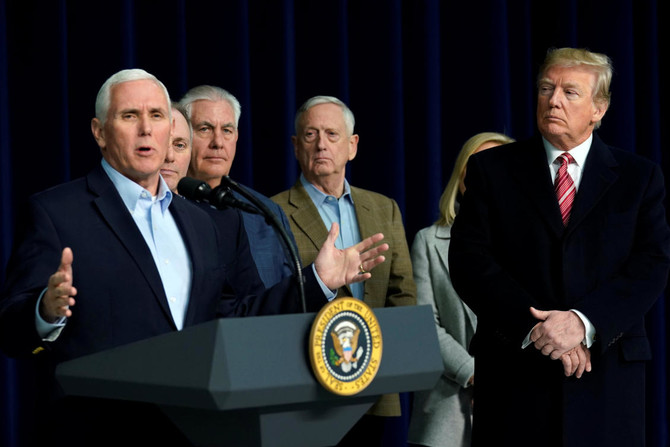
WASHINGTON: US Vice President Mike Pence will visit Egypt, Jordan and Israel from Jan. 20 to 23, the White House said on Monday, embarking on a tour originally planned for last month after President Donald Trump recognized Jerusalem as the capital of Israel.
Pence will hold talks with Egyptian President Abdel Fattah El-Sisi, Jordan’s King Abdullah and Israeli Prime Minister Benjamin Netanyahu, the White House said in a statement.
Pence, a strong supporter of Trump’s decision on Jerusalem, will also visit the city’s Western Wall and give a speech at the Israeli parliament, it said.
Trump’s decision on Jerusalem and announcement in December that the United States would start the process of moving its embassy from Tel Aviv led to uproar and protest in the region.
“At President Trump’s direction, the vice president is traveling to the Middle East to reaffirm our commitment to work with the US’s allies in the region to defeat radicalism that threatens future generations,” said Alyssa Farah, a spokeswoman for Pence.
He plans to discuss with the three leaders “ways to work together to fight terrorism and improve our national security,” she added.
The status of Jerusalem, which is home to Muslim, Jewish and Christian holy sites, is one of the thorniest obstacles to a peace deal between Israel and the Palestinians, who were furious over Trump’s move and have declined to meet with Pence. The international community does not recognize Israeli sovereignty over the full city.
Israel considers Jerusalem its eternal capital, while Palestinians want the capital of an independent state of theirs to be in the city’s eastern sector, which Israel captured in the 1967 Middle East war and annexed in a move never recognized internationally.
Pence postponed a planned visit to Egypt and Israel last month to stay in Washington for a congressional vote on Trump’s tax overhaul plan.

Pence to visit Egypt, Jordan, Israel in January — White House
Kabul shakes as 5.8-magnitude earthquake hits eastern Afghanistan
- The 5.8-magnitude quake struck a mountainous area around 130 kilometers northeast of Kabul
- Earthquakes are common in Afghanistan, particularly along the Hindu Kush mountain range
KABUL: A strong earthquake rocked eastern Afghanistan including the capital Kabul on Friday, AFP journalists and residents said.
The 5.8-magnitude quake struck a mountainous area around 130 kilometers (80 miles) northeast of Kabul, the United States Geological Survey said.
The epicenter was near several remote villages and struck at 5:39 p.m. (1309 GMT), just as people in the Muslim-majority country were sitting down to break their Ramadan fast.
“We were waiting to do our iftars, a heavy earthquake shook us. It was very strong, it went on for almost 30 seconds,” said Zilgay Talabi, a resident of Khenj district near of the epicenter.
“Everyone was horrified and scared,” Talabi told AFP, saying he feared “landslides and avalanches” may follow.
Power was briefly cut in parts of the capital, while east of Kabul an AFP journalist in Nangarhar province also felt it.
Earthquakes are common in Afghanistan, particularly along the Hindu Kush mountain range, near where the Eurasian and Indian tectonic plates meet.
Haqmal Saad, spokesman for the Panjshir province police, described the quake as “very strong” and said the force was “gathering information on the ground.”
Mohibullah Jahid, head of Panjshir Natural Disaster Management agency, told AFP he was in touch with several officials in the area.
The district governor had told him there were reports of “minor damage, such as cracks in the walls, but we have not received anything serious, such as the collapse of houses or anything similar,” Jahid said.
Residents in Bamiyan and Wardak provinces, west of Kabul, told AFP they also felt the earthquake.
In Pakistan’s Khyber Pakhtunkhwa province, rescue service official Bilal Ahmad Faizi said the quake was felt in border areas.
In August last year, a shallow 6.0-magnitude quake in the country’s east wiped out mountainside villages and killed more than 2,200 people.
Weeks later, a 6.3-magnitude quake in northern Afghanistan killed at least 27 people.
Large tremors in western Herat, near the Iranian border, in 2023, and in Nangarhar province in 2022, killed hundreds and destroyed thousands of homes.
Many homes in the predominantly rural country, which has been devastated by decades of war, are shoddily built.
Poor communication networks and infrastructure in mountainous Afghanistan have hampered disaster responses in the past, preventing authorities from reaching far-flung villages for hours or even days before they could assess the extent of the damage.