US vice president Pence vows America will not allow ‘collapse of Venezuela’

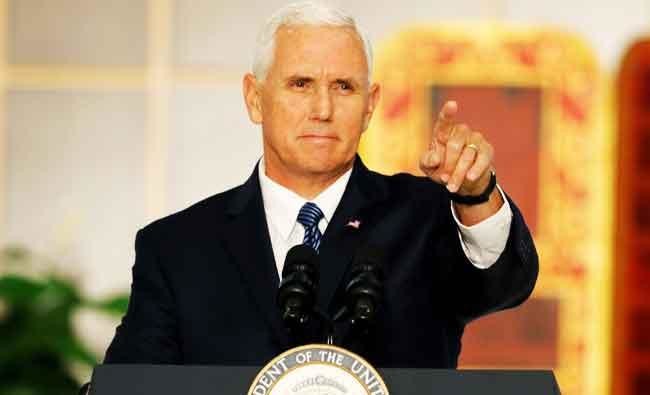
U.S. Vice President Mike Pence speaks to a large crowd after meeting with members of the Venezuelan exile community, recent Venezuelan migrants, other local leaders and officials about the continuing devastation and unrest in Venezuela at Our Lady of Guadalupe Catholic Church in Doral, Florida, on Wednesday. (REUTERS)
Updated 24 August 2017
Follow

US vice president Pence vows America will not allow ‘collapse of Venezuela’

MIAMI: US Vice President Mike Pence on Wednesday vowed the US would not allow “the collapse of Venezuela,” saying such an event would “endanger” countries in the wider region.
“The collapse of Venezuela will endanger all who call the Western Hemisphere home,” Pence said in remarks delivered before some 600 people at a Catholic church in Doral, the heart of Miami’s Venezuelan community.
“We cannot and will not let that happen,” he said, adding that “working with our allies in the Latin American region, the US will confront and overcome all who dare to threaten our wellbeing.”
He emphasized that Venezuela’s “collapse” would “drive more illegal drug trafficking with its murderous consequences” — a notion his boss President Donald Trump has also pushed.
The vice president gave his speech just back from his tour last week of Colombia, Argentina, Chile and Panama. Venezuela was among the key issues discussed.
The country has spiraled into political and economic chaos, threatening regional stability. Clashes between protesters and police this year have left 125 people dead, according to prosecutors.
In Miami Pence did not raise the specter of military action, which Trump has evoked.
Pence insisted that the US would not make decisions unilaterally: “America first does not mean America alone.”
US Senator Marco Rubio and Florida Governor Rick Scott also spoke, reiterating their pledge to ban companies in the southeastern state from doing business with Venezuelan firms.
According to 2015 census data, some 273,000 Venezuelans live in the United States — nearly half of them in Florida, and most in Miami-Dade and Broward counties.


Japan protests China comments on reviving ‘militarism’

Updated 4 sec ago
Follow

Japan protests China comments on reviving ‘militarism’

TOKYO: Tokyo said it had lodged a “stern demarche” to China through diplomatic channels after Beijing’s top diplomat Wang Yi accused “far-right forces” in Japan of seeking to revive militarism.
Speaking at the Munich Security Conference in Germany, Wang weighed in on Beijing’s current relationship with Tokyo, which has been under heavy strain since Prime Minister Sanae Takaichi made comments about Taiwan in November.
Wang said that “Japanese people should no longer allow themselves to be manipulated or deceived by those far-right forces, or by those who seek to revive militarism.”
“All peace-loving countries should send a clear warning to Japan: if it chooses to walk back on this path, it will only be heading toward self-destruction.”
Japan’s ministry of foreign affairs dismissed the claims in a post on X Sunday as “factually incorrect and ungrounded.”
“Japan’s efforts to strengthen its defense capabilities are in response to an increasingly severe security environment and are not directed against any specific third country,” the statement said.
It said there were “countries in the international community that have been rapidly increasing their military capabilities in a non-transparent manner” but added that “Japan opposes such moves and distances itself from them.”
Foreign Minister Toshimitsu Motegi made his stance clear at another session of the conference, followed by a stern demarche against the Chinese side through diplomatic channels, the statement said.
Just weeks into her term, Takaichi said Japan would intervene militarily in any attack on Taiwan.
Beijing claims the self-ruled democratic island as part of its territory and has threatened to use force to bring it under its control.
Takaichi was seen as a China hawk before becoming Japan’s first woman prime minister in October.
She said last week that under her leadership Japan — which hosts some 60,000 US military personnel — would bolster its defenses and “steadfastly protect” its territory.