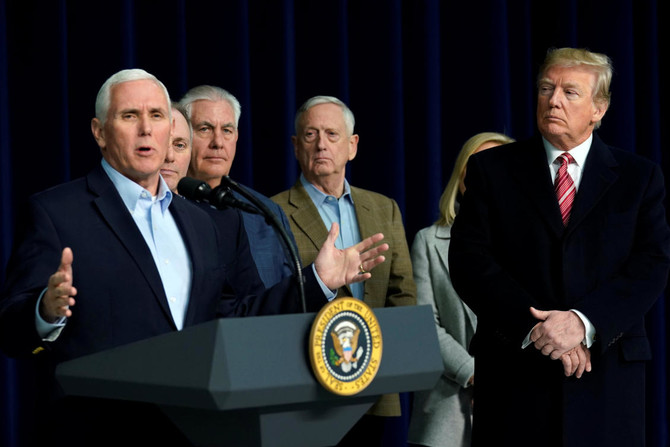
WASHINGTON: US Vice President Mike Pence will visit Egypt, Jordan and Israel from Jan. 20 to 23, the White House said on Monday, embarking on a tour originally planned for last month after President Donald Trump recognized Jerusalem as the capital of Israel.
Pence will hold talks with Egyptian President Abdel Fattah El-Sisi, Jordan’s King Abdullah and Israeli Prime Minister Benjamin Netanyahu, the White House said in a statement.
Pence, a strong supporter of Trump’s decision on Jerusalem, will also visit the city’s Western Wall and give a speech at the Israeli parliament, it said.
Trump’s decision on Jerusalem and announcement in December that the United States would start the process of moving its embassy from Tel Aviv led to uproar and protest in the region.
“At President Trump’s direction, the vice president is traveling to the Middle East to reaffirm our commitment to work with the US’s allies in the region to defeat radicalism that threatens future generations,” said Alyssa Farah, a spokeswoman for Pence.
He plans to discuss with the three leaders “ways to work together to fight terrorism and improve our national security,” she added.
The status of Jerusalem, which is home to Muslim, Jewish and Christian holy sites, is one of the thorniest obstacles to a peace deal between Israel and the Palestinians, who were furious over Trump’s move and have declined to meet with Pence. The international community does not recognize Israeli sovereignty over the full city.
Israel considers Jerusalem its eternal capital, while Palestinians want the capital of an independent state of theirs to be in the city’s eastern sector, which Israel captured in the 1967 Middle East war and annexed in a move never recognized internationally.
Pence postponed a planned visit to Egypt and Israel last month to stay in Washington for a congressional vote on Trump’s tax overhaul plan.

Pence to visit Egypt, Jordan, Israel in January — White House
Trump administration ends temporary protected status for Yemen
- Decision ends humanitarian protections that grant deportation relief and work permits to more than 1,000 Yemeni nationals
US President Donald Trump’s administration has ended temporary protected status for Yemen, Secretary of Homeland Security Kristi Noem said on Friday, the latest move targeting immigrants.
The decision to end humanitarian protections that grant deportation relief and work permits to more than a thousand Yemeni nationals was taken after determining that it was against the US “national interest,” Noem said.
TPS provides relief to people already in the US if their home countries experience a natural disaster, armed conflict or other extraordinary event. The Trump administration has sought to end most enrollment in the program, saying it runs counter to US interests.
“After reviewing conditions in the country and consulting with appropriate US government agencies, I determined that Yemen no longer meets the law’s requirements to be designated for Temporary Protected Status,” she said.
Around 1,380 Yemeni nationals were covered by the temporary protected status as of March 31, 2025, according to the US Citizenship and Immigration Services. The status was last extended in 2024 and was set to expire on March 3 this year.
The decision to end humanitarian protections that grant deportation relief and work permits to more than a thousand Yemeni nationals was taken after determining that it was against the US “national interest,” Noem said.
TPS provides relief to people already in the US if their home countries experience a natural disaster, armed conflict or other extraordinary event. The Trump administration has sought to end most enrollment in the program, saying it runs counter to US interests.
“After reviewing conditions in the country and consulting with appropriate US government agencies, I determined that Yemen no longer meets the law’s requirements to be designated for Temporary Protected Status,” she said.
Around 1,380 Yemeni nationals were covered by the temporary protected status as of March 31, 2025, according to the US Citizenship and Immigration Services. The status was last extended in 2024 and was set to expire on March 3 this year.
© 2026 SAUDI RESEARCH & PUBLISHING COMPANY, All Rights Reserved And subject to Terms of Use Agreement.