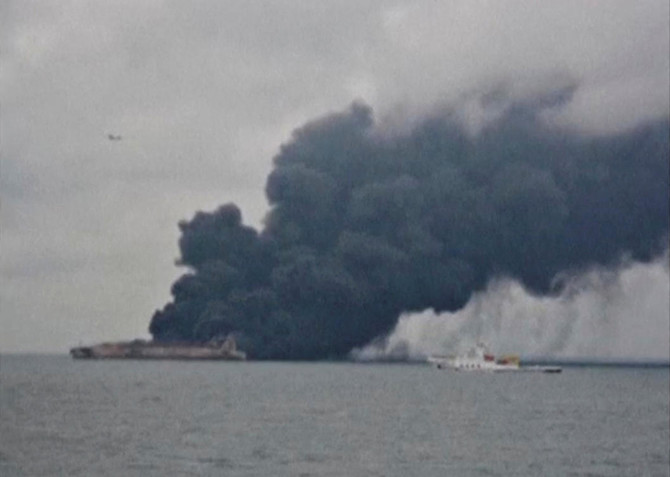
BEIJING: An Iranian oil tanker that caught fire after colliding with a freighter off China’s east coast is at risk of exploding and sinking, Chinese state media reported Monday as authorities from three countries struggled to find its 32 missing crew members and contain oil spewing from the blazing wreck.
The body of one crew member has been found aboard the stricken tanker, an Iranian official said on Monday. Mohammad Rastad, head of Iran’s Ports and Maritime Organization, was quoted as saying by ISNA news agency that the body was sent to Shanghai for identification.
The US Navy has joined the search for the 32 crew. China, South Korea and the US sent ships and planes to search for the 30 Iranians and two Bangladeshis who have been missing since the collision late Saturday. The US Navy, which sent a P-8A aircraft from Okinawa, Japan, to aid the search.
Meanwhile, search and cleanup efforts have been hampered by fierce fires and poisonous gases that have completely consumed the tanker and surrounding waters, CCTV reported.
The Panama-registered tanker Sanchi was sailing from Iran to South Korea when it collided late Saturday with the Hong Kong-registered freighter CF Crystal in the East China Sea, 257 kilometers (160 miles) off the coast of Shanghai, China’s Ministry of Transport said.
All 21 crew members of the Crystal, which was carrying grain from the United States to China, were rescued, the ministry said. The Crystal’s crew members were all Chinese nationals.
It wasn’t immediately clear what caused the collision.
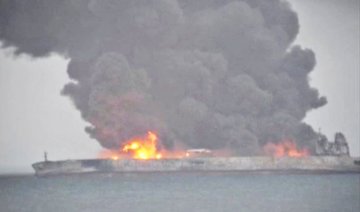
State-run China Central Television reported Sunday evening that the tanker was still floating and burning, and that oil was visible in the water. Photos distributed by the South Korean government showed the tanker on fire and shrouded in thick black smoke.
Chinese authorities dispatched three ships to clean the oil spill. It was not clear, however, whether the tanker was still spilling oil as of Monday and the size of the oil slick caused by the accident also was not known.
The Sanchi was carrying 136,000 metric tons (150,000 tons, or nearly 1 million barrels) of condensate, a type of ultra-light oil, according to Chinese authorities.
By comparison, the Exxon Valdez was carrying 1.26 million barrels of crude oil when it spilled 260,000 barrels into Prince William Sound off Alaska in 1989.
The Sanchi has operated under five different names since it was built in 2008, according the UN-run International Maritime Organization. The IMO listed its registered owner as Hong Kong-based Bright Shipping Ltd., on behalf of the National Iranian Tanker Co., a publicly traded company based in Tehran. The National Iranian Tanker Co. describes itself as operating the largest tanker fleet in the Middle East.
An official in Iran’s Oil Ministry, who spoke to The Associated Press on condition of anonymity because he was not authorized to speak to reporters, said 30 of the tanker’s 32 crew members were Iranians.
“We have no information on their fate,” he said Sunday. “We cannot say all of them have died, because rescue teams are there and providing services.”
The official said the tanker was owned by the National Iranian Tanker Co. and had been rented by a South Korean company, Hanwha Total Co. He said the tanker was on its way to South Korea.
Hanwa Total is a 50-50 partnership between the Seoul-based Hanwha Group and the French oil giant Total. Total did not immediately respond to a request for comment.
It’s the second collision for a ship from the National Iranian Tanker Co. in less than a year and a half. In August 2016, one of its tankers collided with a Swiss container ship in the Singapore Strait, damaging both ships but causing no injuries or oil spill.


![]()
Oil tanker burning off China’s coast at risk of exploding; body of crew member found
Oil tanker burning off China’s coast at risk of exploding; body of crew member found
Latest updates


© 2026 SAUDI RESEARCH & PUBLISHING COMPANY, All Rights Reserved And subject to Terms of Use Agreement.