Iran’s Guard claims victory against anti-government protests

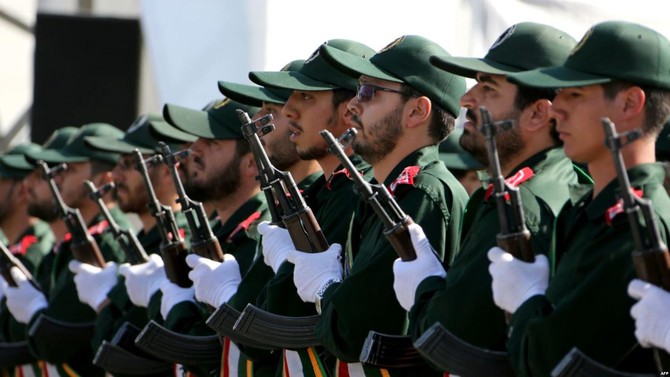
Iran's Revolutionary Guards Corps troops march during the annual military parade marking the start of Iran's 1980-88 war with Iraq in Tehran in September 2015. (AFP)
Updated 07 January 2018
Follow

Iran’s Guard claims victory against anti-government protests

TEHRAN: Iran’s Revolutionary Guard said Sunday that the nation and its security forces have ended the wave of unrest linked to anti-government protests that erupted last month.
Price hikes sparked protests in a number of cities and towns late last month, and at least 21 people were killed in scattered clashes. The protests, which vented anger at high unemployment and official corruption, were the largest seen in Iran since the disputed 2009 presidential election, and some demonstrators called for the overthrow of the government.
The Guard is a powerful paramilitary force loyal to the supreme leader, Ayatollah Ali Khamenei. Many of the demonstrators protested against the Guard’s massive budget, its costly interventions across the region, and against the supreme leader himself.
Hundreds of people have been detained since the protests began. They include around 90 university students, reformist lawmaker Mahmoud Sadeghi was quoted as saying by the semi-official ISNA news agency.
Iranian lawmakers held a closed session on Sunday in which senior security officials briefed them on the protests and the conditions of the detainees, the state-run IRNA news agency reported.
“It was emphasized that foreign elements, and in particular the United States, played a basic role in forming and manipulating the recent unrest,” IRNA quoted lawmaker Jalal Mirzaei as saying.
The United States and Israel have expressed support for the protests, which began on Dec. 28 in Iran’s second largest city, Mashhad, but deny allegations of fomenting them.
In recent days, government supporters have held several mass rallies across the country to protest the unrest.


Editorial: The threat of Yemen’s fragmentation is far reaching

President of Yemen’s Presidential Leadership Council Rashad Mohammed Al-Alimi. (SABA Net)
Updated 7 sec ago
Follow

Editorial: The threat of Yemen’s fragmentation is far reaching

  • The southern issue is a just cause — one that must be addressed in any future political settlement and not reduced to the ambitions of any single individual, including the likes of Aidarous Al-Zubaidi

RIYADH: As Yemen’s political landscape continues to shift at a dizzying pace, it is worth pausing to reflect on the official Saudi position — and the commentary of some of our leading Saudi columnists — regarding the recent unilateral moves by the Southern Transitional Council (STC) in the governorates of Hadramout and Al-Mahrah. These actions, taken without the consent of the Presidential Leadership Council (PLC) or coordination with the Arab Coalition, represent a dangerous gamble with the future of a fragile nation — one that Saudi Arabia, like its Arab neighbors, wishes only peace, stability, and prosperity.
There is no ambiguity in the Kingdom’s stance: it has worked tirelessly to preserve calm in Hadramout and Al-Mahrah, steering both regions away from military escalation and toward peaceful solutions. In a bid to contain the situation, Saudi Arabia, in coordination with its brothers and partners in the United Arab Emirates and the PLC, dispatched a joint team to negotiate with the STC. The goal was clear — facilitate the withdrawal of STC forces and hand over military sites to the National Shield Forces.
Yet despite Riyadh’s call for de-escalation and its appeal to the STC to prioritize national interest and social cohesion, the Council has persisted in its confrontational posture, seemingly indifferent to the grave consequences of its actions.
Observers in Riyadh will note that the Kingdom remains steadfast in its support for the PLC and Yemen’s internationally recognized government. Its commitment to Yemen’s stability is not rhetorical — it is political, economic, and developmental. Saudi Arabia’s vision is to shepherd Yemen from the shadows of conflict into an era of peace, prosperity, and regional integration. This is not merely a function of geography or shared borders; it is a reflection of the Kingdom’s religious, political, and economic responsibilities in the Arab and Islamic world.
From this vantage point, the newspaper firmly believes that the STC’s unilateral actions in Hadramout constitute a blatant violation of Yemen’s transitional framework. They undermine the legitimacy of the recognized government, threaten the fragile peace, and jeopardize the political process. Worse still, they echo the very tactics employed by the Houthi militias — an alarming parallel that should not be ignored.
It is therefore essential to reiterate the Kingdom’s position: the STC must withdraw its forces from Hadramout and Al-Mahrah, restoring the status quo ante. This is not a punitive demand, but a necessary step to safeguard national security and prevent further military flare-ups.
At the same time, Saudi Arabia has consistently affirmed that the southern issue is a just cause — one that must be addressed in any future political settlement. It is enshrined in the outcomes of Yemen’s National Dialogue and must be resolved inclusively, reflecting the aspirations of all southern Yemenis — not reduced to the ambitions of any single individual, including the likes of Aidarous Al-Zubaidi or other STC figures.
Ultimately, we urge the separatists to choose reason over recklessness. Partitioning Yemen will not bring peace — it will sow the seeds of future wars, embolden extremist actors, and pose a threat not only to Yemen’s internal cohesion but to regional and international stability. As Western and American policymakers know all too well: what happens in Yemen never stays in Yemen.