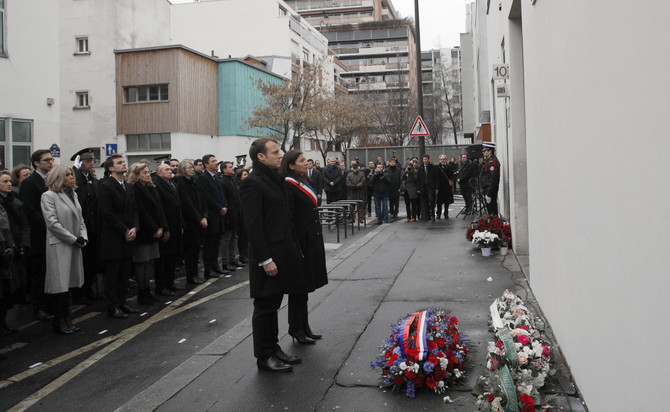
PARIS: French President Emmanuel Macron led a somber tribute on Sunday to the 17 victims of attacks in Paris three years ago that marked the first of a wave of deadly extremist assaults in France.
During a three-day killing spree in January 2015, gunmen killed reporters and illustrators at satirical weekly Charlie Hebdo, police officers and shoppers at a Jewish supermarket.
Sunday’s commemoration started at the former premises of Charlie Hebdo, where two brothers armed with assault rifles shot and killed 11, including most of the notoriously irreverent publication’s cartoonists and writers.
The names of the victims were read out before wreaths were laid in front of the office building, including one by Macron and Paris Mayor Anne Hidalgo.
Homage was then paid at the nearby site where a policeman was shot dead at point-blank range by one of the gunmen.
A similar tribute was later held at the kosher store where a third gunman killed four people.
The Charlie Hebdo attack was carried out by brothers Said and Cherif Kouachi, who died in a police assault two days later.
The perpetrator of the attack on the Jewish store, Amedy Coulibaly, also shot dead a policewoman in a separate incident. Coulibaly was also killed by police.

France remembers Charlie Hebdo victims three years after attacks
130 kidnapped Nigerian schoolchildren freed: government
- The religiously diverse African country of 230 million people is the scene of myriad conflicts that have killed both Christians and Muslims
ABUJA: Nigerian authorities have secured the release of 130 kidnapped schoolchildren taken by gunmen from a Catholic school in November, a presidential spokesman said Sunday, after 100 were freed earlier this month.
“Another 130 abducted Niger state pupils released, none left in captivity,” Sunday Dare said in a post on X, accompanied by a photo of smiling children.
In late November, hundreds of students and staff were kidnapped from St. Mary’s co-educational boarding school in north-central Niger state.
The attack came as the country buckled under a wave of mass abductions reminiscent of the infamous 2014 Boko Haram kidnapping of schoolgirls in Chibok.
The west African country suffers from multiple interlinked security concerns, from jihadists in the northeast to armed “bandit” gangs in the northwest.
A UN source told AFP that “the remaining set of girls/secondary school students will be taken to Minna,” the capital of Niger state, on Tuesday.
The exact number of those kidnapped, and those who remain in captivity, has been unclear since the attack on the school, located in the rural hamlet of Papiri.
The Christian Association of Nigeria (CAN) said 315 students and staff were kidnapped.
Some 50 escaped immediately afterwards, and on December 7 the government secured the release of around 100.
That would leave about 165 thought to remain in captivity.
But a statement from President Bola Tinubu at the time put the remaining people being held at 115.
- Spate of mass kidnappings -
It has not been made public who seized the children from their boarding school, or how the government secured their release.
Though kidnappings for ransom are a common way for criminals and armed groups to make quick cash, a spate of mass abductions in November put an uncomfortable spotlight on Nigeria’s already grim security situation.
Assailants across the country kidnapped two dozen Muslim schoolgirls, 38 church worshippers and a bride and her bridesmaids, with farmers, women and children also taken hostage.
The kidnappings came as Nigeria faces a diplomatic offensive from the United States, where President Donald Trump has alleged that there were mass killings of Christians that amounted to a “genocide.”
The Nigerian government and independent analysts reject that framing, which has long been used by the Christian right in the United States and Europe.
The religiously diverse African country of 230 million people is the scene of myriad conflicts that have killed both Christians and Muslims.