Daesh militant linked to Charlie Hebdo attack could still be alive — Iraq

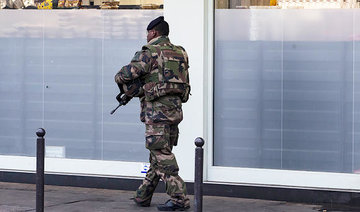
A man pauses outside the old offices of the satirical Charlie Hebdo magazine where two brothers armed with assault rifles shot and killed 11 people, including most of the publication’s cartoonists and writers, on January 7, 2015, as France pays tribute two years later in Paris, France, January 5, 2017. (REUTERS)
Updated 15 April 2017
Follow

Daesh militant linked to Charlie Hebdo attack could still be alive — Iraq

BAGHDAD: A Daesh militant linked to the deadly 2015 attack on French weekly Charlie Hebdo could be still be alive, the Iraqi military said on Saturday.
Boubaker el-Hakim was reported by American defense officials to have been killed in November, in a US drone strike in Raqqa, Daesh’s de facto capital in Syria.
Iraqi intelligence supplied information to the Syrian airforce to carry out a series of strikes on Daesh headquarters and hideouts in Syria, including one believed to belong to el-Hakim, an Iraqi military statement said.
Aircraft from Syrian President Bashar Assad’s airforce targeted several locations in Raqqa and Albu Kamal, near the Iraqi border, said the statement, without indicating the location of el-Hakim’s headquarters or the date of the raids.
An Iraqi military spokesman told Reuters el-Hakim’s headquarters were destroyed but it wasn’t clear if he was killed.
In 2015 Iraq and Syria established a joint committee with Russia and Iran, Assad’s main foreign backers, to share intelligence about Daesh.
El-Hakim was believed to have been involved in planning the January 2015 attack on Charlie Hebdo, a weekly known for its satirical covers ridiculing political and religious leaders.
Two Islamist militants broke into an editorial meeting of the weekly, raking it with bullets, killing 17 people. Another militant later killed a policewoman and took hostages at a supermarket, killing four before police shot him dead.
Daesh declared a “caliphate” spanning parts of Iraq and Syria after it captured the Iraqi city of Mosul in mid-2014.
The hard-line Sunni group has since lost most cities it captured in Iraq and its fighters are now surrounded in parts of Mosul by US-backed Iraqi government forces.
A US-backed offensive is also under way to capture Raqqa, involving a Syrian Kurdish-Arab militia alliance.


Bangladesh’s religio-political party open to unity govt

Updated 01 January 2026
Follow

Bangladesh’s religio-political party open to unity govt

  • Opinion polls suggest that Jamaat-e-Islami will finish a close second to the Bangladesh Nationalist Party in the first election it has contested in nearly 17 years

DHAKA: A once-banned Bangladeshi religio-political party, poised for its strongest electoral showing in February’s parliamentary vote, is open to joining a unity government and has held talks with several parties, its chief said.

Opinion polls suggest that Jamaat-e-Islami will finish a close second to the Bangladesh Nationalist Party in the first election it has contested in nearly 17 years as it marks a return to mainstream politics in the predominantly Muslim nation of 175 million.

Jamaat last held power between 2001 and 2006 as a junior coalition partner with the BNP and is open to working with it again.

“We want to see a stable nation for at least five years. If the parties come together, we’ll run the government together,” Jamaat chief Shafiqur Rahman said in an interview at his office in a residential area in Dhaka, ‌days after the ‌party created a buzz by securing a tie-up with a Gen-Z party.

Rahman said anti-corruption must be a shared agenda for any unity government.

The prime minister will come from the party winning the most seats in the Feb. 12 election, he added. If Jamaat wins the most seats, the party will decide whether he himself would be a candidate, Rahman said.

The party’s resurgence follows the ousting of long-time Prime Minister Sheikh Hasina in a youth-led uprising in August 2024. 

Rahman said Hasina’s continued stay in India after fleeing Dhaka was a concern, as ties between the two countries have hit their lowest point in decades since her downfall.

Asked about Jamaat’s historical closeness to Pakistan, Rahman said: “We maintain relations in a balanced way with all.”

He said any government that includes Jamaat would “not feel comfortable” with President Mohammed Shahabuddin, who was elected unopposed with the Awami League’s backing in 2023.