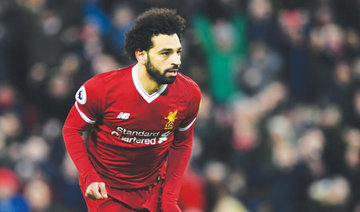
CAIRO: An enchanting story being shared on social media in Egypt tells how Mohamed Salah, the Liverpool forward and one of the world’s hottest soccer players right now, was once rejected by a local team he dreamt of playing for.
That Salah succeeded anyway is being latched onto by his fellow Egyptians as a sign of hope for a country battered by years of turmoil, deadly attacks and a harsh economic crisis.
Salah provides inspiration to many of Egypt’s 95 million people that hard times can be overcome, yet his success has also been hailed by the country’s authoritative government.
Rarely a day goes by without Salah on the front pages of Egyptian newspapers. Grim news reports often give way to more uplifting stories of how the 25-year-old Salah, who hails from an out-of-the-way Nile Delta village north of Cairo, has lit up the English Premier League in his first six months at Liverpool.
Just one of his milestones: Salah scored 20 goals in his first 26 games for Liverpool. Only one player in Liverpool’s 125-year history has reached 20 goals quicker than Salah — and that was George Allan in 1895 (in 19 games).
One Egyptian newspaper, Al-Watan, devoted nine pages of its 16-page New Year’s Day edition to Salah.
“The Pharaoh: Joy of 2017 and hope of 2018,” declared Al-Watan’s headline banner above an image of Salah wearing a red-and-black Egypt shirt, arms raised in triumph, and sporting just a hint of a smile. The picture nearly took up the entire front page.
Salah hasn’t sent Egyptians streaming to street cafes to watch him play just because of his phenomenal club form. He also led Egypt’s national team to this year’s World Cup finals in Russia, the first time in nearly 30 years.
At those packed street cafes, TV channels showing Lionel Messi’s Barcelona and Cristiano Ronaldo’s Real Madrid — for years the subjects of obsession for Egyptian fans — are now flicked over for Liverpool and Salah’s latest showing.
Intriguingly, Salah’s soccer success is prompting a deeper examination of what’s happening in Egypt.
In 2011, Egyptians rose up during the Arab Spring to remove the unpopular Hosni Mubarak as president after 29 years in charge. But the country was then subject to instability and violence, first under direct military control and then under Islamist leader Muhammad Mursi. It’s now ruled by army general-turned-president Abdel-Fattah el-Sisi.
Right now, it’s not just soccer fans hailing Salah’s success.
“This is linked to the notion by tyrannical or authoritarian regimes of creating a distraction from the basic issues that people should be concerned with,” said Amar Ali Hassan, an Egyptian novelist and social science researcher.
Supporting that argument, the Al-Watan newspaper, which made such a big deal of the “joy” Salah brought Egypt, is a pro-government paper. Missing from its front page on the first day of 2018 was the reality: Egypt is bedeviled by violent unrest and the majority of people struggle to stay afloat in the face of steep price rises caused by reforms to overhaul an economy crippled by the years of turmoil.
Mada Masr, one of a shrinking number of independent media outlets under the rule of el-Sisi, was more scathing in a column this week, framing Salah’s success as only possible because he left Egypt behind.
“We are faced with a person (Salah) who firmly believes in hope and that’s why he is able to constantly evolve and grow,” it said. “We are facing an Egyptian that Egypt failed to ‘Egyptianize’ and that is exactly why he is celebrated everywhere.”
There’s no doubt that Salah has been positive for Egypt.
When he won a game for the national team, with Egypt securing a World Cup spot for the first time since 1990, thousands took to the streets to celebrate, forcing authorities to drop an iron-clad ban on unauthorized gatherings and demonstrations. It’s OK to be a soccer fan again, six years after a politically linked riot at a stadium killed more than 70 people and forced followers of the sport to retreat into their homes.
The Salah phenomenon has swelled the ranks of football academies, and conversations in the media tackle a wide range of Salah-related topics, from the values of commitment and discipline to why Egypt must nurture role models.
Even Hassan, the social science researcher distrustful of Salah-mania, conceded: “There is another way of looking at it, which is that Egyptians can be creative and successful if given the chance in the right climate and context.”
And there’s the downright decency with which Salah appears to operate, a solid enough lesson for anyone inside and outside Egypt.
The ending of that enchanting tale about Salah goes like this: When Liverpool played Chelsea at its home stadium in November, Salah invited Mamdouh Abbas, the president at his local Egyptian club who rejected him, to watch him play. Abbas, now in his 70s and holding a walking stick, watched from a luxurious seat organized by the young man who showed no bitterness years later.
Down on the field, Salah, who was bought by Liverpool for 42 million euros (then $46.8 million), scored against the reigning Premier League champion.


![]()

Salah’s success offers hope in Egypt to fans and authorities
Salah’s success offers hope in Egypt to fans and authorities

Latest updates


© 2026 SAUDI RESEARCH & PUBLISHING COMPANY, All Rights Reserved And subject to Terms of Use Agreement.