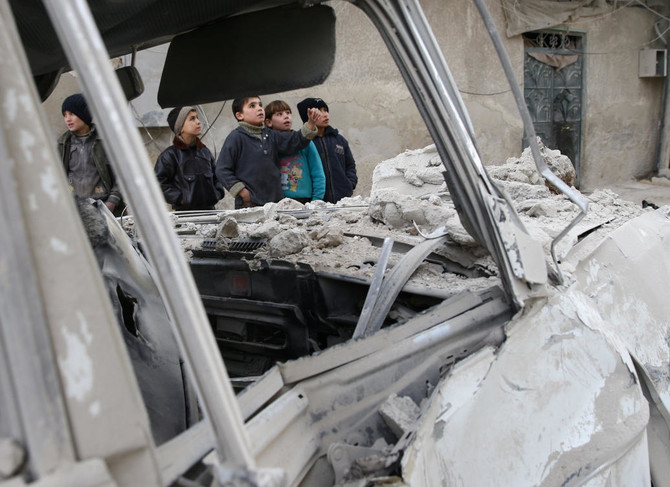
BEIRUT: Syrian regime forces on Thursday battled to reach troops trapped in rebel bastion Eastern Ghouta, as a monitor said at least 28 civilians were killed in Russian and government bombardments.
State television said “army units had launched an assault to break the siege” of the Armored Vehicle Base where some 250 soldiers are believed to be cut off.
On the outskirts of Damascus, Eastern Ghouta is one of the last remaining opposition strongholds in Syria and has itself been under government siege since 2013, causing severe food and medicine shortages for up to 400,000 residents.
The regime base on the edge of the region was surrounded by rebels at the start of the week after an offensive that involved Hayat Tahrir Al-Sham, an alliance dominated by a former Al-Qaeda affiliate, the British-based Syrian Observatory for Human Rights said.
Observatory head Rami Abdel Rahman said “violent clashes were taking place” Thursday close to the base, the only one in Eastern Ghouta still held by President Bashar Assad’s forces.
Ahead of the government operation, Abdel Rahman said at least 29 civilians were killed in Eastern Ghouta Wednesday by Russian and regime bombardments.
Twenty were killed in Russian air strikes in the town of Misraba, while the remainder died in regime raids and shelling in other areas.
Seven children and 11 women were among those killed, said the head of the war monitor, which relies on a network of sources inside Syria.
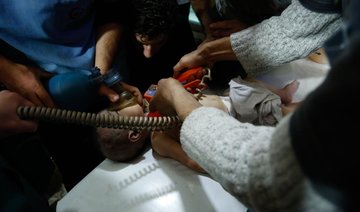
Victims were taken to a hospital in Douma, where an AFP correspondent saw rescuers bringing in mostly women and children.
Medical staff tried to revive a child who had been pulled from the rubble, but without success. A young girl among the wounded received stitches for a serious injury to her face.
A medical source at the hospital told AFP: “Among the wounded were two women in their 20s. One of them lost both eyes and the other lost one eye.”
Eastern Ghouta is one of four “de-escalation zones” agreed by Russia, as well as regime backer Iran and rebel supporter Turkey, to help halt fighting around Syria.
The deal excludes Hayat Tahrir Al-Sham, but other larger rebel groups in Eastern Ghouta are part of it.
The latest fighting there comes as regime troops backed up by Russian airpower battle rebels and extremists on the edge of northwestern Idlib province, the only one still fully beyond government control.
The government push near Idlib — also a “de-escalation zone” — follows two months of sporadic fighting that the United Nations says has displaced more than 60,000 people.
Meanwhile, Russia’s defense ministry on Thursday said two servicemen were killed in a New Year’s Eve mortar attack by militants on its Hmeimim air base in Latakia province, but denied media reports seven military planes were destroyed.
Moscow has declared its mission in Syria largely completed after a two-year intervention that has shifted the conflict firmly in Assad’s favor.
Russia says it has carried out a partial withdrawal but it will still keep soldiers and bases in Syria.
The war in Syria has killed more than 340,000 people and displaced millions from their homes since it began in 2011 with the brutal repression of anti-government protests.

Clashes in Syria rebel bastion over surrounded regime base
Lebanon PM publishes long-awaited banking law draft
- The law stipulates that each of the state, the central bank, commercial banks and depositors will share the losses accrued as a result of the financial crisis.
- Depositors with a limit of $100,000, over the course of four years
BEIRUT: Lebanese Prime Minister Nawaf Salam published on Friday a long-awaited banking draft bill, which distributes losses from the 2019 economic crisis between banks and the state.
The draft law is a key demand from the international community, which has conditioned economic aid to Lebanon on financial reforms.
In a televised speech, Salam said “this draft law constitutes a roadmap to getting out of the crisis” that still grips Lebanon.
The draft will be discussed by the Lebanese cabinet on Monday before being sent to parliament, where it could be blocked.
The law stipulates that each of the state, the central bank, commercial banks and depositors will share the losses accrued as a result of the financial crisis.
Depositors, who lost access to their funds after the crisis, will be able to retrieve their money, with a limit of $100,000, over the course of four years.
Salam said that 85 percent of depositors had less than $100,000 in their accounts.
The wealthiest depositors will see the remainder of their money compensated by asset-backed securities.
“I know that many of you are listening today with hearts full of anger, anger at a state that abandoned you,” Salam said.
“This bill may not be perfect... but it is a realistic and fair step toward restoring rights, halting the collapse.”
- ‘Banks are angry’ -
The International Monetary Fund, which closely monitored the drafting of the bill, had previously insisted on the need to “restore the viability of the banking sector consistent with international standards” and protect small depositors.
The Associations of Banks in Lebanon criticized the draft law on Monday, saying in a statement that it contains “serious shortcomings” and harms commercial banks.
“Banks are angry because the law opens the door to them sharing any part of the losses,” said Sami Zougheib, researcher at The Policy Initiative, a Beirut-based think tank.
He told AFP that banks would have preferred that the state bear full responsibility.
The text provides for the recapitalization of failing banks, while the government’s debt to the Central Bank will be converted into bonds.
Salam said that the bill aims to “revive the banking sector” which had collapsed, giving free rein to a parallel economy based on cash transactions, which facilitate money laundering and illicit trade.
According to government estimates, the losses resulting from the financial crisis amounted to about $70 billion, a figure that is expected to have increased over the six years that the crisis was left unaddressed.
Since assuming power, Salam and President Joseph Aoun have pledged to implement the necessary reforms and legislation.
In April, Lebanon’s parliament adopted a bank restructuring law, as the previous legislation was believed to have allowed a flight of capital at the outbreak of the 2019 crisis.
The new bill stipulates that politically exposed persons and major shareholders who transferred significant capital outside the country from 2019 onwards — while ordinary depositors were deprived of their savings — must return them within three months or face fines.
The draft law could still be blocked by parliament even if the cabinet approves it.
“Many lawmakers are directly exposed as large depositors or bank shareholders, politically allied with bank owners, and unwilling to pass a law that either angers banks or angers depositors,” Zougheib said.
Politicians and banking officials have repeatedly obstructed the reforms required by the international community for Lebanon to receive financial support.