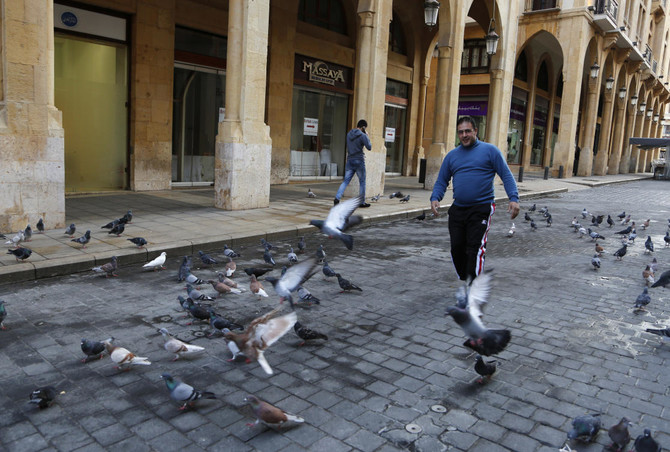
BEIRUT: Lebanese security forces have removed roadblocks and barriers surrounding Beirut’s downtown commercial district, which for years had been choked by security measures.
Parliament speaker Nabih Berri ordered the roads leading to Parliament Square open days after the square witnessed its largest New Year’s Eve celebration, with thousands of revelers, as part of a government initiative to revive the area.
Berri on Wednesday urged business owners, restaurants, hotels and offices in the area to reopen after many of them had closed down, having given up on the area attracting visitors again.
The downtown area is home to Lebanon’s parliament and government building and has in the past often been the scene of anti-government protests, prompting security forces to close down the premises to pedestrians with concrete barriers and barbed wire.
Security forces removed metal barriers and heavy concrete slabs which had blocked all entrances to Beirut’s showpiece Place d’Etoile quarter and forced most shops and restaurants in the once thriving district to shut down.
The security measures had been in place for a number of years, but were significantly tightened in 2015 following large-scale protests over a garbage crisis.
Crowds thronged the Place d’Etoile for the first time in a decade on Sunday night to usher in the new year with fireworks, music and dancing in the streets.
The speaker of parliament, Nabih Berri, who issued Wednesday’s order, said he hoped businesses, restaurants, hotels and offices in the area would now be able to resume work.
“There were many times we thought about closing, but we said ‘no, maybe things will pick up’,” said Zeina Hasbini, who runs a chocolate boutique just off the square.
She and her son, who runs a small grocery store next door, said they were sure lifting the barriers would boost business as footfall and investment increased.
Though Lebanon still faces daunting challenges, it has seen some progress over the past year despite continued conflict in neighboring Syria and rising tensions elsewhere in the region.
Its squabbling politicians clinched a deal that ended a two-and-a-half-year period without a state president and installed a new government under Prime Minister Saad Al-Hariri. The government also approved its first budget in 12 years and awarded its first offshore oil land gas exploration licenses.
In August, Islamic State and other militants were cleared from the Lebanon-Syria border area after separate offensives by the Lebanese army and Lebanon’s powerful Hezbollah militia.
The Petit Cafe overlooking Place d’Etoile reopened in mid-2017 after shutting its doors as the Syrian crisis erupted.
“The country ground to a halt: you no longer saw tourists, or people from the Gulf countries, so we closed for about 6-7 years,” said Muhammad Faris, the restaurant manager.
He said the new year’s celebrations and the lifting of the barriers were signs that the area “can flourish again.”
Despite such signs of hope, Lebanon remains a politically fraught country.
Tensions flared in November when Hariri unexpectedly resigned as prime minister in a shock broadcast from Saudi Arabia — a move linked to conflict in the wider region between Riyadh and Tehran. He subsequently withdrew the resignation and the government resumed business as usual.

Lebanon removes security barriers in downtown Beirut
Virtual museum preserves Sudan’s plundered heritage
CAIRO: Destroyed and looted in the early months of Sudan’s war, the national museum in Khartoum is now welcoming visitors virtually after months of painstaking effort to digitally recreate its collection.
At the museum itself, almost nothing remains of the 100,000 artefacts it had stored since its construction in the 1950s. Only the pieces too heavy for looters to haul off, like the massive granite statue of the Kush Pharaoh Taharqa and frescoes relocated from temples during the building of the Aswan Dam, are still present on site.
“The virtual museum is the only viable option to ensure continuity,” government antiquities official Ikhlass Abdel Latif said during a recent presentation of the project, carried out by the French Archaeological Unit for Sudanese Antiquities (SFDAS) with support from the Louvre and Britain’s Durham University.
When the museum was plundered following the outbreak of the war between the regular army and the paramilitary Rapid Support Forces (RSF) in April 2023, satellite images showed trucks loaded with relics heading toward Darfur, the western region now totally controlled by the RSF.
Since then, searches for the missing artefacts aided by Interpol have only yielded meagre results.
“The Khartoum museum was the cornerstone of Sudanese cultural preservation — the damage is astronomical,” said SFDAS researcher Faiza Drici, but “the virtual version lets us recreate the lost collections and keep a clear record.”
Drici worked for more than a year to reconstruct the lost holdings in a database, working from fragments of official lists, studies published by researchers and photos taken during excavation missions.
Then graphic designer Marcel Perrin created a computer model that mimicked the museum’s atmosphere — its architecture, its lighting and the arrangement of its displays.
Online since January 1, the virtual museum now gives visitors a facsimile of the experience of walking through the institution’s galleries — reconstructed from photographs and the original plans — and viewing more than 1,000 pieces inherited from the ancient Kingdom of Kush.
It will take until the end of 2026, however, for the project to upload its recreation of the museum’s famed “Gold Room,” which had housed solid-gold royal jewelry, figurines and ceremonial objects stolen by looters.
In addition to the virtual museum’s documentary value, the catalogue reconstructed by SFDAS is expected to bolster Interpol’s efforts to thwart the trafficking of Sudan’s stolen heritage.
At the museum itself, almost nothing remains of the 100,000 artefacts it had stored since its construction in the 1950s. Only the pieces too heavy for looters to haul off, like the massive granite statue of the Kush Pharaoh Taharqa and frescoes relocated from temples during the building of the Aswan Dam, are still present on site.
“The virtual museum is the only viable option to ensure continuity,” government antiquities official Ikhlass Abdel Latif said during a recent presentation of the project, carried out by the French Archaeological Unit for Sudanese Antiquities (SFDAS) with support from the Louvre and Britain’s Durham University.
When the museum was plundered following the outbreak of the war between the regular army and the paramilitary Rapid Support Forces (RSF) in April 2023, satellite images showed trucks loaded with relics heading toward Darfur, the western region now totally controlled by the RSF.
Since then, searches for the missing artefacts aided by Interpol have only yielded meagre results.
“The Khartoum museum was the cornerstone of Sudanese cultural preservation — the damage is astronomical,” said SFDAS researcher Faiza Drici, but “the virtual version lets us recreate the lost collections and keep a clear record.”
Drici worked for more than a year to reconstruct the lost holdings in a database, working from fragments of official lists, studies published by researchers and photos taken during excavation missions.
Then graphic designer Marcel Perrin created a computer model that mimicked the museum’s atmosphere — its architecture, its lighting and the arrangement of its displays.
Online since January 1, the virtual museum now gives visitors a facsimile of the experience of walking through the institution’s galleries — reconstructed from photographs and the original plans — and viewing more than 1,000 pieces inherited from the ancient Kingdom of Kush.
It will take until the end of 2026, however, for the project to upload its recreation of the museum’s famed “Gold Room,” which had housed solid-gold royal jewelry, figurines and ceremonial objects stolen by looters.
In addition to the virtual museum’s documentary value, the catalogue reconstructed by SFDAS is expected to bolster Interpol’s efforts to thwart the trafficking of Sudan’s stolen heritage.
© 2026 SAUDI RESEARCH & PUBLISHING COMPANY, All Rights Reserved And subject to Terms of Use Agreement.