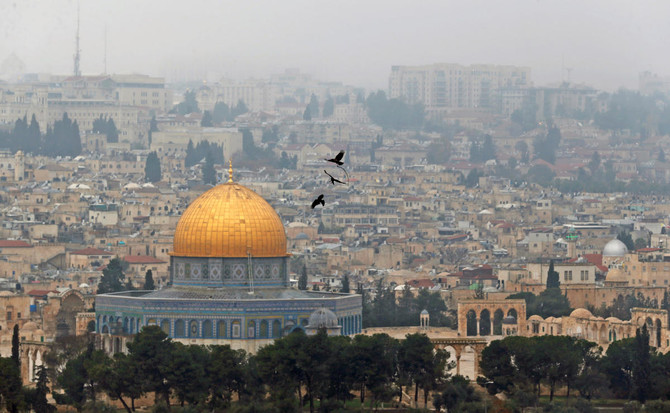
JERUSALEM: Israel’s parliament on Tuesday gave final approval to legislation aimed at making it more difficult for the government to hand the Palestinians parts of Jerusalem under any future peace deal.
The bill, approved by a 64 to 51 vote, is the latest blow to remaining hopes for a two-state solution to the Israeli-Palestinian conflict.
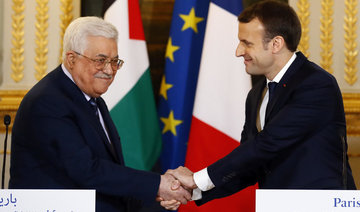
Palestinian president Mahmud Abbas’s office said US President Donald Trump’s recent declaration of Jerusalem as Israel’s capital and the new Israeli law amounted to a “declaration of war.”
Formulated by Shuli Moalem-Refaeli of the far-right Jewish Home party, the new law comes weeks after Trump’s decision on Jerusalem sparked deadly protests in the Palestinian territories.
It also follows a vote earlier this week by the central committee of Prime Minister Benjamin Netanyahu’s Likud party in favor of extending Israeli sovereignty over settlements in the occupied West Bank.
The Likud vote was non-binding, but was a further expression of the hopes of many right-wing Israelis who oppose the creation of a Palestinian state.
The law approved on Tuesday determines that any ceding of lands considered by Israel to be part of Jerusalem would necessitate a two-thirds majority vote in parliament — 80 out of 120 members of the Knesset.
It also enables changing the municipal definition of Jerusalem, which means that sectors of the city “could be declared separate entities,” a statement from parliament read.
Israeli right-wing politicians have spoken of unilaterally breaking off overwhelmingly Palestinian areas of the city in a bid to increase its Jewish majority.
However, the new law is not necessarily definitive. It can be changed by a regular parliamentary majority of 61.
Israel occupied east Jerusalem and the West Bank in 1967. It later annexed east Jerusalem in a move never recognized by the international community.
It claims all of Jerusalem as its united capital, while the Palestinians see the eastern sector as the capital of their future state.
The issue is among the most contentious in the Israeli-Palestinian conflict.
“We’ve ensured the unity of Jerusalem,” Education Minister Naftali Bennett, who heads Jewish Home, said after the vote.
“The Mount of Olives, the Old City... will forever remain ours,” he wrote on Twitter.
Abbas’s office said Trump’s recognition and the Israeli law amounted to a “declaration of war on the Palestinian people and its political and religious identity.”
The statement called the moves a “dangerous project for the future of the region and the world.”
Saeb Erekat, secretary general of the Palestine Liberation Organization, said the Israelis were moving ahead with such measures because the United States had stayed silent and signalled approval with Trump’s Jerusalem declaration.
Hamas, the Islamist movement that runs the Gaza Strip, said Abbas should declare the end of the Oslo peace accords of the 1990s and withdraw the PLO’s recognition of Israel.
Trump’s December 6 decision upended decades of precedent and broke with international consensus, but maintains that Jerusalem’s final status would have to be decided in negotiations between the two sides.
It has led to deep anger among Palestinians, with Abbas saying the United States can no longer play any role in the Middle East peace process.
On Monday, Abbas said the White House “has refused to condemn Israeli colonial settlements as well as the systematic attacks and crimes of the Israeli occupation against the people of Palestine.”
Speaking of the Likud vote, he said “we hope that this vote serves as a reminder for the international community that the Israeli government, with the full support of the US administration, is not interested in a just and lasting peace.”

Israel law tightens hold on occupied Jerusalem sectors
Gulf airlines cautiously restore flights as regional airspace restrictions ease
RIYADH: Emirates and Etihad Airways resumed limited flight operations after parts of Middle Eastern airspace reopened, while Qatar Airways began operating a limited schedule to and from Doha under restricted conditions.
The gradual restoration follows days of disruption triggered by military escalation involving the US, Israel and Iran, which forced widespread airspace closures across the region, disrupted major global aviation corridors and prompted thousands of cancellations and diversions.
Qatar Airways said flights were operating only for passengers whose final destination was Doha, reflecting continued airspace restrictions even as parts of the region reopened.
In a statement, Emirates said customers transiting through Dubai would only be accepted for travel if their onward connecting flight was operating.
“Emirates continues to monitor the situation, and we will develop our operational schedule accordingly,” the airline said.
Etihad said it resumed a limited commercial flight schedule on March 6 to selected destinations after safety reviews conducted with relevant authorities.
“The decision has been taken in coordination with relevant authorities following extensive safety and security assessments. Etihad continues to monitor the situation closely and will only operate flights once all safety criteria are met,” the airline said in a statement on March 6.
The disruption has affected the region’s largest hub airports in Dubai, Abu Dhabi and Doha, where the three carriers together normally handle about 90,000 passengers a day, according to aviation analytics firm Cirium.
Fitch Ratings said the duration of aviation disruption following the Feb. 28 strikes by Israel and the US on Iran, and Iran’s subsequent retaliation across the region, would be key in determining the impact on sectors including airlines, airports, hospitality, insurance and aircraft leasing.
“Our baseline expectation that the conflict in the Middle East will last less than a month should limit the implications for Fitch-rated issuers in sectors affected by the aviation disruption,” Fitch said, adding that a prolonged disruption would pose greater risks, particularly for smaller and less diversified operators.
More than 15,000 flights were canceled across seven major regional airports between Feb. 28 and March 5, affecting more than 1.5 million passengers, according to Fitch. Some flights were also diverted to European airports.
The ratings agency said airlines with hubs in directly affected countries faced the largest revenue exposure, particularly in the UAE and Qatar, while other carriers were affected by suspended routes and the need to avoid restricted airspace.
It added: “The highest volume exposure among Fitch-rated EMEA (Europe, the Middle East and Africa) network airlines to the broader Middle East region does not exceed a high single-digit percentage.”
The report also said the disruption was pushing up operating costs as airlines were forced to take longer routes, make additional technical stops, and absorb crew overtime, along with higher accommodation and ground-handling expenses.
Passenger compensation is expected to remain limited because the conflict is beyond airlines’ control, though carriers may still face costs related to meals, lodging, refunds or travel vouchers for canceled flights. At the same time, disruption often leads to higher ticket prices on affected and nearby routes, helping partially offset the financial impact.
In addition to revenue losses, airlines are also expected to face pressure from rising fuel prices. Most carriers across Europe, the Middle East and Africa, including those based in the Gulf, maintain relatively strong fuel-hedging positions, with coverage for the next three months typically ranging from about 50 percent to over 80 percent.
“The impact on Fitch-rated European airports is likely to be mixed, with lost revenue from declining point-to-point traffic from the Far East and the knock-on effect on retail spending per passenger, potentially offset by higher ancillary revenues such as parking fees, and, where applicable, regulatory protection against traffic volatility,” the report said.