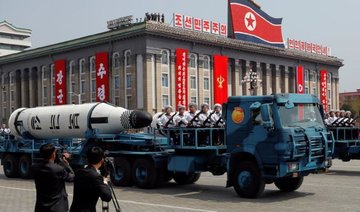
WASHINGTON/MOSCOW: The United States announced sanctions on two North Korean officials behind their country’s ballistic missile program on Tuesday, while Russia reiterated an offer to mediate to ease tensions between Washington and Pyongyang.
The new US steps were the latest in a campaign aimed at forcing North Korea — which has defied years of multilateral and bilateral sanctions — to abandon a weapons program aimed at developing nuclear-tipped missiles capable of hitting the United States.
The US Treasury named the officials as Kim Jong Sik and Ri Pyong Chol. It said Kim was reportedly a key figure in North Korea’s efforts to switch its missile program from liquid to solid fuel, while Ri was reported to be a key official in its intercontinental ballistic missile (ICBM) development.
“Treasury is targeting leaders of North Korea’s ballistic missile programs, as part of our maximum pressure campaign to isolate (North Korea) and achieve a fully denuclearized Korean Peninsula,” Treasury Secretary Steven Mnuchin said in a statement.
The largely symbolic steps block any property or interests the two might have within US jurisdiction and prohibit any dealings by US citizens with them.
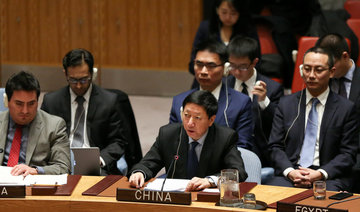
The move followed new United Nations sanctions announced last Friday in response to North Korea’s Nov. 29 test of an ICBM that Pyongyang said put all of the US mainland within range of its nuclear weapons. Those sanctions sought to further limit North Korea’s access to refined petroleum products and crude oil and its earnings from workers abroad.
North Korea declared the UN steps to be an act of war and tantamount to a complete economic blockade.
The standoff between the United States and North Korea has raised fears of a new conflict on the Korean peninsula, which has remained in a technical state of war since the 1950-53 Korean War ended in an armistice, not a peace treaty.
Washington has said that all options, including military ones, are on the table in dealing with North Korea. It says it prefers a diplomatic solution, but that North Korea has given no indication it is willing to discuss denuclearization.
KREMLIN OFFER
On Tuesday, the Kremlin, which has long called for the two sides to hold negotiations, said it was ready to act as a mediator if the United States and North Korea were willing for it to play such a role.
“Russia’s readiness to clear the way for de-escalation is obvious,” Kremlin spokesman Dmitry Peskov told reporters.
Asked to comment on the offer, a spokesman for the US State Department, Justin Higgins, said the United States “has the ability to communicate with North Korea through a variety of diplomatic channels,” and added:
“We want the North Korean regime to understand that there is a different path that it can choose, however it is up to North Korea to change course and return to credible negotiations.”
Russian Foreign Minister Sergei Lavrov, who made a similar offer on Monday, told US Secretary of State Rex Tillerson in a phone call on Tuesday that “Washington’s aggressive rhetoric” and beefing up of its military presence in the region had heightened tensions and was unacceptable, Russia’s foreign ministry said.
It said Lavrov underscored the need for “the fastest move to the negotiating process from the language of sanctions.”
Another State Department spokesman, Michael Cavey, said Washington remained open to talks, but the onus was on North Korea “to take sincere and meaningful actions toward denuclearization and refrain from further provocations.”
He said North Korea had “made clear through its words and actions it is not interested in dialogue at this stage.”
South Korea’s Unification Ministry forecast on Tuesday that North Korea would look to open negotiations with the United States next year while continuing to seek recognition as a de facto nuclear power.
Washington has stressed the need for all countries, especially Russia, and China — North Korea’s main trading partner — to fully implement sanctions, including by cutting off oil supplies.
According to Chinese customs data, China exported no oil products to North Korea in November, apparently going above and beyond UN sanctions imposed earlier this year.
Beijing also imported no North Korean iron ore, coal or lead in November, the second full month of those trade sanctions, the data showed.
Beijing has not disclosed its crude exports to North Korea for several years, but industry sources say it still supplies about 520,000 tons, or 3.8 million barrels, a year to the country via an aging pipeline.
North Korea also sources some of its oil from Russia.
Trade between North Korea and China has slowed through the year, particularly after China banned coal purchases in February.
Chinese exports of corn to North Korea in November also slumped, down 82 percent from a year earlier to 100 tons, the lowest since January. Exports of rice plunged 64 percent to 672 tons, the lowest since March.
China has expressed concern about the humanitarian effects of sanctions, and has repeatedly called for constructive efforts to ease tensions.