

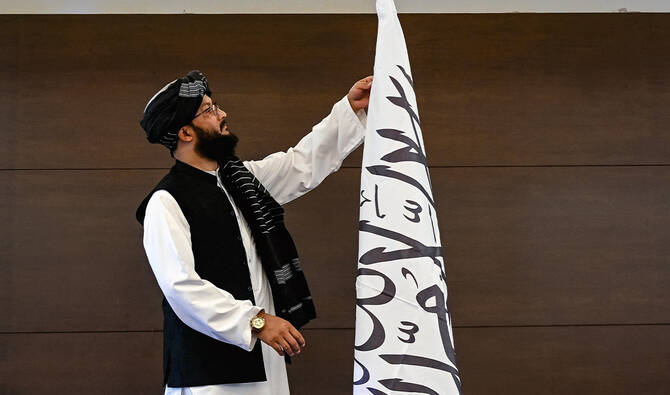
Afghan Taliban envoy posted to Indian capital

An Afghan man adjusts the Taliban flag before a press conference of Afghanistan's Foreign Minister Amir Khan Muttaqi at the Embassy of Afghanistan in New Delhi on October 12, 2025. (AFP/File)
Short Url
Updated 13 January 2026
Follow

Afghan Taliban envoy posted to Indian capital

  • India has not officially recognized Taliban government but latest move signals deepening engagement between both
  • Development takes place as New Delhi seeks to exploit surging tensions between Kabul, Islamabad to its advantage

NEW DELHI, India: Afghanistan’s Taliban government has appointed their first senior official in India since the group returned to power in 2021, charged with leading their embassy in Delhi.

India has not officially recognized the Taliban government, but the move signals a deepening engagement, with New Delhi seeking to exploit divisions between Islamabad and Kabul.

Noor Ahmad Noor, a Taliban foreign ministry official, assumed responsibility as charge d’affaires, and has already held meetings with Indian officials, the embassy said in a statement.

“Both sides emphasized the importance of strengthening Afghanistan-India relations,” the Afghan Embassy said, in a post on X late Monday.

India has not commented, but the Afghan embassy posted a photograph of Noor with senior Indian foreign ministry official Anand Prakash.

The Taliban’s strict interpretation of Islamic law may appear an unlikely match for Prime Minister Narendra Modi’s Hindu nationalist government, but India has sought to seize the opening.

Nuclear-armed rivals India and Pakistan fought a brief but deadly clash in May 2025, their worst confrontation in decades.

The appointment is significant for the Taliban, which has sought to reclaim control over Afghanistan’s overseas diplomatic missions as part of a broader push for international legitimacy.

In October, India said it would upgrade its technical mission in Afghanistan to a full embassy.

Russia is the only country to officially recognize the Afghan Taliban government.


Pakistan, seven Muslim nations back Palestinian technocratic body, stress Gaza-West Bank unity

Updated 15 January 2026
Follow

Pakistan, seven Muslim nations back Palestinian technocratic body, stress Gaza-West Bank unity

  • The National Committee for the Administration of the Gaza Strip was announced on January 14
  • Muslim nations call for consolidation of the ceasefire and unimpeded humanitarian aid into Gaza

ISLAMABAD: Pakistan and seven other Muslim-majority countries on Thursday welcomed the formation of a temporary Palestinian technocratic body to administer Gaza, stressing that it must manage daily civilian affairs while preserving the institutional and territorial link between the Gaza Strip and the West Bank amid the ongoing peace efforts.

In a joint statement, the foreign ministers of Pakistan, Egypt, Jordan, Saudi Arabia, Qatar, Türkiye, Indonesia and the United Arab Emirates said the newly announced National Committee for the Administration of the Gaza Strip would play a central role during the second phase of a broader peace plan aimed at ending the war and paving the way for Palestinian self-governance.

“The Ministers emphasize the importance of the National Committee commencing its duties in managing the day-to-day affairs of the people of Gaza, while preserving the institutional and territorial link between the West Bank and the Gaza Strip, ensuring the unity of Gaza, and rejecting any attempts to divide it,” the statement said.

The committee, announced on Jan. 14, is a temporary transitional body established under United Nations Security Council Resolution 2803 and is to operate in coordination with the Palestinian Authority, the ministers said.

The statement said the move forms part of the second phase of US President Donald Trump’s Comprehensive Peace Plan for Gaza, which the ministers said they supported, praising Trump’s efforts to end the war, ensure the withdrawal of Israeli forces and prevent the annexation of the occupied West Bank.

The top leaders of all eight Muslim countries attended a meeting with Trump in New York last September, shortly before he unveiled the Gaza peace plan.

The ministers also called for the consolidation of the ceasefire, unimpeded humanitarian aid into Gaza, early recovery and reconstruction and the eventual return of the Palestinian Authority to administer the territory, leading to a just and sustainable peace based on UN resolutions and a two-state solution on pre-1967 lines with East Jerusalem as the Palestinian capital.