NEW DELHI: India is debating the real intent behind Pakistan allowing Kulbhushan Jadhav, a convicted Indian spy facing the death sentence in a Pakistani jail, to meet his mother and wife.
Jadhav’s mother Avanti Jadhav and wife Chetankul Jadhav, accompanied by the Indian Deputy High Commissioner J.P. Singh, met the former Indian navy officer in Islamabad on Monday afternoon.
“It has happened due to international pressure,” said Suman Sharma, a New Delhi-based foreign affairs expert.
“It is a tactical gesture by the Pakistan government before the next hearing at the International Court of Justice (ICJ), which is hearing the case. Islamabad can argue in the ICJ that they are treating the case from the humanitarian points of view,” Sharma told Arab News.
Dr. Zakir Husain of the Indian Council of World Affairs, a New Delhi based think-tank, said: “The larger point of this meeting is more than humanitarian. Pakistan is sending a signal that it is willing to break the ice with India and hold talks with its eastern neighbor.”
Talking to Arab News, Husain underlined that “it’s now up to India how it responds to the Pakistani overtures. This comes just days after the Pakistani army chief’s announcement of his willingness to talk with India.”
However, there was a lot of curiosity in Mumbai, the city where Jadhav’s family lives.
“We are really excited about the meeting taking place in Islamabad,” said Subrato Mukherjee, an old friend of Jadhav in Mumbai.
Talking to Arab News, Mukherjee said that “last week a bike rally and human chain were organized in the city to extend support to Jadhav’s family and express our solidarity with the family.”
India does not accept the Pakistani version of the story that Jadav was arrested in Baluchistan province of Pakistan on March 3, 2016, and was acting as a spy to create disturbances in its territory.
New Delhi, however, claims that Jadhav was kidnapped from Iran, where he went to do some business after his retirement from the Indian Navy.
Jadhav’s case has created a frenzy in the Indian media with the majority calling Pakistan’s move “an optical illusion and choreographed exercise.”
“On the question of Pakistan, Indian media loses its balance. We lose objectivity and sense of proportion,” said Sharma.
“I feel the Jadhav case is a wonderful opportunity for both India and Pakistan to engage each other in dialogue. Had there been a regular mechanism of engagement between the two nations, we would not have had this kind of polarized debate and tension.”


![]()
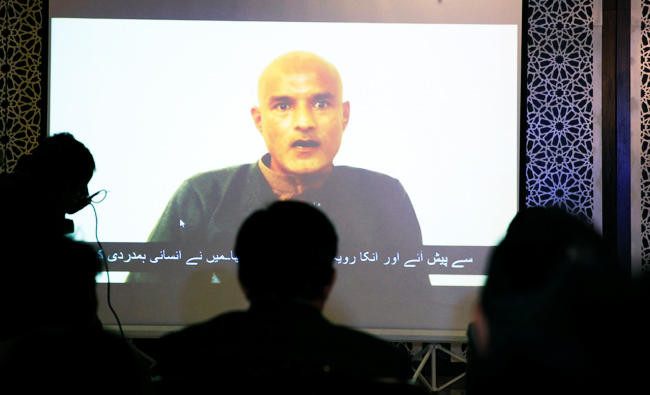
Jadhav’s case is an opportunity for two countries to talk, say Indian experts
Jadhav’s case is an opportunity for two countries to talk, say Indian experts

Latest updates


© 2026 SAUDI RESEARCH & PUBLISHING COMPANY, All Rights Reserved And subject to Terms of Use Agreement.