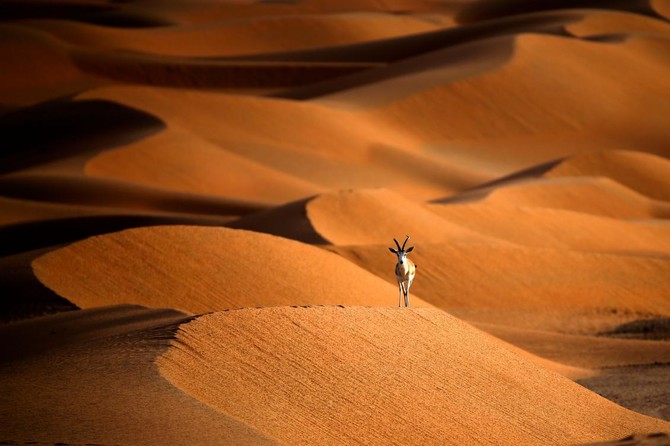
Haima, OMAN: The Gulf sultanate of Oman is looking to carve itself a new niche in ecotourism by opening up a sanctuary for one of the desert’s most fabled creatures — the Arabian oryx.
Once extinct in the wild, the rare member of the antelope family famed for its elegant horns has been dragged back from the precipice in a sprawling reserve fenced off for decades from the public.
That changed last month when authorities for the first time officially opened the sanctuary to visitors — part of a broader bid by Oman to boost tourism as oil revenues decline.
On a recent outing, wildlife rangers in SUVs patrolled the sandy plains of the reserve in central Oman’s Haima province, spotting groups of grazing oryx and other indigenous species.
For years, the main goal has been a basic one — ensuring the oryx can survive by focusing on “helping the animals here reproduce and multiply,” said sanctuary spokesman Hamed bin Mahmoud Al-Harsousi.
But now, as numbers have ticked up from just 100 some two decades ago to almost 750 today, the authorities began eyeing another role for the reserve.
“There has been more interest in its tourism potential — to take advantage of its uniqueness and rare animals,” Harsousi told AFP.
The story of the Arabian oryx — sometimes referred to as the Arabian “unicorn” due to its distinctive profile — is one of miraculous survival.
Hunted prolifically, the last wild member of the species was killed in Oman by suspected poachers in 1972.
The species only clung to existence thanks to a program to breed them in captivity and in the early 1980s a batch of 10 were released into Oman’s Arabian Oryx Sanctuary.
Since then, regenerating the oryx has been an often precarious process.
The Omani sanctuary sprawls over 2,824 square kilometer (1,100 sq miles) of diverse terrain — from flat plains to rocky slopes and sandy dunes.
Its own fate has been nearly as tortured as that of the oryx it houses.
In 2007, the sanctuary became the first place ever to be removed from UNESCO’s World Heritage list as the government of Oman turned most of it over to oil drilling.
Now, as oil prices have plunged over the past few years, it is the wildlife once again that has become an increasing priority for the authorities.
Harsousi puts the current number of Arabian oryx in the sanctuary at 742 and says that other species are flourishing there too.
“In the past three years, we have been able to increase the number of the Arabian gazelle, known as sand gazelles, from 300 to about 850,” he added.
In addition to the animals, there are 12 species of trees that provide a habitat for diverse birds.
Oman has been on a push to transform itself into a tourist draw — pitching its beach resorts to luxury travelers and desert wilderness to the more adventurous.
Officials in the sultanate told AFP that a major tourism plan would be announced within a matter of weeks.
Those working at the oryx sanctuary hope that it can help play a lead role in luring visitors to the country.
But there are also fears that greater openness could see the return of an old foe — hunters.
With that in mind security is being kept tight, said Abdullah Ghassab Obaid, a wildlife guard at the reserve.
“Thirty guards and a police patrol are working to provide security in the reserve to prevent any infiltration.”

Oman opens sprawling oryx reserve to ecotourists ahead of new tourism push
Saudi National Development Fund sees 45 agreements worth $1.6bn at Momentum 2025
RIYADH: Saudi Arabia’s National Development Fund and its affiliates signed 45 agreements with a total value of SR6 billion ($1.59 billion), with several local and international partners at the conclusion of the Momentum 2025 development finance conference.
The event, held from Dec. 9 to 11 at the King Abdulaziz International Conference Center in Riyadh, was organized by the NDF under the patronage of Prince Mohammed bin Salman bin Abdulaziz Al Saud, crown prince, prime minister, and chairman of the NDF board of directors.
The new agreements seek to accelerate the pace of investment, empower the private sector, and unlock new opportunities in priority sectors including small and medium sized enterprises, tourism, and sustainable development.
On the institutional level, the fund signed two strategic agreements with two leading global partners in technology and professional services, aiming to enable artificial intelligence, data, and digital solutions within the development finance ecosystem.
The two memorandum of understandings aim to enhance the institutional capabilities of the fund, encourage innovation in products and services, and improve the efficiency and overall impact of development financing in the Kingdom.
The NDF signed a memorandum of understanding through the National Infrastructure Fund aimed at unifying the efforts of the development system to support small enterprises by cooperating on designing a developmental financing model for SMEs.
The Saudi SME Bank signed 19 cooperation agreements and MoUs with a value exceeding SR3 billion, to support the developmental finance system and enhance integration between public and private sector entities.
The Tourism Development Fund concluded 6 agreements with entities from both the government and private sectors, strengthening its partnerships with an impact exceeding SR4 billion. These aim to enhance financing solutions through the “Tourism Enablement Programs” offered by the fund to micro, small, and medium enterprises.
The Cultural Development Fund signed five credit facility agreements within the framework of the “Cultural Financing” program, with a total value exceeding SR63 million, to finance numerous cultural projects.
As part of its efforts to support human capital development, the Human Resources Development Fund concluded 3 agreements aimed at supporting and enabling 2,191 male and female job seekers in multiple sectors, with a value exceeding SR324 million.
The Saudi Industrial Development Fund signed a cooperation agreement with the Saudi Railways Co. to identify cooperation opportunities in enabling the industrial sector, including the railway sector, and supporting investors in localizing goods and services to increase local content.
The Saudi Fund for Development signed five developmental memoranda of understanding with Imam Mohammad Ibn Saud Islamic University, the Islamic Military Counter Terrorism Coalition, and the Middle East Green Initiative, as well as the Saudi Agricultural and Livestock Investment Co., and the Arab Urban Development Institute.
The Investment Events Fund signed a partnership agreement with entertainment firm Legends Global to enhance the events sector by leveraging international expertise in organizing major global events.
The agreements and MoUs signed during the Momentum 2025 conference represent a significant step in the Kingdom’s efforts to build a diverse, inclusive, and sustainable economy.
These partnerships contribute to bridging financing gaps, mitigating risks for strategic projects, and achieving long-term value for Saudi citizens, companies, and communities. Furthermore, they advance global sustainable development goals by aligning public and private capital with national priorities in infrastructure, SMEs, and green growth.
Dialogue sessions embody development transformation message
The conference agenda included over 35 sessions addressing sustainable investment, climate adaptation, and the role of development finance institutions in expanding economic opportunities. It also featured an exhibition with participation from more than 20 public and private sector entities.
Over 100 speakers from more than 100 countries participated to discuss ways to develop financing for development efforts, tackle emerging global challenges, and accelerate national and international priorities.
The conference concluded with a session titled “The Role of Development Finance Institutions: Enabling Development by Enhancing Financial Capabilities,” which brought together the Governor of the NDF, Stephen Groff, and the CEOs of various development funds and banks.
The session discussions focused on enhancing joint coordination, improving investment readiness, and expanding developmental impact across multiple sectors including tourism, infrastructure, and SMEs.
During the roundtable discussion, participants reviewed the pivotal role led by the Fund and its development ecosystem across various sectors and their role in supporting the economic transformation of the Kingdom.
Groff explained that the strength of this ecosystem lies in the diversity of the funds and the integration of their mandates, adding that achieving the targets of Saudi Vision 2030 requires flexibility in resource allocation and the ability to adapt to national development priorities.
In support of expanding the presence of international companies in the Kingdom and enhancing the competitiveness of the financial sector, the Minister of Investment, Khalid Al-Falih, presented the regional headquarters license to HSBC Bank on the sidelines of the conference, a step that reflects growing confidence in and the attractiveness of the Saudi market to global financial institutions.
To enrich the development sector, the Digital Cooperation Organization launched, on the sidelines of the conference, the Digital Economy Trends 2026 report. The report predicted that the global digital economy will grow by 9.5 percent next year, three times faster than global economic growth.