PARIS: Boeing is eyeing a broad partnership with Embraer reaching beyond commercial aircraft to defense and global services, but its shape hinges on talks with the Brazilian government.
The US aerospace group has yet to make a formal offer and its final structure would be driven by talks that are expected to resume in coming weeks — but sources say the aim is to go well beyond traditional joint ventures or an equity infusion.
“A broader combination would be preferred but Boeing is sensitive to concerns the government may have about issues like defense. If those can be addressed ... this deal can get done,” a person with direct knowledge of the discussions said.
Political obstacles to a deal have eased since a US spying scandal helped derail a Boeing fighter sale to Brazil in 2013.
Brazilian President Michel Temer, who took office last year, has pushed a market-friendly agenda aimed at privatizing utilities and reducing the government’s role in state-run firms.
But Temer has been wrestling with single-digit poll ratings and officials have warned they would veto any full bid.
“The companies are now working through the regulatory issues with the government of Brazil. The defense portfolio would be handled in accordance with the government of Brazil and the golden share and discussions are ongoing,” the person said.
A tie-up would round out Boeing’s commercial portfolio at the lower end where sales have been slow, and echo a venture between Airbus and Canada’s Bombardier on the CSeries jet.
Analysts say October’s deal for Airbus to control the new Canadian project left Embraer looking exposed with its smaller E-Jet, and keenly aware that China may be on the prowl again after seeing its own efforts to buy the CSeries thwarted.
Though most sources say that deal rang alarms at Embraer, people involved in the Boeing talks insist they are independent.
“It is a longstanding relationship that has evolved over time. These discussions have been going on for the better part of a year and came into greater focus in the last few months, but well before the Airbus and Bombardier announcement. It is not a reactive play,” the person with direct knowledge said.
Boeing and Embraer have long pondered commercial links and sources say they were close to a deal last decade for the Brazilian company to work on the next Boeing single-aisle jet.
In 2012 they agreed to work on safety and alternative fuel.
Their partnership expanded to include Boeing’s joint sales and support for Embraer’s KC-390 military transporter.
But Boeing is now wooing the privatized firm with a broad offer including access to a global supply chain and new markets for the KC-390 and Brazil’s Super Tucano light attack plane.
Analysts say Embraer would value access to the US defense market while Boeing hopes to steady a defense portfolio weakened by slow fighter sales and the end of C-17 transport production, although there are many hurdles to full military co-operation.
“It gives Embraer access to Boeing’s balance sheet, greater access to US defense and international markets and alignment of a global supply chain and services,” the person said.
“It’s a growth play that would result in more planes being built in Brazil due to more sales volume from a stronger combined portfolio and with broader benefits to the customer.”
Observers say the two managements are culturally close and broadly in step on issues like trade, where they are waging parallel battles against alleged Bombardier subsidies.
A tie-up is also not expected to strain Boeing financially.
But with pride at stake and Brazil still limping out of severe recession, any deal is expected to depend on cast-iron assurances over autonomy and jobs.
“It would not be Boeing plus Embraer with a small ‘e’. Embraer would keep its brand identity, management and jobs footprint,” the person said.
Boeing said on Friday it respected the need to safeguard the company’s defense and other state links.


![]()
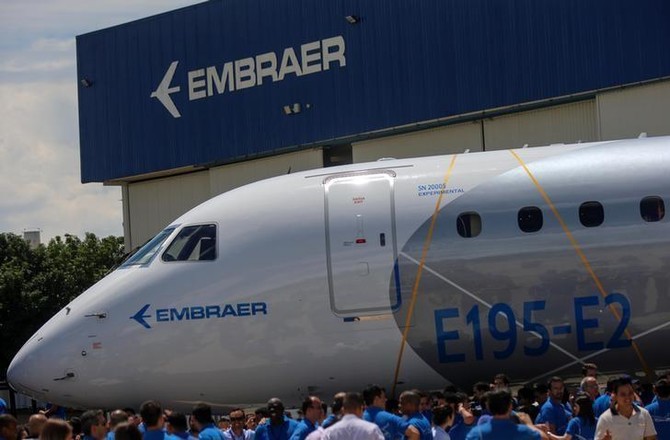
Boeing seen eyeing broad Embraer deal, but no firm proposal made
Boeing seen eyeing broad Embraer deal, but no firm proposal made


Latest updates





© 2026 SAUDI RESEARCH & PUBLISHING COMPANY, All Rights Reserved And subject to Terms of Use Agreement.