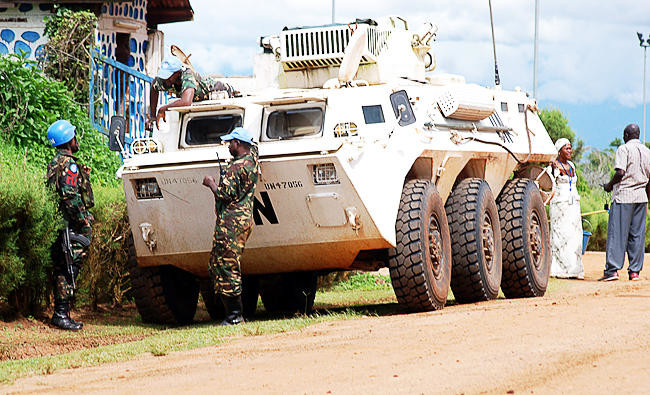
KAMPALA: Uganda’s army said Friday that it had launched attacks on a shadowy rebel group in the eastern Democratic Republic of Congo (DR Congo), where the militants killed 14 UN peacekeepers earlier this month.
“Shared intelligence between Uganda and the DR Congo confirmed that the Allied Democratic Forces (ADF) terrorists which recently carried out attacks on UN peacekeepers... were planning to conduct hostile activities against Uganda,” the army said in a statement.
“In a pre-emptive move, this afternoon UPDF (Ugandan People’s Defense Force) conducted attacks on their camps in Eastern DRC.”
The ADF, a Ugandan rebel group dominated by Muslim militants operating in the DR Congo, was behind an attack that left 14 Tanzanian peacekeepers dead two weeks ago, according to the UN.
The ADF started out with the aim of overthrowing Uganda’s President Yoweri Museveni, who was seen as hostile to Muslims. But it went on to absorb other rebel factions and started carrying out attacks in 1995.
Gradually pushed westwards by the Ugandan army, the ADF relocated most of its activities to the DR Congo.
It was also blamed for an ambush on UN peacekeepers in eastern DR Congo in October, which killed two peacekeepers and wounded 12.
It has also been accused by Kinshasa and the UN peacekeeping mission MONUSCO of killing more than 700 people in the Beni region since October 2014.
Kinshasa has insisted on a militant motive to the killings, but many observers and experts say that there has been no proven link with the global militancy underground, and that this is a “simplistic” explanation for their acts.
Many ADF recruits — drawn from Tanzania, Burundi, Kenya and as far as Somalia — are young Muslims.
A group run by US researcher Jason Stearns published a report claiming that several distinct groups “appear to be involved in the massacres,” including soldiers from the regular army.
The government rejected the claims and Stearns was expelled from the DR Congo after the report’s release.
Beni’s Mayor Bwanakawa Nyonyi told AFP last year that he believed the massacres were carried out by a nebulous group, with politically motivated “Congolese hands” behind them.
In explaining the violence, some have cited struggles for control of trafficking in various industries like timber, agricultural produce or minerals in a region with extremely rich resource potential.

Ugandan army says it attacked rebel camps in DR Congo

Australian bushfires raze homes in two states; firefighter dies
- Sixteen homes lost on Central Coast region in New South Wales
- Tasmania 700-hectare blaze destroys 19 homes at Dolphin Sands
SYDNEY/WELLINGTON: An Australian firefighter was killed overnight after he was struck by a tree while trying to control a bushfire that had destroyed homes and burnt large swathes of bushland north of Sydney, authorities said on Monday.
Emergency crews rushed to bushland near the rural town of Bulahdelah, 200 kilometers north of Sydney, after reports that a tree had fallen on a man. The 59-year-old suffered a cardiac arrest and died at the scene, officials said.
Prime Minister Anthony Albanese said the “terrible news is a somber reminder” of the dangers faced by emergency services personnel as they work to protect homes and families.
“We honor that bravery, every day,” Albanese said in a statement.
A fast-moving fire over the weekend destroyed 16 homes in New South Wales state’s Central Coast region, home to about 350,000 people and a commuter region just north of Sydney.
Resident Rouchelle Doust, from the hard-hit town of Koolewong, said she and her husband tried to save their home as flames advanced.
“He’s up there in his bare feet trying to put it out, and he’s trying and trying, and I’m screaming at him to come down,” Doust told the Australian Broadcasting Corp.
“Everything’s in it: his grandmother’s stuff, his mother’s stuff, all my stuff — everything, it’s all gone, the whole lot.”
Conditions eased overnight, allowing officials to downgrade fire danger alerts, though the weather bureau warned some inland towns in the state could hit more than 40 degrees Celsius (104 Fahrenheit) on Tuesday, raising fire dangers.
More than 50 bushfires were burning across New South Wales as of Monday.
On the island state of Tasmania, a 700-hectare blaze at Dolphin Sands, about 150km northeast of the state capital of Hobart, destroyed 19 homes and damaged 40. The fire has been contained, but residents have been warned not to return as conditions remain dangerous, officials said.
Authorities have warned of a high-risk bushfire season during Australia’s summer months from December to February, with increased chances of extreme heat across large parts of the country following several relatively quiet years.
New Zealand national park fire
In neighboring New Zealand, five helicopters and multiple crews were working to put out a fire near the country’s oldest national park, a month after a wildfire burnt through 2,589 hectares of alpine bush there.
Police said they had closed a road near the state highway and advised motorists to avoid the area and expect delays, after the blaze near Tongariro National Park, a popular hiking spot, spread to 110 hectares by Monday afternoon.
Emergency crews rushed to bushland near the rural town of Bulahdelah, 200 kilometers north of Sydney, after reports that a tree had fallen on a man. The 59-year-old suffered a cardiac arrest and died at the scene, officials said.
Prime Minister Anthony Albanese said the “terrible news is a somber reminder” of the dangers faced by emergency services personnel as they work to protect homes and families.
“We honor that bravery, every day,” Albanese said in a statement.
A fast-moving fire over the weekend destroyed 16 homes in New South Wales state’s Central Coast region, home to about 350,000 people and a commuter region just north of Sydney.
Resident Rouchelle Doust, from the hard-hit town of Koolewong, said she and her husband tried to save their home as flames advanced.
“He’s up there in his bare feet trying to put it out, and he’s trying and trying, and I’m screaming at him to come down,” Doust told the Australian Broadcasting Corp.
“Everything’s in it: his grandmother’s stuff, his mother’s stuff, all my stuff — everything, it’s all gone, the whole lot.”
Conditions eased overnight, allowing officials to downgrade fire danger alerts, though the weather bureau warned some inland towns in the state could hit more than 40 degrees Celsius (104 Fahrenheit) on Tuesday, raising fire dangers.
More than 50 bushfires were burning across New South Wales as of Monday.
On the island state of Tasmania, a 700-hectare blaze at Dolphin Sands, about 150km northeast of the state capital of Hobart, destroyed 19 homes and damaged 40. The fire has been contained, but residents have been warned not to return as conditions remain dangerous, officials said.
Authorities have warned of a high-risk bushfire season during Australia’s summer months from December to February, with increased chances of extreme heat across large parts of the country following several relatively quiet years.
New Zealand national park fire
In neighboring New Zealand, five helicopters and multiple crews were working to put out a fire near the country’s oldest national park, a month after a wildfire burnt through 2,589 hectares of alpine bush there.
Police said they had closed a road near the state highway and advised motorists to avoid the area and expect delays, after the blaze near Tongariro National Park, a popular hiking spot, spread to 110 hectares by Monday afternoon.
© 2025 SAUDI RESEARCH & PUBLISHING COMPANY, All Rights Reserved And subject to Terms of Use Agreement.