Peru president defeats bid to oust him by 8 votes in Congress

1 / 3
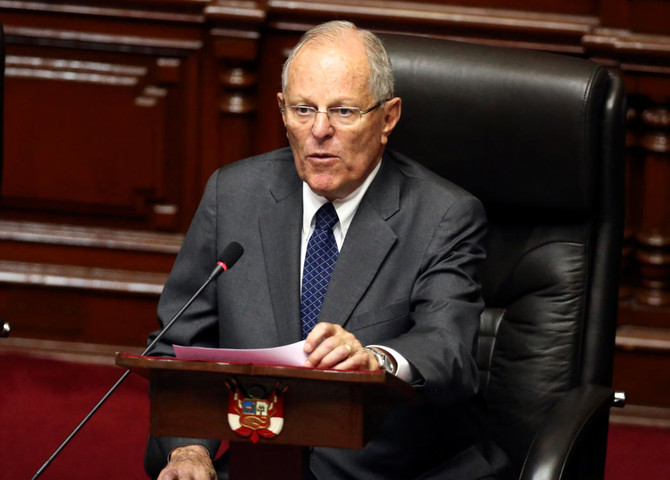
Peru’s President Pedro Pablo Kuczynski makes final remarks to lawmakers of the opposition-ruled Congress, in Lima, Peru December 21, 2017. (Reuters)
2 / 3
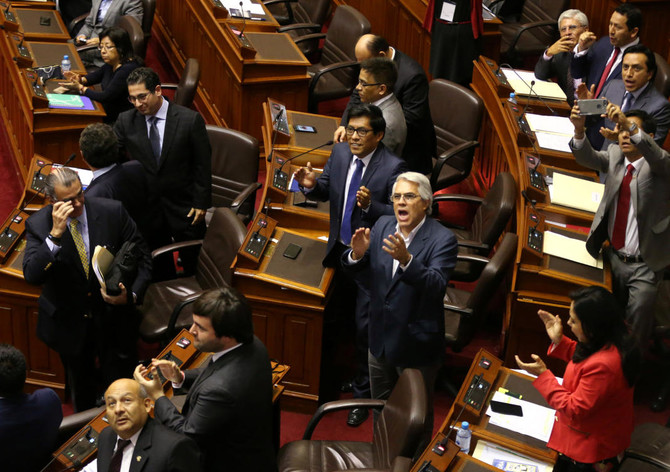
Lawmakers supporting Peru’s President Pedro Pablo Kuczynski celebrate after Kuczynski defeated an opposition bid to force him from power in Congress in Lima, Peru, December 21, 2017. (Reuters)
3 / 3
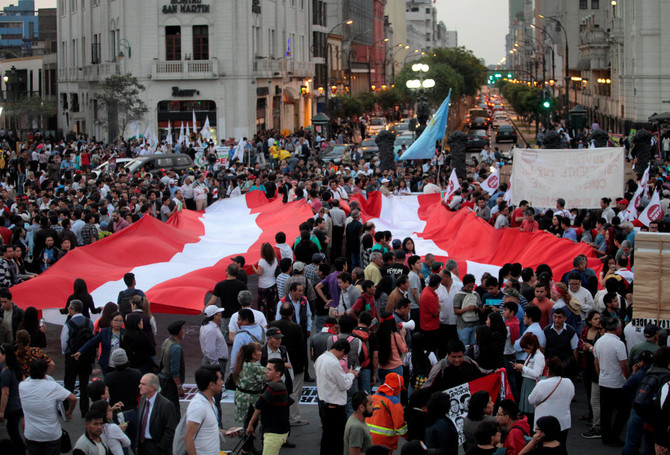
People protest against the Congress after it passed a motion to remove Peruvian President Pedro Pablo Kuczynski from office in Lima, Peru, December 20, 2017. (Reuters)
Updated 22 December 2017
Follow

Peru president defeats bid to oust him by 8 votes in Congress

LIMA: Peruvian President Pedro Pablo Kuczynski pulled off a surprise victory against the opposition’s bid to force him from power as a graft scandal rocks Latin America, with a motion in Congress falling eight votes short of the 87 needed to oust him.
Before hours of debate in Congress, Kuczynski called on lawmakers to set aside his defects to help defend Peru’s democracy from what he deemed a hasty “coup” attempt staged by the right-wing opposition Popular Force party.
Popular Force, which emerged under an authoritarian movement in the 1990s, sought to remove Kuczynski from office on grounds he was “morally unfit” to govern after discovering his past business connections to a company at the center of the region’s biggest graft scandal.
Kuczynski survived thanks to 19 votes against the motion, 21 abstentions and another 10 lawmakers who failed to show up. A motion to start the “presidential vacancy” proceedings passed with 93 votes last week.
The final vote — widely unexpected just a few days ago — capped a week of intense political uncertainty in the world’s second-biggest copper producer and one of Latin America’s most stable and robust economies.


26 Doctors without Borders workers remain unaccounted for in South Sudan a month after attacks

Updated 4 sec ago
Follow

26 Doctors without Borders workers remain unaccounted for in South Sudan a month after attacks

  • A hospital in the town of Lankien was bombed by government forces, MSF said
  • “We have lost contact with them amid ongoing insecurity”

NAIROBI: More than two dozen Doctors Without Borders workers remain unaccounted for a month after attacks in South Sudan, the medical charity said.
Two facilities belonging to the group, known by French acronym MSF, were attacked on Feb. 3 in Jonglei State, northeast of the capital, Juba, where violence has displaced an estimated 280,000 people since December.
A hospital in the town of Lankien was bombed by government forces, MSF said, while another medical facility in the town of Pieri was raided by “unknown assailants.” Both were located in opposition-held areas.
Staff working at the two facilities fled alongside much of the local population into deeply rural areas where armed clashes and aerial bombardments were ongoing.
MSF said in a statement on Monday that “26 of 291 of our colleagues working in Lankien and Pieri remain unaccounted for.
“We have lost contact with them amid ongoing insecurity,” it said.
The lack of communication with its staff could be linked to the limited network connectivity in much of the state. Staff members who had been contacted described “destruction, violence and extreme hardships.”
Fighting escalated sharply in December, when opposition forces captured a string of government outposts in north central Jonglei. In January, the government responded with a counteroffensive that recaptured most of the area it had lost.
Displaced people in Akobo, an opposition-held town near the Ethiopian border, described horrific violence by government fighters. Many described not being able to find food or water as they walked for days to reach safety.
The attacks on MSF facilities in Lankien and Pieri are part of an uptick in violence on humanitarian staff, supplies and infrastructure, aid groups say. MSF facilities have been attacked 10 times in the last 12 months.
“This violence has taken an unbearable toll not only on health care services, but on the very people who kept them running,” said Yashovardhan, MSF head of mission in South Sudan, who only uses one name.
“Medical workers must never be targets,” he said. “We are deeply concerned about what has happened to our colleagues and the communities we serve.”