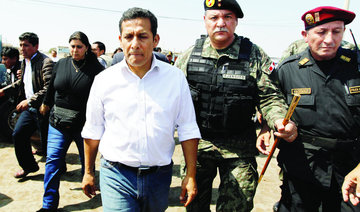
LIMA: Peru’s opposition-controlled Congress ousted center-right President Pedro Pablo Kuczynski’s cabinet in a vote of no-confidence early on Friday, pitching the copper-producing Andean country into its worst political crisis in years.
In a gamble that will likely force him to scrap his plans to travel abroad later in the day, Kuczynski had dared Congress on Wednesday to revoke its confidence in his cabinet if it insisted on forcing out his second education minister.
Under Peru’s constitution, if Congress does not deliver a president a vote of confidence for his cabinets twice, the president can summon new legislative elections.
But the rightwing populist opposition party Popular Force, led by Kuczynski’s defeated electoral rival, Keiko Fujimori, answered Prime Minister Fernando Zavala’s request on Thursday to back his cabinet with a resounding ‘no.’
Peru’s single-chamber Congress, where Popular Force has an absolute majority, voted 77-22 to dismiss Zavala’s cabinet.
Kuczynski now has 72 hours to swear in a new cabinet. While he cannot name Zavala as prime minister again, Kuczynski can reappoint other ministers in his cabinet.
Going forward, Kuczynski might have a freer hand to govern in the remaining four years of his term if the opposition steers clear of a fresh confrontation out of fear of losing its majority.
But several opposition lawmakers said they would welcome taking the battle to the ballot box.
“If they close Congress, we’re not afraid,” said Hector Becerril, a hard-line Popular Force lawmaker. “We’re willing to seek the people’s support again. And it won’t be 13 seats we win, or 73. There’ll be 100 of us!”
The vote came on the eve of Kuczynski’s 8-day trip abroad, which includes plans for dinner with US President Donald Trump on Monday, a speech before the UN General Assembly on Tuesday and a meeting with Pope Francis in the Vatican.
Kuczynski, a 78-year-old former Wall Street banker who has vowed to modernize Peru and revive economic growth, took office a year ago with one of the weakest mandates of any president, having beat Fujimori by a razor-thin margin while his party only secured a small portion of seats in Congress.
In a plenary debate that stretched on for more than seven hours, opposition lawmakers portrayed Kuczynski as an out-of-touch lobbyist who lacks authority and poses a danger to Peru.
Congress has forced Kuczynski’s former education and finance ministers to resign amid allegations of ethical breaches, while a third minister quit to avoid being censured.
Popular Force announced this week that it planned to propose censuring Education Minister Marilu Martens over her handling of a teachers’ 2-month strike, which her supporters alleged was fueled by an alliance between Popular Force and extremists.
“We can’t deliver the head of a minister as a trophy,” Zavala told lawmakers after walking to Congress with the rest of the cabinet in a show of union. “It’s clear to us that the country can’t make progress like this.”

Peru’s Congress ousts cabinet as political crisis deepens
US Justice Department official eyes cases against Cuba leaders as Trump floats ‘friendly takeover’
- “Working group” formed to build cases against people connected to the Cuban government
- Trump’s has increasingly displayed aggressive stance against Cuba’s communist leadership
MIAMI: The top Justice Department prosecutor in Miami is considering criminal investigations of Cuban government officials, according to people familiar with the matter. The inquiry comes as President Donald Trump has raised the possibility of a “friendly takeover” of the communist-run island.
Jason Reding Quiñones, the US attorney for the Southern District of Florida, has created a “working group” that includes federal prosecutors and officials from the Drug Enforcement Administration and other agencies to try to build cases against people connected to the Cuban government and its Communist Party, according to one of the people. They spoke on the condition of anonymity because they were not authorized to publicly discuss the effort.
It was not immediately clear which Cuban officials the office is targeting or what criminal charges prosecutors may be looking to bring.
The Justice Department said in a statement Friday that “federal prosecutors from across the country work every day to pursue justice, which includes efforts to combat transnational crime.”
The effort is taking place against the backdrop of Trump’s increasingly aggressive stance against Cuba’s communist leadership.
Emboldened by the US capture of Cuba’s close ally, Venezuelan President Nicolás Maduro, Trump last month said his administration was in high-level talks with officials in Havana to pursue “a friendly takeover” of the country. He repeated those claims this week, saying his attention would turn back to Cuba once the war with Iran winds down.
“They want to make a deal so bad,” Trump said of Cuba’s leadership.
While Cuba has faded from Washington’s radar as a major national security threat in recent decades, it remains a priority in the US Attorney’s office in Miami, whose political, economic and cultural life is dominated by Cuban-American exiles.
The FBI field office has a dedicated Cuba group that in 2024 was instrumental in the arrest of former US Ambassador Victor Manuel Rocha on charges of serving as a secret agent of Cuba stretching back to the 1970s.
In recent weeks, several Miami Republicans, in addition to Florida Sen. Rick Scott, have called on the Trump administration to reopen its criminal investigation into the 1996 shootdown of four planes operated by anti-communist exiles.
In a letter to Trump on Feb. 13, lawmakers including Reps. Maria Elvira Salazar and Carlos Gimenez highlighted decades-old news reports indicating that former President Raúl Castro — the head of Cuba’s military at the time — gave the order to shoot down the unarmed Cessna aircraft.
“We believe unequivocally that Raúl Castro is responsible for this heinous crime,” lawmakers wrote. “It is time for him to be brought to justice.”
While no indictment against Castro has been announced, Florida’s attorney general said this week that he would open a state-level investigation into the crime.
The Trump administration has also accused Cuba of not cooperating with American counterterrorism efforts, adding it alongside North Korea and Iran to a select few nations the US considers state sponsors of terrorism.
The designation stems from Cuba’s harboring of US fugitives and its refusal to extradite several Colombian rebel leaders while they were engaged in peace talks with the South American nation.