Pakistan currency plunge stokes inflation fears

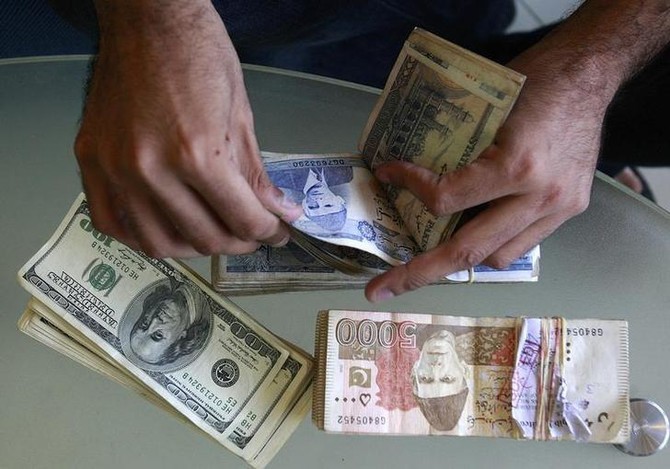
A currency dealer counts Pakistani rupees and U.S. dollars at his shop in Karachi October 8, 2008. (REUTERS)
Updated 21 December 2017
Follow

Pakistan currency plunge stokes inflation fears

ISLAMABAD: Pakistan is bracing for the impact of the sharp decline of its currency against the dollar – sparking fears of punishing inflation.
The weakening rupee, which now trades at about 110 against the greenback, will increase prices in Pakistan as the cost of imports rises.
“Firstly, the devaluation can increase the debt burden of foreign loans and make the servicing more difficult. Secondly, the rise in cost of imports can increase the inflation rate in the economy,” researcher Hafiz Abdul Qadoos of the Institute of Public Policy, told Arab News.
Last week, the International Monetary Fund (IMF) mission to Pakistan appreciated the State Bank’s (SBP) adjustment to the currency exchange but advised that the Rupee must remain flexible moving forward.
The IMF rejected suggestions that it played a role in SBP’s decision in devaluating the currency.
IMF Mission Chief to Pakistan Harald Finger, said: “The government’s biggest challenge is political uncertainty. The second biggest challenge for Pakistan has been maintaining foreign exchange reserves. To contain the fiscal deficit has been the third biggest challenge for Pakistan.”
He said that under current reserve positions, Pakistan does not require borrowing from IMF.
However, some experts believe that Pakistan might go back to the IMF by August or September 2018 – despite floating Eurobonds and Sukuk (Islamic bonds) worth $2.5 billion recently and increasing the regulatory duty on imports.
Former Finance Minister and ex-Vice President of World Bank, Shahid Javed Burki explained that
the currency had been under pressure for several years
“The rupee was under pressure as the country was losing its export markets to other low-income exporters, most notably Bangladesh and Vietnam.”
He added that the rate of inflation in Pakistan was much higher than that in its main export markets such as the US.


Saudi-French cooperation to localize veterinary vaccine manufacturing

Updated 17 February 2026
Follow

Saudi-French cooperation to localize veterinary vaccine manufacturing

RIYADH: In the presence of sector leaders, the National Livestock and Fisheries Development Program signed a memorandum of understanding with French company Ceva under the patronage of Minister of Environment, Water and Agriculture Abdulrahman bin Abdulmohsen Al-Fadhli, who also chairs the program’s board.

The agreement aims to localize vaccine manufacturing, transfer technology and technical expertise, and expand the industrial and commercial production of veterinary vaccines across the Kingdom.

According to the MoU, the two parties will work to achieve high efficiency in mass production scale-up and establish a clear path for sustainable commercial operation that meets the needs of the local and national market, as well as strengthen the biosecurity and food security system.

The MoU also includes the development and modernization of messenger RNA vaccine technologies, along with joint research and development of a Middle East Respiratory Syndrome vaccine for camels. This involves designing, evaluating, and developing vaccines specifically tailored to combat the virus.

The agreement also covers the development of a rabies vaccine and related solutions, as well as supporting national efforts to control the disease through vaccine provision, capacity building, and the implementation of integrated prevention strategies.

The collaboration between the program and Ceva aims to meet the needs of the poultry vaccine market in the Kingdom, currently estimated at around SR750 million ($199 million).

The company will work to cover approximately 30 percent of this market with an initial investment of around SR250 million.

With continued government support for poultry projects and increased production in the sector, the market is expected to grow at a rate exceeding 10 percent annually, reaching approximately SR1.25 billion by 2030.

The addition of the world’s leading poultry vaccine manufacturer to Biotech Park highlights the program’s key role in developing new industries within the livestock and fisheries sector.

It also highlights the program’s commitment to building international partnerships with global companies, organizations, research centers, and universities to support advanced biotechnology industries and attract high-quality investments. It also seeks to create new economic sectors based on biotechnology, enhance veterinary health security, and support the sustainable economic development of the livestock sector, as well as empower national and emerging companies and provide advanced research and industrial infrastructure.

This will solidify the Kingdom’s position as a global hub for biotechnology industries and the development of national capabilities.

Ceva is the first international partner to join Biotech Park, the future veterinary biotechnology city launched by the program in Dhurma Governorate. The city is the world’s first specialized and fully integrated hub for veterinary biotechnology, serving as a benchmark for sector development and a platform supporting markets across the Kingdom, the Gulf, the Middle East, Africa and beyond.

The signing of Ceva is a significant step, given its position as the world’s leading manufacturer of poultry vaccines and medicines, and one of the most prominent international companies in the field of biotechnology.

The MoU aims to localize the veterinary vaccine industry, ensuring its compatibility with the strains of poultry diseases prevalent in Saudi Arabia. This includes the transfer of technology and technical expertise from Ceva, along with the implementation of specialized training programs to guarantee that manufacturing facilities comply with international Good Manufacturing Practice standards.