LONDON: In May 2015, when Peter Moores was sacked after England’s cricketers had blundered their way through another World Cup campaign, there were two leading contenders for the job. Jason Gillespie, once part of Steve Waugh’s all-conquering Australian side, had helped Yorkshire to a first County Championship in 13 years, and was on the way to retaining the title. The other candidate, Trevor Bayliss, had an impeccable resume for limited-overs cricket.
He had taken Sri Lanka to the final of both the World Twenty20 (2009) and the World Cup (2011), and had won the Indian Premier League (IPL) twice with the once-dysfunctional Kolkata Knight Riders. Back home, Bayliss won the Big Bash League with the Sydney Sixers, who then went on to triumph at the Champions League Twenty20 as well. And just to illustrate that there was more to him than white-ball nous, Bayliss won the Sheffield Shield twice with New South Wales.
The choice for English cricket’s decision-makers was a straightforward one. Gillespie had become an insider of sorts, someone with an intimate knowledge of the county scene and its players. At the highest level, however, he was untested. Bayliss was not. He has been there, done that, and then done some more.
With the England and Wales Cricket Board (ECB) certain that the sport’s future lay in attracting more young players and fans to the white-ball formats, Bayliss became the obvious choice. Gillespie did win that second title, and then nearly a third, before returning home to Australia.
The upswing in England’s limited-overs fortunes has vindicated the ECB. Where other teams had floored the pedal during the World Cup campaign, England went through the competition with the handbrake on. Bayliss soon fixed that, empowering the players to go out and express themselves. England have a 34-15 win-loss record in 52 ODIs since he was appointed, and a 12-9 record in the T20 format.
They reached the final of the World Twenty20 in 2016, when the manner in which they overhauled a huge South Africa total of 229 in one of the group games spoke volumes of the mindset change that Bayliss had helped bring about. On home soil for the Champions Trophy in 2017, they romped through the league phase before coming unstuck against an inspired Pakistan in the semifinal.
The white ball is not a problem. The red ball is. In 36 Tests that he has presided over, England have lost 17 and won only 15. Apart from this Ashes debacle, there was the 4-0 drubbing in India last winter, and Test losses to Bangladesh and West Indies, who languish at the bottom of the pile.
There have been some notable victories, especially home and away against South Africa. But away from seam-friendly surfaces, where raw pace, spin and reverse swing come into play, England have been no match for the opposition. Bayliss’s admission after Perth, that he had no answers, was admirably forthright, but it would not have pleased his employers.
Far removed from the county circuit, which has already been weakened by a decade of ECB tweaks, Bayliss is no technical genius like Duncan Fletcher either. Part of the reason for England’s plight has been the inability of the batting group to post big scores. In those 36 Tests, there have been just 25 hundreds.
In that same period, Steve Smith alone has scored 14 in 33 Tests, while his teammates have accounted for another 30. India have tallied 46 centuries in 31 Tests, with Virat Kohli scoring 10 of them. England may well beat both Australia and India in seam-friendly conditions, but batsmen and bowlers alike struggle when confronted by harder, drier surfaces. Unfortunately for England, the vast majority of cricket is played in such conditions.
If Bayliss continues to be lost for answers, it is time the ECB started asking harder questions.


England coach Trevor Bayliss might be best to stick to white-ball cricket
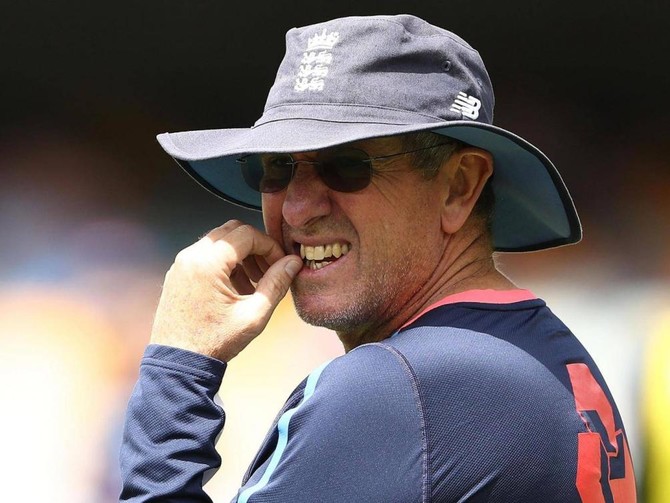
England coach Trevor Bayliss might be best to stick to white-ball cricket



Africa Cup of Nations moved to every four years
- The tournament, which brings in an estimated 80 percent of CAF’s revenue, has traditionally been held every two years since its inception in 1957
RABAT: The Africa Cup of Nations will in future be held every four years instead of every two years, the Confederation of African Football said on Saturday.
The surprise decision was made at the body’s executive committee meeting in the Moroccan capital and announced at a press conference by CAF President Patrice Motsepe.
The tournament, which brings in an estimated 80 percent of CAF’s revenue, has traditionally been held every two years since its inception in 1957.
Sunday marks the start of the 35th edition, hosted in Morocco with the home team taking on Comoros.
Motsepe said the next Cup of Nations finals, scheduled for 2027 in Kenya, Tanzania and Uganda, will go ahead and then another tournament would be held in 2028 but after that it will be hosted every four years.
Motsepe announced the launch of an African Nations League annually from 2029 to fill the gap, following the example of Europe which holds its championship every four years.
“Historically the Nations Cup was the prime resource for us but now we will get financial resources every year,” he said.
“It is an exciting new structure which will contribute to sustainable financial independence and ensure more synchronization with the FIFA calendar.”
Holding the Cup of Nations every four years had been previously proposed by FIFA President Gianni Infantino but this had been rebuffed by CAF because of their reliance on the revenues that the tournament generates.
The timing of AFCON has long courted controversy because it has usually been hosted in the middle of the European season, forcing clubs to release their African players.
This tug of loyalty was supposed to be solved by moving the Cup of Nations to mid-year from 2019 but later tournaments in Cameroon in 2022 and Ivory Coast in 2024 were again hosted at the start of the year.
This year’s tournament in Morocco was moved back six months when FIFA introduced a new-look Club World Cup, which was hosted in the US in June and July.


