Catalonia: Compromise is still the answer

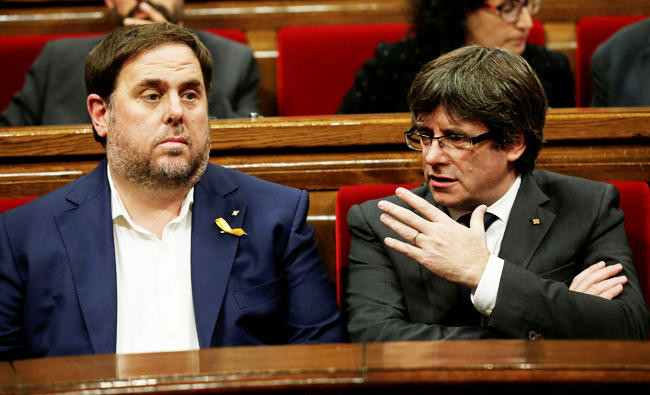
Catalan President Carles Puigdemont (R) talks to Catalan Vice President Oriol Junqueras at the start of a session at the Catalan regional Parliament in Barcelona, Spain, in this October 26, 2017 photo. (REUTERS)
Updated 18 December 2017
Follow

Catalonia: Compromise is still the answer

BARCELONA: A decisive victory in Thursday’s Catalan elections by either the pro-Spanish or separatist blocs seems unlikely, so eventually some sort of compromise allowing greater Catalonia autonomy may have to be found.
“Philosopher Ortega y Gasset said you can’t resolve the Catalan question; you have to live with it,” said Jorge San Miguel Lobeto, a political scientist and adviser to the unionist Ciudadanos party.
“The best we can expect in the short term is to go back to a pre-crisis situation where separatists still push for independence, promote their language, but they’re not breaking the law and aren’t being disloyal to the Madrid government daily.”
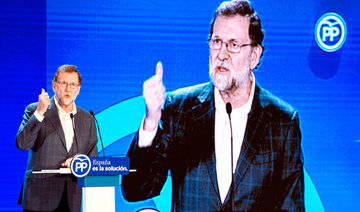
Spain’s ruling People’s Party has denounced Catalan separatists. Campaigning under the slogans of “Spain is the solution,” and “The solution is PP,” Prime Minister Mariano Rajoy and his cohorts warn they will again suspend Catalonia’s semi-autonomy should separatist parties achieve a parliamentary majority.
“Rajoy has long faced demands from the Spanish right-wing to take a tough stance on Catalonia, so he did so even though he knows it’s a flawed approach because ultimately some kind of compromise will be needed to solve the problem in the long term,” said Juan Rodriguez Teruel, professor of political sciences at the University of Valencia.
“If separatist parties maintain their current support or even expand it, the first political victim will probably be Rajoy, because critics from within the PP and its opponents like Cuidadanos, which have been very tough on this issue, will blame him.”
With the vote too close to call and having blundered in declaring independence in October – a move that highlighted the separatists’ inability to break unilaterally from Spain – pro-independence parties were equivocal when asked what will happen post-election.
“The results of the new elections are crucial to re-open political negotiations with the Spanish government,” said Jordi Xucla, a spokesman for Junts per Catalunya.
Leftist Esquerra Republicana de Catalunya, whose former president Lluis Companys was executed by Spanish fascists in 1940, indicated it would push Madrid to agree to a legally binding referendum should voters return another pro-independence majority.
“Let’s hope the democratic responsibility of the Spanish state will push it to open a real democratic dialogue,” said spokesman Ernest Maragall.


Ireland’s defense gaps exposed as EU presidency nears

Cathal Berry, former Irish army special forces member, on The Curragh plain. (AFP)
Updated 7 sec ago
Follow

Ireland’s defense gaps exposed as EU presidency nears

  • Militarily neutral Ireland is not a NATO member, yet its waters — seven times its landmass — account for around 16 percent of the EU’s total

THE CURRAGH: Sheep amble around steel fences skirting Ireland’s largest military base on a grassy plain west of Dublin, a bucolic scene masking an underfunded defense force struggling with outdated equipment.

Ireland’s threadbare military and its long-standing policy of neutrality are under heightened scrutiny as the country prepares to assume the rotating EU presidency from July.

“Ireland is the only EU country with no primary radar system, nor have we sonar or anti-drone detection equipment — let alone the ability to disable drones,” said former Irish special forces member Cathal Berry.

“We can’t even monitor the airspace over our capital city and main airport,” he said as he surveyed Ireland’s main military base at The Curragh.

Militarily neutral Ireland is not a NATO member, yet its waters — seven times its landmass — account for around 16 percent of the EU’s total.

Nearly three-quarters of transatlantic subsea cables run close to or beneath them.

But the Irish army numbers only a few thousand troops, is focused largely on UN peacekeeping missions and has neither a combat air force nor a sizeable navy.

Ireland’s annual defense spending of roughly €1.2 billion is the lowest in Europe at around 0.2 percent of the GDP, well below the EU average of 1.3.

“Neutrality itself is actually a fine policy. If you want to have it, it must be defended,” said retired Irish army colonel Dorcha Lee.

“That’s the whole point. Undefended neutrality is absolutely definitely not the way to go.”

Berry points to a long-standing “complacency” about defense in Ireland that has fueled a vacuum in debate over neutrality and military spending.

“If you wanted to squeeze the EU without any risk of NATO retaliation, Ireland is where you’d come,” he said, adding that also applied to US interests in Europe.

US tech giants like Google, Apple and Meta have their European headquarters in Ireland, supported by vast data centers that analysts say are vulnerable to cyberattacks.

European Council President Antonio Costa said he was still “confident” Ireland could protect EU summits during its presidency.

Defense Minister Helen McEntee has pledged that new counter-drone technology will be in place by then.

Speaking in front of a row of aging army vehicles at the Curragh military site, she also announced a broader increase in military spending, although the actual details remain unclear.

On Dec. 17, the Irish government said it plans to buy a military radar system from France at a reported cost of between €300 and €500 million (around $350-$585 million).

For Paul Murphy, a left-wing opposition member of parliament, “scaremongering over allegedly Russian drones with concrete evidence still unprovided” is

giving the government cover to steer Ireland away from neutrality toward NATO.

“But it’s more important than ever that we’re genuinely neutral in a world that is increasingly dangerous,” he told AFP.

Ireland has historically prioritized economic and social spending over defense investment, he said.

“Joining an arms race that Ireland cannot compete in would waste money that should be spent on real priorities like climate change,” he added.

Pro-neutrality sentiment still holds sway among the Irish public, with an Irish Times/Ipsos poll earlier this year finding 63 percent of voters remained in favor of it.

And very few voices in Ireland are calling to join NATO.

Left-winger Catherine Connolly, who won Ireland’s presidential election in October by a landslide, is seen as a pacifist.

“I will be a voice for peace, a voice that builds on our policy of neutrality,” she said in her victory speech.