

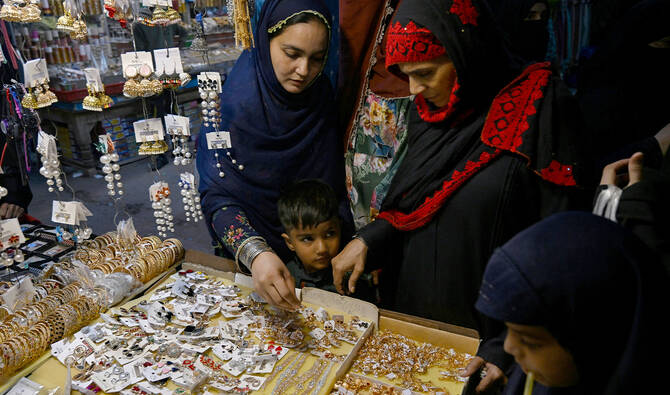

KARACHI: Women entrepreneurs in Pakistan’s commercial hub of Karachi say they are struggling through a subdued Eid shopping season as rising inflation dampens consumer spending and squeezes small businesses.
At the Gul Tijarah Shopping Mall (GTSM), a retail complex in Karachi, women traders say customer footfall has declined significantly while operating costs such as rent, inventory and transportation have increased, cutting festive sales by as much as 40% compared to last year.
The economic strain has deepened after Pakistan last week raised petrol and diesel prices by Rs55 per liter (about $0.20) as global oil prices surged following the conflict involving the United States, Israel and Iran. Petrol prices jumped to around Rs321 per liter, a rise of more than 20%, with officials warning the increase could push up transportation costs and the price of essential goods during the holy month of Ramadan and ahead of the Eid shopping season.
Economists say the surge in fuel costs is likely to add fresh pressure on household budgets and small businesses already grappling with rising food and utility bills.
“Compared to last year, about 60% of customers are coming while 40% are not,” Benazir Nawab, 27, who sells shoes, jewelry, gift items, toys, garments and home décor items, told Arab News when asked whether inflation was keeping customers away.
“There is a significant impact,” she said, citing an increase in her traveling and overall expenses. “If we look at rent and other costs, everything becomes more expensive.”
Pakistan was already grappling with high living costs in recent years following an economic crisis marked by soaring inflation, currency depreciation and rising energy prices. The Pakistan Bureau of Statistics (PBS) last month reported consumer price inflation at 7 percent, up from 5.8 percent in January and the highest level in 16 months, driven largely by higher electricity tariffs and food prices.
Women make up nearly half of Pakistan’s population of more than 240 million, yet they remain significantly underrepresented in the country’s formal economy. According to World Bank and government data, fewer than 5% of women participate in formal entrepreneurship, with many operating small businesses in the informal sector.
The International Labour Organization said last year that Pakistan’s female employment rate stood at 23% as of 2021, while women accounted for only 13.5% of wage employees.
At GTSM, which houses more than 400 shops, about 20 outlets are run by women who manage their businesses themselves, according to the mall’s president, Yousuf Memon.
Seema Ali, who sells women’s shoes under the brand name “Bloom Aura Collection,” said rising prices have significantly increased her business costs.
“When we purchase things from wholesalers, their rates are very inflated,” she said.
“If we buy a piece for Rs1,000 ($3.6) and if we are selling it with a margin of Rs100 ($0.4) or Rs50 ($0.2), then the customers ask us how we can sell it at such a high price.”
“QUITE SLOW”
Inflation has been a key concern for Prime Minister Shehbaz Sharif’s government and the International Monetary Fund (IMF), which is supporting Pakistan under a $7 billion loan program approved in September 2024. The IMF has urged Pakistan’s central bank to maintain an “appropriately tight” monetary policy to keep inflation under control.
The State Bank of Pakistan expects inflation to exceed its medium-term target range of 5–7% for several months this year.
Ali said inflation had risen “beyond limits” in Pakistan.
“Normally, no one can afford anything,” the 36-year-old said.
For some entrepreneurs, the slowdown has been visible in daily business activity during the normally busy pre-Eid shopping weeks.
Hifsa Fahad, a science graduate who previously worked as a teacher before starting a small business customizing bouquets, chocolates and jewelry items, said commercial activity had slowed noticeably.
“Last season, we did not even have time to rest,” she said. “Now after around 12-12:30 am we close. The season is quite slow this time.”
Fahad said inflation had reduced consumers’ ability to spend on non-essential items.
“People are struggling to manage their households,” she said, before asking: “How will they manage other things?”
‘STAND ON YOUR OWN FEET’
Despite the challenges, the women say running businesses has become increasingly important as households cope with rising living costs.
“In today’s time it is necessary. Earlier women used to sit at home and light the stove. They used to make Roti (bread) and raise their children,” Ali told Arab News.
“I have opened a small business, and now earning for my children.”
Fahad said rising economic pressures mean families increasingly rely on multiple earners.
She encouraged other women to pursue economic independence, particularly during difficult times.
“Stand on your own feet and encourage others as well,” Fahad said. “Also tell people not to suppress their daughters but to support them and help them move forward.”


