Rovaniemi, Finland: In the run-up to Christmas, tourists from around the world flock to the Santa Claus Village, an amusement park in Finnish Lapland, where temperatures can hit nearly -15 degrees Celsius (5 Fahrenheit).
They buy soft toys and souvenirs from pricey gift shops while a bearded Santa receives hundreds of admirers every day throughout December before embarking on his world tour from the valleys of Finland to the skyscrapers of New York and beyond to deliver gifts.
Holding their winter beanie hats in their hands, visitors wait patiently in line for a brief encounter with “Joulupukki” — the Finnish word for Santa Claus — and a photo opportunity in exchange for hard currency.
“We’ve seen other Santas but they weren’t the real one. But we’re told that is the real one,” said Mary Gleadall, an eight-year-old tourist from Southampton in the UK, visiting the amusement park with her parents, brother and sister.
According to Christmas lore, Santa lives in a secret place in the middle of the snowy pines of the North Pole. But the question is, where?
Since 2010, Rovaniemi, the capital of Finnish Lapland, has marketed itself as Santa’s “official home.”
Situated a few miles from the city, the Santa Claus Village is located in front of a huge gas station.
Tourists rush to cross the Arctic Circle, marked by a white line, to meet Santa Claus in his wooden home with a pointed roof.
But entering his private cottage is out of the question as Mother Claus is reportedly protective of their privacy.
In a large room, the white-bearded old man sits in an armchair next to a chest full of letters.
Each year, he receives more than 300,000 visitors, a deluge he embraces with humility.
“I’m very happy. I’m not exhausted but, of course, I get tired once in a while,” he said.
And how does Santa Claus regain his energy?
“I love to take nap every once and then. Fifteen minutes’ sleeping and then all is very good,” he said.
Shizuka Kawahara and Saki Itoi, Japanese tourists in their thirties, flew for more than 24 hours to hug Santa for a few seconds in a precious moment immortalized with a photograph taken by an elf.
The price for one shot starts at €30 ($35). Photographing with one’s own camera is forbidden as it would ruin the magic of the moment, says the staff of the house.
Four-year-old Harry Gleadall, Mary’s brother, approaches Santa without fear.
He quickly states his list of what he wants for Christmas: Transformers and some more transformers, before he skeptically shakes Santa’s hand.
“But what if it wasn’t the real Santa Claus?” Harry asks with concern.
Eager to set the record straight — and justify the long trip — his mother quickly assures him that the chubby red-clothed man is indeed the real deal.
After a tour around the shop which sells hand-made “Lapland” emblems and tons of souvenirs, the family is back in the village square, surrounded by wooden homes, Christmas carols piped out of nearby speakers.
In this winter wonderland, tourists have the opportunity to go on a reindeer sleigh ride.
A snow “safari” of 400 meters costs €14 per child and €18 per adult, an exotic experience for many foreigners who seek to discover the Arctic landscapes steeped in pink light.
The -13 degrees Celsius temperature does not discourage the plucky visitors bundled up in their ski suits.
“Everything that was told to me during childhood, it’s come true,” said Perpetua, a tourist from Dubai, describing the break from the year round desert climate as “heaven.”
“We expected magic and this is what we found,” added Max, an Italian tourist. “Everything seems to be magic — the lights, the place, everything here.”
But Miriana, a 24-year-old Italian on a university exchange program in southern Finland, was less convinced.
“The place is really nice. But I think nevertheless that it’s a bit commercial,” she said.
— AFP


![]()
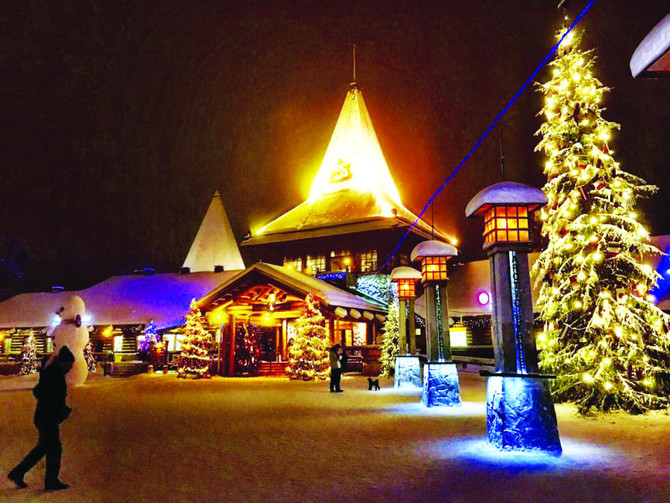
In Finnish Lapland, tourists cross the Arctic Circle to fill Santa’s sack with cash
In Finnish Lapland, tourists cross the Arctic Circle to fill Santa’s sack with cash
Latest updates


© 2026 SAUDI RESEARCH & PUBLISHING COMPANY, All Rights Reserved And subject to Terms of Use Agreement.