Daesh: What happened to all the foreign fighters?

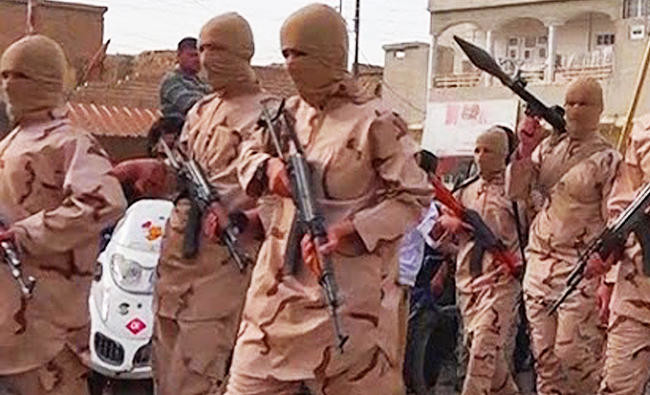
In this photo released on April 25, 2015 by a militant website, which has been verified and is consistent with other AP reporting, young boys known as the "caliphate cubs" hold rifles as they parade after graduating from a religious school in Tal Afar, near Mosul, northern Iraq. (AP)
Updated 17 December 2017
Follow

Daesh: What happened to all the foreign fighters?

WASHINGTON: An estimated 40,000 people traveled from around the world to take up arms for Daesh as it occupied territory in Syria and Iraq in 2014.
A few hundred are believed to still be fighting as Daesh struggles to survive, having lost most of its territory to campaigns by Western-backed Syrian and Iraqi coalition armies.
But what happened to the rest?
Many thousands were certainly killed in the intense fighting, but US experts believe many have survived, posing a formidable threat going ahead.
“The issue is: How many have died? How many are still there and willing to fight? How many have gone elsewhere to fight?” said Seth Jones, director of the International Security and Defense Policy Center at the Rand Corporation.
“How many have given up? I don’t think we have a good answer.”
International counterterror groups are putting huge efforts into answering those questions, working hard to name, count and track Daesh foreign fighters.
In France, officials say, around 1,700 people went to Iraq and Syria since 2013 to join Daesh. Of those, 400 to 450 have been killed, and 250 returned to France.
Foreign Affairs Minister Jean-Yves Le Drian said on Dec. 8 that about 500 are still in the Iraq-Syria theater, and for them it is now very hard to return to France.
But that leaves another 500 whose whereabouts are unknown, many of them with the skills of war, wielding weapons and making bombs.
Terrorism specialist Bruce Hoffman of Georgetown University estimated during a conference on Wednesday that “thousands” have escaped the war zone.
“Today, some of them are most likely in the Balkans, lying low for the time being, waiting for the opportunity to infiltrate themselves to the rest of Europe,” he said.
Some have traveled to other militant fronts, according to Thomas Sanderson, of the Center for Strategic and International Studies’ Transnational Threats Project.
For example, he said, at least 80 Daesh militants from Morocco, Russia and Yemen have joined since May the Daesh-allied Abu Sayyaf insurgents battling government forces in the southern Philippines.
Local people in the northern Afghanistan province of Jowzjan have told AFP that French-speaking Daesh veterans — from France or northern African countries — have recently set up camp there.
And they also have the option of other conflict zones in northern Africa, like Libya, Somalia, Yemen and elsewhere where militant groups akin to Daesh are conducting violent insurgencies.
The defeat of Daesh on the battlefield in Syria in Iraq did not close off escape routes. Daesh militants were able to blend in with civilian refugees or bribe their way to sneak into Turkey.
Many do not have much choice but to continue to fight: They never had a plan to return to their home countries, where they face imprisonment in most cases, according to Jones.
“For many, it was a one-way trip. They wanted to live in the caliphate, permanently. So we don’t see a major move back.”


UN declares famine over in Gaza, says ‘situation remains critical’

Updated 3 sec ago
Follow

UN declares famine over in Gaza, says ‘situation remains critical’

ROME: A famine declared in Gaza in August is now over thanks to improved access for humanitarian aid, the United Nations said on Friday, but warned the food situation in the Palestinian territory remained dire.
More than 70 percent of the population is living in makeshift shelters, it said, with hunger exacerbated by winter floods and an increasing risk of hypothermia as temperatures plummet.
Although a ceasefire between Israel and militant group Hamas that took effect in October has partially eased restrictions on goods and aid, delivery fluctuates daily and is limited and uneven across the territory, it said.
“No areas are classified in Famine,” said the Integrated Food Security Phase Classification Initiative (IPC), a coalition of monitors tasked by the UN to warn of impending crises.
But it stressed that “the situation remains critical: the entire Gaza Strip is classified in Emergency.”
The US-sponsored ceasefire halted two years of fighting, sparked by Hamas’s attack on Israel on October 7, 2023.
Yet the deal remains fragile as Israel and Hamas accuse each other almost daily of violations.
“Following the ceasefire... the latest IPC analysis indicates notable improvements in food security and nutrition compared to the August 2025 analysis, which detected famine,” the IPC said.
However, around 1.6 million people are still forecast to face “crisis” levels of food insecurity in the period running to April 15, it said.
And under a worst-case scenario involving renewed hostilities and a halt in humanitarian aid and commercial goods, the territories of North Gaza, Gaza Governorate, Deir Al-Balah and Khan Younis risk famine, it said.

’Alarmingly high’ -

The UN’s agencies said that despite the roll-back of famine, hunger, malnutrition, disease and the scale of agricultural destruction remains “alarmingly high.”
“Humanitarian needs remain staggering, with current assistance addressing only the most basic survival requirements,” the food, agriculture, health, and childrens’ agencies said in a joint statement.
“Only access, supplies and funding at scale can prevent famine from returning,” they said.
The UN’s declaration of famine in August — the first time it has done so in the Middle East — infuriated Israel, with Prime Minister Benjamin Netanyahu slamming the IPC report as “an outright lie.”
On Friday, foreign ministry spokesman Oren Marmorstein said on X that faced with “overwhelming and unequivocal evidence, even the IPC had to admit that there is no famine in Gaza.”
But he also accused the IPC of continuing to present a “distorted” picture by relying “primarily on data related to UN trucks, which account for only 20 percent of all aid trucks.”
Oxfam said that despite the end of the famine, the levels of hunger in Gaza remain “appalling and preventable,” and accused Israel of blocking aid requests from dozens of well-established humanitarian agencies.
“Oxfam alone has $2.5m worth of aid including 4,000 food parcels, sitting in warehouses just across the border. Israeli authorities refuse it all,” said Nicolas Vercken, Campaigns and Advocacy Director at Oxfam France.

- ‘Rapidly deteriorating’ -

The IPC said hunger was not the only challenge to those in the Palestinian territory.
Access to water, sanitation and hygiene is severely limited, it said, with open defecation and overcrowded living conditions increasing the risk of disease outbreaks.
Over 96 percent of cropland in the Gaza Strip is either damaged, inaccessible, or both, it said, while livestock has been decimated.
“It breaks my heart to see the ongoing scale of human suffering in Gaza,” UN Secretary-General Antonio Guterres said Friday.
“We need more crossings, the lifting of restrictions on critical items, the removal of red tape, safe routes inside Gaza, sustained funding, and unimpeded access — including for NGOs,” he said.
Guterres also urged the world “not lose sight of the rapidly deteriorating situation in the West Bank,” where Palestinians “face escalating Israeli settler violence, land seizures, demolitions and intensified movement restrictions.”