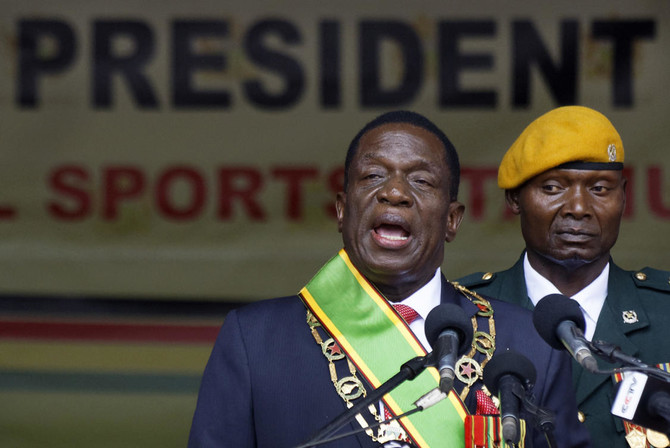
HARARE, Zimbabwe: Zimbabwe’s new president is showing signs of charting a path different from that of his ousted mentor, Robert Mugabe, as he tries to win over the country before next year’s elections.
On Friday, the ruling ZANU-PF party is expected to endorse President Emmerson Mnangagwa as party leader and its presidential candidate. The elections are a key test of his promises to strengthen Zimbabwe’s democracy and attract badly needed foreign investment to revive a devastated economy.
The party congress also will endorse the recall of 93-year-old Mugabe from the party and government, said spokesman Simon Khaya Moyo, completing last month’s dramatic events that saw the military put Mugabe under house arrest, scores of thousands rally in the streets and lawmakers begin impeachment proceedings before the longtime leader resigned.
Mnangagwa at his inauguration described Mugabe as a “father, comrade-in-arms and my leader” but called his swearing-in the day “Zimbabwe renews itself.”
Zimbabweans and others are watching closely to see whether Mnangagwa, a longtime Mugabe ally whose firing as vice president led the country to turn against the president after 37 years in power, can step out of his mentor’s shadow.
So far he has made some bold moves, despite stocking the new Cabinet with military and ruling party members and shutting out the opposition.
A new budget plan by Finance Minister Patrick Chinamasa proposes to reduce diplomatic missions and ban first-class travel for everyone but the president as the government tries to cut costs and repair the once-prosperous economy.
The southern African nation also plans to amend an unpopular, Mugabe-backed indigenization law limiting foreign ownership of businesses to no more than 49 percent of shares.
Zimbabwe’s police, known for setting up numerous roadblocks and demanding bribes, have been removed from the streets and told to reform, while Cabinet ministers who rarely attended parliamentary question-and-answer sessions seem to have changed their ways.
Such changes would have been unthinkable under Mugabe, who was widely criticized for mismanaging the economy so badly that millions of people fled abroad and many in the well-educated nation were reduced to street vending.
The 75-year-old Mnangagwa, who raised the loudest cheers at his inauguration with the promise of “jobs, jobs, jobs,” is at his office before 8 a.m. these days and his motorcade has been seen there on weekends, signaling what some allies call a new work ethic. Among the complaints raised by the ruling party during impeachment proceedings against Mugabe was that he was too old to rule and routinely slept in meetings.
Yet amid the transformation some things have remained the same.
“Mnangagwa is showing postures of one willing to reform and not necessarily change,” said Alex Rusero, a Harare-based political analyst.
Reminiscent of Mugabe’s days, state enterprises have been splashing advertisements in state-run media congratulating the new leader and pledging their loyalty.
“It is a desperate indicator of how ZANU-PF has over the years become a source of livelihood such that failure to exhibit enthusiastic bootlicking, accompanied by hero-worshipping, might automatically translate to deprivation of that very same livelihood. It’s a survival tactic,” Rusero said.
At the ZANU-PF party’s headquarters, Mnangagwa’s face has replaced Mugabe’s on billboards.
“They seem keen to build a personality cult around Mnangagwa just like they did with Mugabe,” said Gabriel Shumba, a human rights lawyer and chairman of the South Africa-based Zimbabwe Exiles Forum.
Zimbabwe’s economy is yet to respond favorably to the change in leadership. Prices of basic food and household items are going up, while banks are still struggling to dispense scarce cash to customers.
The euphoria that greeted Mugabe’s resignation seems to be giving way to expectation. “Things are still tough,” said Anesu Kaeresera, waiting in a bank line.
“You can put up tanks against a seating president, but you can’t put tanks against a non-performing economy,” Tendai Biti, an opposition leader and former finance minister, said on Twitter.
Mnangagwa seems aware of the huge expectations.
“As time is of the essence, we thus need to pursue high-speed program execution,” he told his new ministers at the first Cabinet meeting on Dec. 5.
Some Zimbabweans are expressing concern that two former military commanders are in top Cabinet positions and that the military, cheered by many for its role in removing Mugabe, still seems to be in charge of law enforcement. Soldiers are still visible on the streets of the capital and have mounted roadblocks on all major highways.
“Soldiers belong to the barracks and they must return there,” said Dewa Mavhinga, the southern Africa director for Human Rights Watch. “Their history of human rights abuses makes their presence discomforting.”


![]()
Zimbabwe’s new leader begins journey to key 2018 election
Zimbabwe’s new leader begins journey to key 2018 election

Latest updates



Recommended


© 2026 SAUDI RESEARCH & PUBLISHING COMPANY, All Rights Reserved And subject to Terms of Use Agreement.