Zimbabwe’s ex-VP returns home after Mugabe ouster

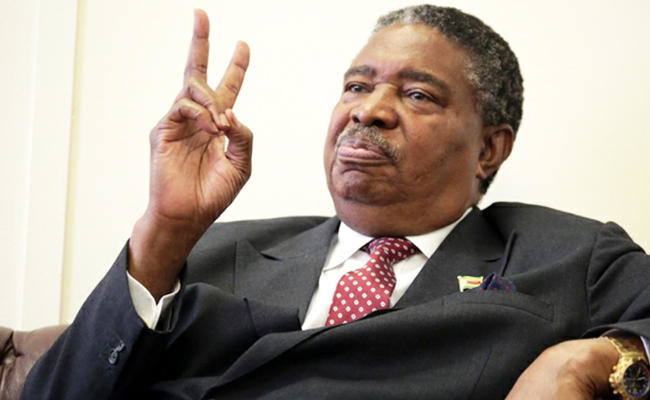
Phelekezela Mphoko. (Twitter photo)
Updated 03 December 2017
Follow

Zimbabwe’s ex-VP returns home after Mugabe ouster

HARARE: Zimbabwe’s former vice president, who was on a trip abroad during last month’s military takeover that led to Robert Mugabe’s resignation, has returned home, local media reported Saturday.
Phelekezela Mphoko was the second deputy appointed in 2014 by longtime strongman Mugabe, along with current President Emmerson Mnangagwa.
Mphoko had flown to Japan on official business the day before the army took over the country in an operation that culminated in Mugabe’s ouster after a 37-year rule.
But instead of returning home at the end of his mission, Mphoko sought sanctuary in Botswana, where he remained until Friday.
“Mr. Mphoko and his family arrived at the Zimbabwean side of the border at 1:15 p.m. aboard a Zimbabwe department of immigration minibus accompanied by Botswana immigration officials,” The Herald newspaper reported.
He was with his wife Laurinda, son Siqokoqela and seven other family members, the paper added.
According to The Herald, Mphoko spoke to Mnangagwa by phone and got “the necessary assurances that he was free to come back to Zimbabwe.”
The former vice president and longtime diplomat — less well-known in the country than popular Mnangagwa — was reportedly a member of a faction in the ruling ZANU-PF which rallied behind Mugabe’s wife Grace and backed her bid to replace her husband as president.
They were reportedly expelled from the party for “engaging in activities meant to destabilize the Government.”
Former finance minister and alleged member of the faction, Ignatius Chombo, was last week the first Mugabe loyalist to be charged by the new government on fraud charges dating from 2004-2009, when he held a different ministerial role.
Other senior members of the so-called G-40 faction are believed to be in hiding.
Mnangagwa, 75, named his Cabinet overnight Thursday and he is expected to appoint his two vice presidents following a special ZANU-PF congress in mid-December, according to a government statement issued Saturday.
But he has come under fire for naming two military allies to top positions in his new Cabinet, including Sibusiso Moyo, a major general who on Nov. 15 went on state TV to announce the military’s takeover — a power grab which led to the 93-year-old Mugabe quitting the presidency a week later.
An estimated 20,000 people were killed during the campaign known as Gukurahundi.
Another Cabinet minister is the air force boss — Air Marshal Perence Shiri, who had previously headed a special North-Korean trained unit that is alleged to have committed atrocities during a crackdown on a rebellion in the western Matabeleland province in the early 1980s.
An estimated 20,000 people were killed during the campaign known as Gukurahundi.
Mnangagwa was also criticized for recycling ministers from Mugabe’s discredited era.
Following public outcry, he dropped Lazarous Dokora as education minister on Saturday, replacing him with Professor Paul Mavima, another ZANU-PF legislator.


US allies, foes alarmed by capture of Venezuela’s Maduro

Updated 55 min 26 sec ago
Follow

US allies, foes alarmed by capture of Venezuela’s Maduro

  • Countries such as Russia and China, which had ties with Maduro’s government, were quick to condemn the operation but alarm also shared by France and EU
  • UN Secretary-General Antonio Guterres was “deeply alarmed” by the US strikes

PARIS: The US military operation that led to the seizure of Venezuelan President Nicolas Maduro on Saturday sparked alarm across the international community, with allies and foes of Washington and Caracas expressing disquiet.
US President Donald Trump said Maduro and his wife would be taken to New York to face federal charges after military strikes and an operation which he described as looking like a “television show.”
The Venezuelan government decried what it termed a “extremely serious military aggression” by Washington and declared a state of emergency.
Countries such as Russia and Iran, which had longstanding ties with Maduro’s government, were quick to condemn the operation but their alarm was also shared by Washington’s allies including France and the EU.
Here is a rundown of the main reaction.

Russia

Russia demanded the US leadership “reconsider its position and release the legally elected president of the sovereign country and his wife.”

China

Beijing said “China is deeply shocked and strongly condemns the US’s blatant use of force against a sovereign state and its action against its president.”

Iran

Iran, which Trump bombed last year, said it “strongly condemns the US military attack on Venezuela and a flagrant violation of the country’s national sovereignty and territorial integrity.”

Mexico

Mexico, which Trump has also threatened with military force over drug trafficking, strongly condemned the US military action in Venezuela, saying it “seriously jeopardizes regional stability.”

Colombia

Colombian President Gustavo Petro — whose country neighbors Venezuela — called the US action an “assault on the sovereignty” of Latin America which would lead to a humanitarian crisis.

Brazil

Brazilian President Luiz Inacio Lula da Silva slammed the US attacks as a “serious affront” to Venezuela’s sovereignty.

Cuba

Cuba, a strong ally of Venezuela, denounced “state terrorism against the brave Venezuelan people.”

Spain

Spain offered to mediate in the crisis to find a way to a peaceful solution, while calling for “de-escalation and restraint.”

France

France condemned the US operation, saying it undermined international law and no solution to Venezuela’s crisis can be imposed from the outside.

EU

The EU more generally expressed concern at the developments and urged respect for international law, even as it noted that Maduro “lacks legitimacy.”
EU candidate country North Macedonia, along with fellow Balkan nations Albania and Kosovo, backed Washington, however.
“We stand with the United States and the Venezuelan people for freedom and democracy,” North Macedonia FM Timco Mucunski said on X.

Britain

British Prime Minister Keir Starmer said all countries should “uphold international law” and added that “the UK was not involved in any way in this operation” as he urged patience in order to “establish the facts.”

Italy

In a rare expression of support for the US operation by a major European country, far-right Italian Prime Minister Giorgia Meloni — a Trump ally — argued the US military action in Venezuela was “legitimate” and “defensive.”

Israel

Israel also hailed the operation, saying Washington acted as the “leader of the free world.”

Ukraine

Ukraine — dependent on US support in its war against invading Russia — did not address the legality of a big country like America using military force against a much smaller one like Venezuela.
Foreign minister Andriy Sybiga instead focused on Maduro’s lack of legitimacy and the Venezuelan government’s repression, while backing “democracy, human rights, and the interests of Venezuelans.”

South Africa

South Africa, which Trump accuses of alleged discrimination — and even “genocide” — of minority white Afrikaners, said: “Unlawful, unilateral force of this nature undermines the stability of the international order and the principle of equality among nations.”

UN

UN Secretary-General Antonio Guterres was “deeply alarmed” by the US strikes, with his spokesman quoting him as saying it could “constitute a dangerous precedent.”