

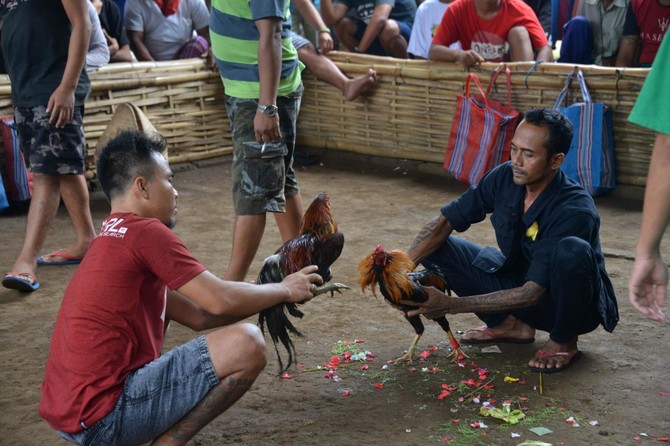
KARANGASEM, Indonesia: A volcano may be rumbling off in the distance, but for a group of Balinese men and their fighting roosters it’s the roar of the crowd that says the show must go on.
Far off the Indonesian resort island’s tourist trail, heavily-tattooed men gather at a clandestine site where birds battle each other — usually to the death — in a gory spectacle known as tajen that meshes bloodsport with ancient Balinese Hindu traditions.
About 100 male spectators gather on bamboo benches around a dirt ring as two roosters pulled from wicker baskets lunge at each other even before the match starts.
The two owners exchange birds to check weight and temperament, a show of sportsmanship to make sure they’re evenly matched.
“If the owners of both fighters reach a deal and say ‘okay, let’s fight’, then the roosters fight,” said I Made Gunawan, who’s rooster was fighting that day.
A small dagger about 10 centimeters (four inches) long is tied to each rooster’s left ankle.
The heady smell of incense wafts over the ring as a roar erupts from the crowd. Bets are placed, usually between 20,000 and 100,000 rupiah each (SR5.62-SR28.12), with most events lasting 15 fights.
The roosters are set loose and feathers fly in an explosion of jumping and pecking that sets the already excited crowd into a bloodthirsty frenzy.
The match goes the distance — three rounds over eight minutes — until the referee calls it a draw. Both roosters, weak and wounded, are unable to keep fighting.
The ankle blades usually make it a fight to the death in a matter of minutes, punctuated by trails of blood seeping into the dirt.
The winner’s owner not only gets bragging rights and some of the betting proceeds — usually 10 percent of the purse which can reach $2,000 — but they also get the carcass of their opponent’s rooster, for eating.
“My fighter lost today — it won the last time,” said Sudira as he helplessly watched his dying rooster be slaughtered to make dinner.
It’s a short career for surviving roosters, who are retired after just a few matches.
“They’re then used to breed with hens,” said Kadek Rudi, whose best fighter was recovering from severe belly wounds.
“The offspring will also be good fighters like their father.”
The fight took place not far from Mt. Agung, which recently burst to life again, sparking mass evacuations and leaving tourists stranded after the main airport was temporarily shuttered.
Despite the dangers, leaving his roosters alone in Pring Sari, a tiny community less than eight kilometers from the belching crater, was not an option for Wayan Kompyang.
“I have to keep taking care of them to make sure they are healthy and ready to fight after this situation calms down,” he said.
Gambling is illegal in Indonesia, where it could land these man in jail for as much as a decade. In conservative Aceh province gamblers can face a public whipping under Islamic law.
Cockfighting — the sole source of income for some Balinese men — cuts a sharp contrast with tranquil images of the island as a palm-fringed paradise.
But it dovetails with centuries-old traditions of Balinese Hinduism in the mostly-Muslim archipelago.
“Tajen (cockfighting) is closely related to a ritual known as ‘tabuh rah’ held at temples,” said Ni Made Ras Amanda Gelgel, a cultural studies lecturer at Bali’s Udayana University.
“The spilling of blood to the earth is needed to expel ‘buta’ or demons, because their blood is believed to appease demons so they don’t disturb people and so the ceremony can be held successfully and safely,” she said.
“But it eventually shifted to become entertainment.”
Training roosters isn’t for everyone, however, even those who have a stomach for violence.
“Taking care of the roosters isn’t easy — they have special food and you need to know how to treat the animals,” Gelgel said.
“It’s not as simple as having a good fighter that wins a lot so you can get rich. There is lot more involved.”


