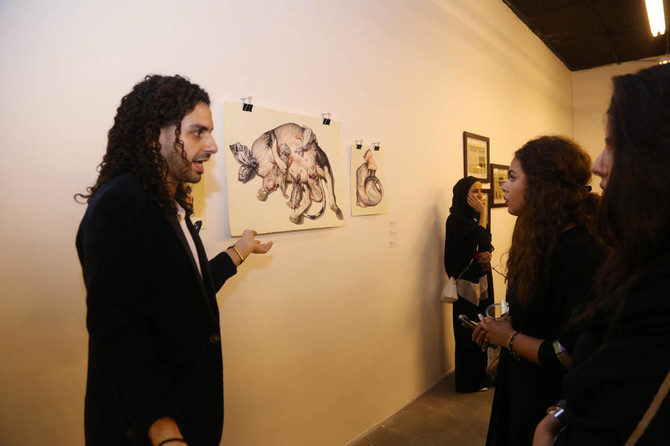
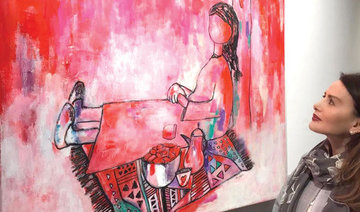
Jeddah: Athr Gallery’s latest exhibition, “Pulse,” opened its doors on Wednesday, showcasing the works of new artists from several genres.
The biannual exhibit, in its fifth edition, hosts an array of artists who offered their version of the concept “Time — past, present and future.”
Some of the 25 artists, both Saudi nationals and residents, aged 15-35 years old, were exhibiting their works for the first time.
The exhibit hall was packed as soon it opened as Jeddawis flocked to see the many pieces on show.
Art students from the nearby King Abdullah University for Science and Technology (KAUST) for the first time viewed the diversity of art installations, calligraphy, contemporary pieces and conceptual renditions by Saudi artists.
It was the artists’ task to look at the world and find how the concept of time translated into their emotional, physiological and psychological state. Each artist had their own take on the “pulse” theme, and each project was distinct from their contemporaries.
On the second floor of the gallery, an outstanding replica of Madinah’s famous Baha’aldeen Hotel was presented by The Loft ME.
Vintage furniture and items dating to the 1970s provided a sense of nostalgia.
The show also displayed works by a number of designers such as Once Upon a Chair, The Loft, Pendulum, Nesma Embroidery and others.
The Athr exhibition will continue in the office towers of Serafi Mega Mall until Jan. 4, 2018.

Jeddah feels the ‘Pulse’ of new art show
The founding economy: A blueprint for stability in the First Saudi State
- The establishment of the First Saudi State created a secure environment that facilitated the arrival of caravans, secured vast trade routes, and revived commerce across the Arabian Peninsula
RIYADH: The economy during the founding stage of the First Saudi State served as a fundamental pillar in building the nation, consolidating its influence, and ensuring its stability. This early economic growth was inextricably linked to achieving security, unifying regions, and organizing society—factors that directly stimulated trade, stabilized markets, and enhanced the foundations of daily life in Diriyah and its surrounding areas.
According to Dr. Abdullah Al-Saleh Al-Othaimeen's "Diriyah: Origins and Development during the First Saudi State," published by the King Abdulaziz Foundation for Research and Archives (Darah), the founding economy stands as a historical model reflecting the reciprocal relationship between political stability and early economic prosperity.
The establishment of the First Saudi State created a secure environment that facilitated the arrival of caravans, secured vast trade routes, and revived commerce across the Arabian Peninsula.
Beyond its political and intellectual prominence, Diriyah emerged as a vibrant economic hub. Its active markets attracted merchants and students from across the region, all of whom benefited from the state-provided stability. The local society relied on diverse activities for its livelihood, including trade, agriculture, and livestock breeding, with horses and camels playing crucial roles in transportation, commerce, and securing roads.
The social and administrative organization upon which the state was founded ensured the continuous availability of goods and sustained market stability. Ultimately, the close relationship between public security and economic growth during this founding phase solidified Diriyah's position as a premier political and commercial center in the Arabian Peninsula.