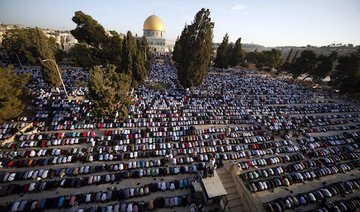
VATICAN CITY: Pope Francis Wednesday defended the “status quo” of Jerusalem, hours ahead of an announcement by US President Donald Trump in which officials said he will recognize the disputed city as Israel’s capital.
“I cannot silence my deep concern over the situation that has emerged in recent days. At the same time, I appeal strongly for all to respect the city’s status quo, in accordance with the relevant UN resolutions,” the pope said in his weekly address.
The Argentine pontiff’s call came a day after he spoke by phone with Palestinian president Mahmud Abbas, the Vatican said without elaborating.
“Jerusalem is a unique city, sacred for Jews, Christians and Muslims,” he said, adding that it was home to sites deemed holy by followers of the three major monotheistic faiths.
Jerusalem, the pope said, holds a “special vocation for peace.”
“I pray to God that this identity is preserved and reinforced, for the sake of the Holy Land, the Middle East and the whole world, and that wisdom and prudence prevail,” he said.
The pontiff added that maintaining the status quo was important “in order to avoid adding new elements of tension to an already volatile world that is wracked by so many cruel conflicts.”


![]()

Pope Francis defends Jerusalem ‘status quo’
Pope Francis defends Jerusalem ‘status quo’

Latest updates




© 2026 SAUDI RESEARCH & PUBLISHING COMPANY, All Rights Reserved And subject to Terms of Use Agreement.