

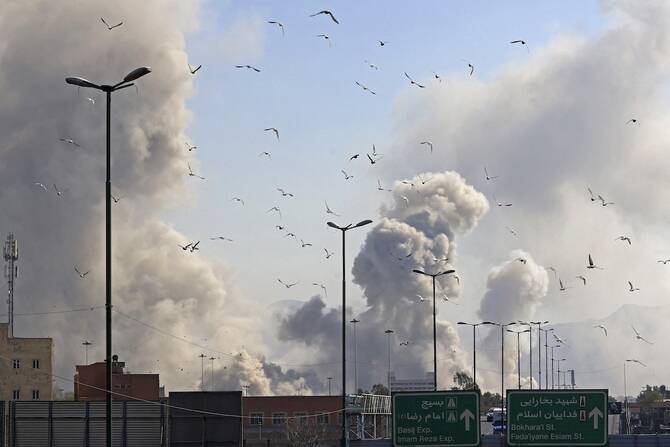

DUBAI: Iranian media said the death toll from airstrikes had risen to 1,230 on Thursday as the war continued for it's sixth day.
Meanwhile, the Iranian Red Crescent Society said that 105 civilian areas have been attacked, according to its latest report.
Iran launched a new wave of attacks Thursday morning at Israeli and American bases and threatened that the United States would “bitterly regret” torpedoing an Iranian warship in the Indian Ocean and a religious leader called for “Trump’s blood,” while Israel said it had begun a “large-scale” attack on Tehran.
US Defense Secretary Pete Hegseth said a torpedo from an American submarine sank an Iranian warship Tuesday night in the Indian Ocean.
Sri Lankan authorities said 32 crew members were rescued, while its navy recovered 87 bodies.
The Iranian ship was on its way back from participating in a February exercise hosted by the Indian navy. The US Navy also participated in the same exercise with a P-8A Poseidon aircraft, which is employed for anti-submarine and anti-surface warfare as well as surveillance and reconnaissance.
During his Pentagon briefing, Hegseth did not give a definitive timeline for US operations, which Trump has said could last for a month or longer.
“You can say four weeks, but it could be six. It could be eight. It could be three,” Hegseth said. “Ultimately, we set the pace and the tempo. The enemy is off balance, and we’re going to keep them off balance.”
US and Israeli military officials say launches from Iran have declined as their attacks have taken out ballistic missiles, launchers and drones. Israel’s Homefront Command announced it was easing restrictions that closed workplaces nationwide. It said workplaces could reopen Thursday if there is a shelter nearby. Schools would remain closed.
Still, explosions sounded early Thursday in Israel, which said its defensive systems were moving to intercept at least three waves of Iranian missiles.
Iran’s clerics are choosing a new supreme leader
Iran’s leaders are scrambling to replace Khamenei, who ruled the country for 37 years. It is only the second time since the 1979 Islamic Revolution that a new supreme leader is being chosen.
Potential candidates range from hard-liners committed to confrontation with the West to reformists who seek diplomatic engagement. Mojtaba Khamenei, Khamenei’s son, has long been considered among them, though he has never held a government position.
In a sign that Iran’s leadership will only seek to consolidate its power, the head of the judiciary warned that “those who cooperate with the enemy in any way will be considered an enemy.”
Israeli Defense Minister Israel Katz said on X that Iran’s next supreme leader “will be a target for elimination” if he continues to threaten Israel, the US and others.


