CAIRO: Arab League chief Ahmed Aboul-Gheit called on the international community on Tuesday to take immediate action in order to contain the dangerous developments in Yemen.
His spokesman Mahmoud Afifi quoted Aboul-Gheit as saying that the assassination of former Yemeni President Ali Abdullah Saleh on Monday demonstrates the criminal nature of the Houthi militants.
Aboul-Gheit said Saleh’s death leaves Yemen, which is already exhausted by war, on the brink of further deterioration on the humanitarian level.
The Houthi militias have rejected all solutions that have been proposed to resolve the conflict that erupted in 2014, he said according to his spokesman. Their refusal to deal with any political efforts reveals that their devious plot is aimed at having the Yemeni people submit to their rule, he said, according to Asharq Al-Awsat.
This plan should be thwarted through all possible legitimate means, he said.
“It is time the international community, especially the influential powers, realized that the Houthi militia is a terrorist organization that is ruling the people through the force of arms. All means should be used to save the Yemeni people from this nightmare,” he stressed.
He warned Yemen’s situation could explode further and worsen humanitarian crisis. “All means should be tackled for the Yemeni people to get rid of this black nightmare,” he said.
The UAE is a key member of the mostly Gulf Arab alliance that sees the Houthis as a proxy of Iran.
Ahmed Ali, the powerful former military commander of Yemen’s elite Republican Guards, appeared to have been groomed to succeed his father, and he may be the family’s last chance to win back influence.
The whereabouts of Saleh’s other key relatives, who had led six days of street battles against the Houthis in the capital Sanaa before their rout on Monday, were unknown.
The Houthi leader, Abdul Malik Al-Houthi, reached out to Saleh’s political party and said his movement had no quarrel with it, underscoring the influence Saleh’s allies still have in Yemen.
The Houthis moved to cement their grip on the capital Tuesday.
Residents reported a few minor clashes between the Houthis and Saleh supporters late on Monday in southern districts which had been loyal to the slain strongman.
But there was no repetition of the heavy fighting that had rocked Sanaa for the five previous nights. New checkpoints manned by militias sprung up across Sanaa as their leaders hailed their control of the capital.
“We declare the end of security operations and the stabilization of the situation,” senior Houthi official Saleh Al-Sammad told the terrorists’ Almasirah television channel late on Monday.
Al-Sammad said he had ordered the security forces to “take steps against the saboteurs and all those who collaborated with them.”
The capital was awash with rumors of widespread arrests of suspected Saleh supporters in the army and the militia regime.
The former strongman retained the loyalty of some of the best-equipped units of the army after he was forced to step down as president in 2012. The Houthis called a mass rally for Tuesday afternoon to celebrate their “foiling of the plot.”
Saleh was forced to step down in 2012, after his forces waged a bloody crackdown on peaceful Arab Spring-inspired protests calling for his ouster.
The 75-year-old had survived a civil war, rebellion in the north, an Al-Qaeda insurgency in the south and a June 2011 bomb attack on his palace that wounded him badly.
Relatives of Yasser Al-Awadi, deputy secretary-general of Saleh’s General People’s Congress party (GPC) who was reported to have been killed by the Houthis on Monday, told Dubai-based Al-Arabiya TV he was safe but GPC Secretary-General Araf Al-Zouka had died in the Houthi attack on Saleh’s convoy.
In the southern city of Aden, where the internationally recognized government is based, residents set off fireworks and expressed joy.
Saleh’s legacy is mixed. He is still loved in much of the north and many supporters will bear a grudge toward his killers. Some feared Saleh’s death would only create more instability in Yemen.
“We expect things will get worse for us. This will be the beginning of a new conflict and more bloodshed. The war will not end soon,” said Aswan Abdu Khalid, an academic at the psychology department at the University of Aden.
Yemen’s war has led to what the UN calls the world’s worst humanitarian crisis. The world body says millions of people may die in one of the worst famines of modern times, caused by warring parties blocking food supplies.
The death of Saleh, who once compared ruling Yemen to dancing on the heads of snakes, deepens the complexity of the multisided war.
Much is likely to depend on the future allegiances of his loyalists.


![]()
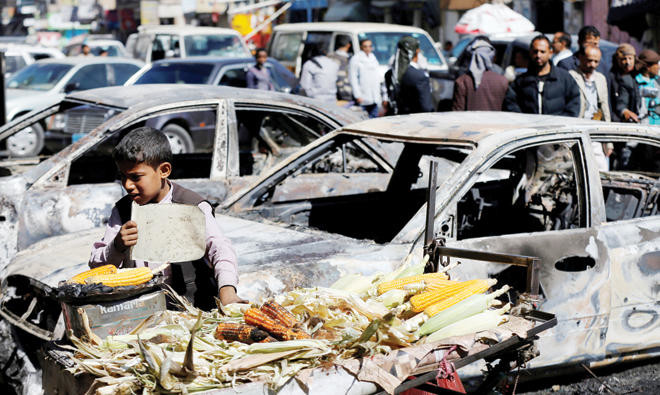
Arab League rings alarm bells over Houthi menace
Arab League rings alarm bells over Houthi menace
Latest updates


© 2026 SAUDI RESEARCH & PUBLISHING COMPANY, All Rights Reserved And subject to Terms of Use Agreement.