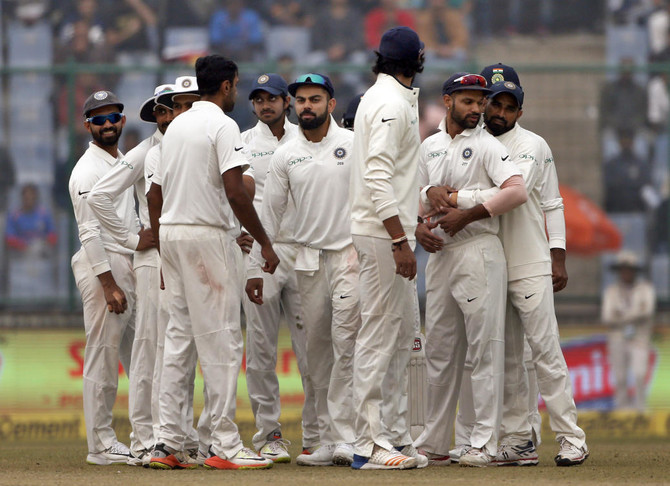
NEW DELHI: Unprecedented scenes of Sri Lankan cricketers wearing face masks have reignited debate about hosting major sports in heavily polluted New Delhi, where doctors are increasingly vocal about the health risks posed by smog.
Medics on Monday urged cricket’s governing body to revise its rulebook after a Test match between India and Sri Lanka went ahead in the capital despite players vomiting and wheezing for air.
International cricketers returned Monday for day three of the third Test even as air pollution at Feroz Shah Kotla stadium soared to hit 18 times the World Health Organization’s safe level.
Play had been disrupted three times on Sunday as Sri Lankan players complained of illness, but umpires ruled the match would proceed.
The Indian Medical Association condemned the decision, warning that playing in such conditions put athletes’ health at serious risk.
“This match should not have taken place in the first place. It is time the ICC (International Cricket Council) comes up with a policy on pollution,” said IMA president K. K Aggarwal.
“You have fast bowlers, batsmen and fielders out there exposed to these very harmful pollutants over five days at a stretch. It takes a serious toll on your health in the long run.”
The sport’s governing body declined to comment.
India’s powerful cricket board accused Sri Lanka of making a “big fuss,” pointing to Indian skipper Virat Kohli who hit a record sixth Test double century despite the smog.
But the US embassy website on Monday urged Delhi residents to “avoid all outdoor exertion” as concentrations of the smallest and most harmful airborne pollutants known as PM2.5 soared to hazardous levels.
These tiny particles — a fraction the size of human hair — lodge deep in the lungs and are linked to higher rates of chronic bronchitis, lung cancer and heart disease.
The concentration of such particles Monday hit 448 — compared to a maximum level of 25 considered safe by the World Health Organization over a 24-hour period.
Even limited exposure can cause shortness of breath and make the eyes weep and throat burn.
Pollution levels generally rise during the winter in Delhi and across northern India and neighboring Pakistan, fueled by crop burning in the region and the fact that cooler air traps particulates close to the ground.
The smog has become especially alarming in the past two years, casting doubt on the future of sports events in the sports-mad swathe of South Asia.
“This should be a wake up call for Pak. Our children are at a huge risk because of dangerous pollution levels,” tweeted former Pakistani cricketer and political opposition leader Imran Khan about the India-Sri Lanka Test.
Doctors and public health campaigners have escalated their fight against sports events in Delhi in recent years.
Last month more than 30,000 runners competed in the Delhi half-marathon — just days after smog shut schools amid a public health emergency in the capital.
Doctors warned of dire health consequences and challenged the race in court but it went ahead, with runners complaining of burning eyes and sore throats.
Greenpeace lobbied in October against India hosting the FIFA Under-17 World Cup, warning it posed unacceptable risks to the world’s youngest soccer stars.
It also proceeded but schedule was adjusted to avoid Delhi at its worst.
“Others should also think about athletes health first,” tweeted tournament director Javier Ceppi after images of Sri Lankan cricketers wearing face masks went around the globe.
Other events in Delhi — like an Asian tour golf title in November and Indian Super League football matches — attract less controversy but doctors say pose no less risk.
“Ideally, sporting events should not be scheduled in the winter months in Delhi,” chest and lung cancer specialist Doctor Arvind Kumar told AFP.
“We cannot expose our athletes to inhuman levels of pollution just because a few hundred crores (tens of millions of dollars) is at stake.”
The Test debacle in Delhi is not the first time cricketers have complained of air pollution in the capital, with Australia citing smoggy air following their loss to India in 1996.


![]()
Doctors say no to sport in Delhi as cricketers choke in smog
Doctors say no to sport in Delhi as cricketers choke in smog


Latest updates


Recommended


© 2026 SAUDI RESEARCH & PUBLISHING COMPANY, All Rights Reserved And subject to Terms of Use Agreement.