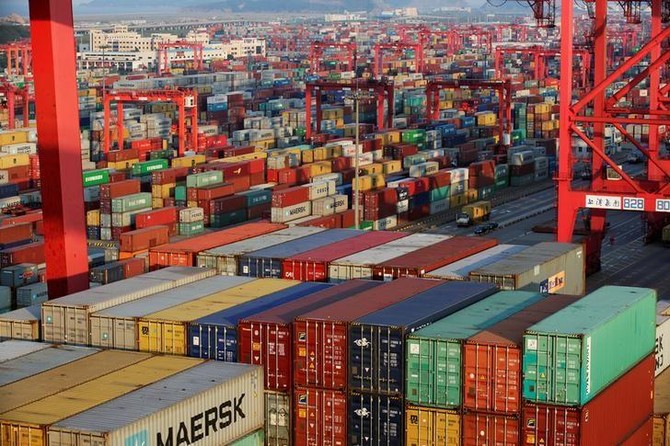
WASHINGTON: The US has formally told the World Trade Organization (WTO) that it opposes granting China market economy status, a position that if upheld would allow Washington to maintain high anti-dumping duties on Chinese goods.
The statement of opposition, made public on Thursday, was submitted as a third-party brief in support of the EU in a dispute with China that could have major repercussions for the trade body’s future.
China is fighting the EU for recognition as a market economy, a designation that would lead to dramatically lower anti-dumping duties on Chinese goods by prohibiting the use of third-country price comparisons.
The US and EU argue that the state’s pervasive role in the Chinese economy, including rampant granting of subsidies, mean that domestic prices are deeply distorted and not market-determined.
A victory for China before the WTO would weaken many countries’ trade defenses against a flood of cheap Chinese goods, putting the viability of more western industries at risk.
US Trade Representative Robert Lighthizer told Congress in June that the case was “the most serious litigation we have at the WTO right now” and a decision in China’s favor “would be cataclysmic for the WTO.”
Lighthizer has repeatedly expressed frustration with the WTO’s dispute settlement body and has called for major changes at the organization.
The USTR brief, which follows a Commerce Department finding in October that China fails the tests for a market economy, argues that China should not automatically be granted market economy by virtue of the expiration of its 2001 accession protocol last year.
“The evidence is overwhelming that WTO members have not surrendered their longstanding rights ... to reject prices or costs that are not determined under market economy conditions in determining price comparability for purposes of anti-dumping comparisons,” the brief concludes.
The move comes as trade tensions between Washington and Beijing are increasing as the Trump administration prepares several possible major trade actions, including broad tariffs or quotas on steel and aluminum and an investigation into Chinese intellectual property misappropriation.
Chinese Foreign Ministry spokesman Geng Shuang told a regular news briefing on Friday that some countries were trying to “skirt their responsibility” under WTO rules.
“We again urge relevant countries to strictly honor their commitment to international principles and laws, and fulfill their agreed upon international pacts,” Geng said.
The Commerce Department on Tuesday launched the first government-initiated anti-dumping and anti-subsidy investigations in decades on Chinese aluminum sheet imports.
US officials say that 16 years of WTO membership has failed to end China’s market-distorting state practices.
“We are concerned that China’s economic liberalization seems to have slowed or reversed, with the role of the state increasing” David Malpass, US Treasury undersecretary for international affairs, told an event in New York on Thursday.
“State-owned enterprises have not faced hard budget constraints and China’s industrial policy has become more and more problematic for foreign firms. Huge exports credits are flowing in non-economic ways that distort markets,” Malpass said.
The brief submitted to the WTO also argues that China should be treated the same way as communist eastern European countries, including Poland, Romania and Hungary were when they joined the WTO’s predecessor organization, the General Agreement on Tariffs and Trade, in the late 1960s and early 1970s.
A senior US official said those countries eventually earned market economy status as evidence of state subsidies and state distortions waned. He added that going forward, WTO members wishing to use third-country price comparisons against Chinese imports would need to keep presenting evidence of economic distortions.


![]()
US formally opposes China market economy status at WTO
US formally opposes China market economy status at WTO

Latest updates


© 2026 SAUDI RESEARCH & PUBLISHING COMPANY, All Rights Reserved And subject to Terms of Use Agreement.