Macron seeks support to rescue migrants trapped in Libya

Smoke rises following an explosion close to the Egyptian side of the Rafah border on Tuesday. (AFP)
Updated 29 November 2017
Follow

Macron seeks support to rescue migrants trapped in Libya

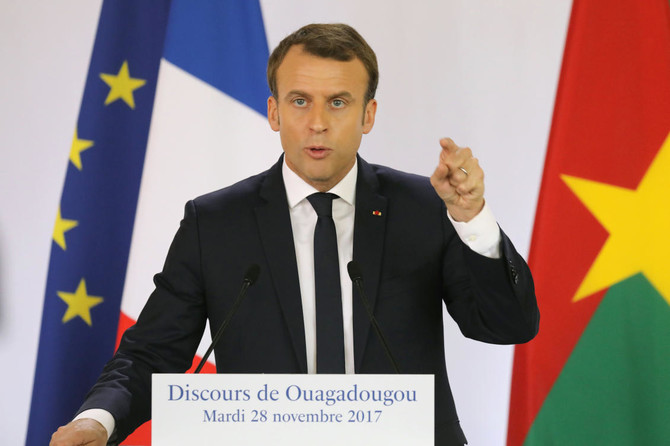
OUAGADOUGOU: French President Emmanuel Macron called the trafficking of migrants a “crime against humanity” on Tuesday as he began an African visit in Burkina Faso with his first major address on the continent.
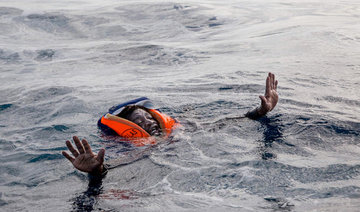
Macron proposed a crackdown on human smugglers’ networks between Africa and Europe after video footage broadcast on CNN this month showed the auction and sale of migrant men as slaves in Libya. Migrants hope to survive an often deadly voyage across the Mediterranean from the chaotic nation.
Macron said he wants “Africa and Europe to help populations trapped in Libya by providing massive support to the evacuation of endangered people.” He said he will formally detail his proposal at a summit of the EU and the African Union (AU) in Ivory Coast Wednesday.
The footage prompted widespread outcry across West Africa, where many migrants pressured by climate change and high unemployment set off in search of a better life.
Already Burkina Faso’s foreign affairs minister has recalled his ambassador from Libya, calling it “unacceptable to have slaves in this 21st century.” Concerns about the treatment of migrants are expected to feature prominently at this week’s summit. Also high on the agenda is regional security, including the growing threat of extremism.
Macron is urging international support for a new military force that includes Burkina Faso and four other regional countries and is meant to counter a growing terror threat. Burkina Faso has seen two attacks on restaurants popular with foreigners, including one in August that killed 18 people.
The threat was underscored late Monday by an attempted assault on a French military vehicle just hours before Macron’s arrival. Authorities said two people on motorcycles had intended to use a grenade to attack a bus carrying French military members. The assailants missed their intended target but several people nearby were wounded, police said.
Also Tuesday, the French presidency’s spokesman said stones were thrown at a vehicle transporting members of the French delegation accompanying Macron’s visit, despite heavy security.
Bruno Roger-Petit said on his official Twitter account that Macron was meeting with his Burkina Faso counterpart, President Roch Marc Christian Kabore, at the time. No vehicle was destroyed and there were not “hundreds of assailants.”
In his first major Africa address at the University of Ouagadougou, Macron sought to refocus the France-Africa dynamic away from a colonial past. The 39-year-old president said he is the child of “a generation that has never known Africa as a colonized continent,” and he stressed the “undeniable crimes of European colonization.”
Macron also said he wants conditions to be met in five years so that pieces of African cultural heritage can return to African museums “temporarily or definitively,” saying that “I cannot accept that a large part of African heritage is in France.”
The French leader also referred to his comments that prompted controversy in July, when he suggested that it is a problem when African women have “seven or eight children.” He said Tuesday that “I want a young girl to have the choice not to have children at the age of 13” and that “When you see families of six, seven, eight children per woman, are you sure it’s a choice from the girl?”
After Macron’s visit to Ivory Coast for the summit he will make a stop in Ghana before returning to France.


 

Last Christians gather in ruins of Turkiye’s quake-hit Antakya

Updated 5 sec ago
Follow

Last Christians gather in ruins of Turkiye’s quake-hit Antakya

  • Saint Peter’s, one of the world’s oldest rock churches, is a sacred rallying point for the isolated Christians still left in quake-hit Antakya in southeastern Turkiye
ANTAKYA: Saint Peter’s, one of the world’s oldest rock churches, is a sacred rallying point for the isolated Christians still left in quake-hit Antakya in southeastern Turkiye, the city known in ancient times as Antioch.
“Since the earthquake, our community has scattered,” said worshipper Mari Ibri.
“Those who remain are trying to regroup. We each had our own church but, like mine, they have been destroyed.”
The landscape around the cave remains scarred by the disaster nearly three years ago, when two earthquakes devastated Hatay province on February 6, 2023 and its jewel, Antakya, the gateway to Syria.
Sad fields of rubble and the silhouettes of cracked, abandoned buildings still scar the city — all enveloped in the ever-present grey dust.
Since the earthquakes, Antakya city has emptied and the Christian community has shrunk from 350 families to fewer than 90, Father Dimitri Dogum told AFP.
“Before, Christmas at our house was grandiose,” Ibri recalled.
“Our churches were full. People came from everywhere.”
Ibri’s own church in the city center was rendered inaccessible by the earthquakes.
Now she and other worshippers gather at the cave on December 24 — Christmas Eve in some Christian calendars.
It is here, they believe, that Peter, the disciple Jesus assigned to found the Christian church, held his first religious service in the 1st century.
The rock church was later enlarged and 11th-century crusaders added a pale stone facade.
It is now a museum, opened to the faithful only on rare occasions.
Christmas Eve is one.
The morning sun was still glowing red in the sky when Fadi Hurigil, leader of Antakya’s Orthodox Christian community, and his assistants prepared the service.
They draped the stone altar and unpacked candles, holy oil, chalices and plastic chairs.
Out in front they placed figurines of Christ and three saints near a bottle of rough red wine, bread baskets and presents for the children.
The sound system played a recording of the bells of Saint Peter and Paul church, which now stands empty in Antakya city center.
“That was my church,” said Ibri, crossing herself. “They recorded the peals.”
Around one hundred worshippers soon squeezed into the incense-filled cave and at least as many congregated outside.
A large police contingent looked on. Sniffer dogs had already inspected the cave and esplanade.
“It’s normal,” said Iliye, a 72-year-old from Iskenderun, 60 kilometers (40 miles) further north. “We’re a minority. It’s to protect us.”
The slow chanting of Orthodox hymns heralded the start of the two-hour service, conducted entirely in chants sung in Arabic and Turkish by Dogum and another cleric.
“It’s very moving for us to be here in the world’s first cave church, where the first disciples gathered,” the priest said.
“There used to be crowds here,” he added.
“In 2022, there were at least 750 people outside, Christians and non-Christians alike.”
Since the earthquakes, the gathering has been much smaller, although it is now starting to grow again.
At the end of the service, when Christmas carols fill the air, Dogum and Hurigil cut a huge rectangular cake.
The Nativity scene at its center — Mary, baby Jesus, the ox and the ass — was edged with whipped cream.
“There’s the religious dimension but it’s also important that people can gather here again,” a worshipper said.
“After February 6, our fellow citizens scattered. But they’re starting to come back. We’re happy about that.”