LONDON: Britain’s biggest banks can withstand a series of economic shocks — including a no-deal Brexit — that would have more severe impacts than what they experienced during the global financial crisis, the Bank of England said Tuesday.
While concluding that lenders can deal with Britain crashing out of the European Union without a deal and restrictions imposed on British business, the Bank of England warned that additional problems may emerge if a “disorderly” Brexit takes place at the same time as a sharp global recession.
In its annual stress test of the sector, the central bank said the country’s biggest lenders, such as Barclays and Lloyds Bank, were “resilient” to a raft of adverse scenarios, including deep simultaneous recessions at home and abroad and hefty falls in the price of assets.
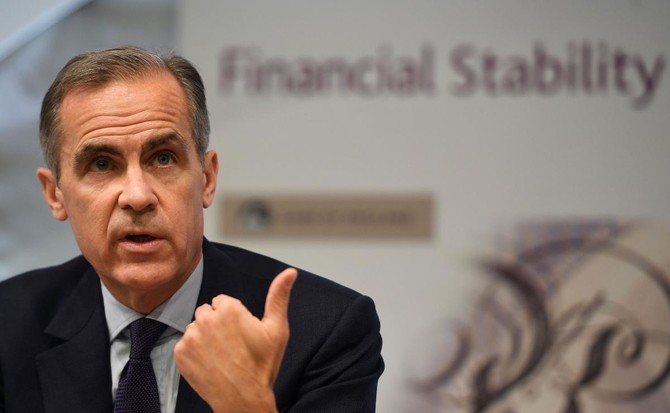
“Despite the severity of the tests, for the first time since the bank began stress testing in 2014, no bank needs to strengthen its capital position as a result,” Bank of England Governor Mark Carney said.
Stress tests have become a key policy instrument of central banks around the world since the global financial crisis. In Britain’s case, many of the country’s banks, including Royal Bank of Scotland, had to be bailed out by taxpayers at the height of the global crash in 2008-9 because they weren’t strong enough to cope with the shock.
In what is effectively a war-gaming exercise, the Bank of England tested banks’ ability to withstand a recession that was even worse than the one that took place after the global financial crisis nearly a decade ago. Included in the test was the simulation of a 2.4 percent fall in global GDP, a 4.7 percent contraction in Britain, a domestic housing market crash, a further fall in the value of the pound to below a dollar and a spike in interest rates.
In the test, banks would incur losses of around 50 billion pounds ($65 billion) in the first two years of the stress, the scale of which, the Bank said, would have wiped out the underlying capital base of the sector ten years ago. Since the crisis, banks have been forced by regulators to boost their buffers, which they can draw upon in the event of a financial shock.
The bank’s Financial Policy Committee, which monitors the stability and resilience of the banking system, also concluded that banks can continue to support the British economy in the event that the country experiences a “disorderly” exit from the European Union, which would see Britain crashing out of the bloc with no deal on future relations with the EU.
Britain is due to leave in March 2019 but negotiations with Brussels over the post-Brexit relationship have failed to make much progress, raising fears that tariffs and other restrictions would be slapped on British exports to the EU.
“We’re putting our money where our mouth is,” Carney said. “This is not a good scenario; it’s a scenario that we are all trying to avoid because it has some material economic costs even if financial system continues to function through it ... There will be some pain.”
However, Carney warned that losses to the banking system would “likely be more severe” than in this year’s annual test if a “disorderly” Brexit takes place at the same time as a sharp global recession and banks are simultaneously hit with a series of fines such as those they’ve faced in past scandals involving the mis-sale of financial products.
“In this case, where a series of highly unfortunate events happen simultaneously, capital buffers would need to be drawn down substantially more than in the test and as a result banks would likely need to restrict lending to the real economy, worsening macroeconomic outcomes,” Carney said.
Carney said the FPC will reconsider the requirement that banks stash away 1 percent of their capital in the first half of next year to protect against risks. But he said that the central bank’s central assumption is that a “disorderly” Brexit is not the most likely scenario and that the relationship between Britain and the EU will remain “highly cooperative.”
Carney said a transition period after Brexit of between 18-24 months is the “minimum necessary” and that it’s a view “increasingly appreciated on both sides of the Channel.” During this period, Prime Minister Theresa May has indicated, Britain would trade with the EU under the same terms as now and would remain subject to the EU’s legal codes.


UK banks seen to be resilient to shocks — even ‘hard Brexit’
UK banks seen to be resilient to shocks — even ‘hard Brexit’



What changed in Saudi stocks on the first day of foreign entry
RIYADH: Saudi Arabia’s stock market saw foreign non-strategic investors reduce their ownership in nearly half of the companies listed on the main Tadawul All Share Index, or TASI, on the first day of implementing the decision to open the market to all categories of foreign investors, according to Tadawul data reflecting ownership positions as of Feb. 1
According to the Financial Analysis Unit at Al-Eqtisadiah, foreign ownership declined in 120 companies, increased in 97 others, and remained unchanged in the rest, with no variation in the number of shares held by foreign investors.
Foreign investors favor growth stocks
Looking at the changes purely through valuation multiples — without factoring in operational or sectoral considerations — foreign investors appear to be reallocating ownership toward growth stocks at the expense of value stocks, with higher multiples used as an approximate indicator of growth.
Ownership declines were concentrated in companies with lower valuation multiples, where the median price-to-earnings ratio stood at about 17.1 times and the median price-to-book ratio was around 2 times.
Conversely, ownership rose in companies with higher multiples, with a median price-to-earnings ratio of 23.3 times and a median price-to-book ratio of 2.6 times.
Mid- and small-cap firms see biggest changes
Raoom, Entaj, and Obeikan Glass saw the largest declines in foreign ownership, dropping between 10 percent and 16 percent. In contrast, Tamkeen, SACO, and Abo Moati led gains, with foreign stakes rising 10 to 20 percent.
In terms of overall foreign ownership, Al-Babtain, Rasan, and Etihad Etisalat topped the list at roughly 34 percent, 29 percent, and 24 percent, respectively.
Gradual foreign inflow and delayed impact
The initial changes remain insufficient to reflect a major impact of the full foreign access decision, especially as the first day coincided with the weekend. Additionally, entry is expected to be gradual until financial institutions are fully ready to open accounts, particularly for individuals.
Mohammed Al-Shammasi, CEO of Derayah Financial, has told Asharq that the firm received around 500 individual investor applications on the first day of full foreign access.
Meanwhile, foreign institutions managing under $500 million can now invest directly in the market with easier access, joining more than 4,000 qualified foreign investors who already hold assets worth SR377 billion ($100.5 billion)


