Nepal begins historic vote, army says rogue Maoists behind blasts

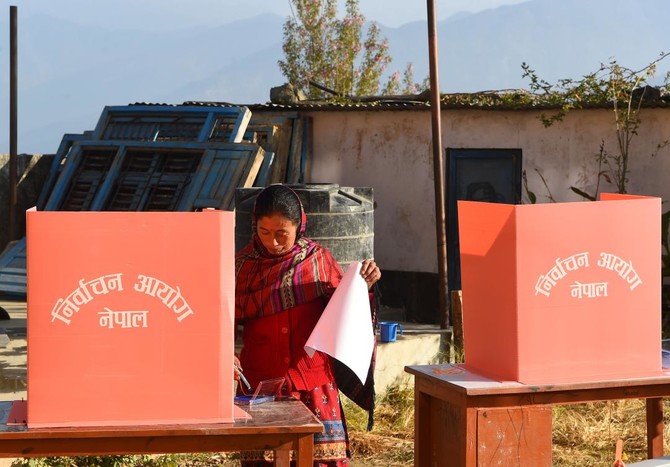
A Nepali woman casts her vote at a polling station during the general election at Chautara, Sindhupalchowk district some of 100 kilometers east of Kathamndu on November 26, 2017. (AFP)
Updated 26 November 2017
Follow

Nepal begins historic vote, army says rogue Maoists behind blasts

KATMANDU: Nepalis began voting for a new parliament on Sunday with the army on alert as a series of small blasts blamed on a rogue Maoist group reminded the Himalayan nation of the violence and instability it is hoping to leave behind.
More than decade after the end of a civil war between Maoist peasant guerrillas, Nepal is hoping this election — the first parliamentary polls since 1999 — will complete its long journey from a monarchy to becoming a federal republic.
A second phase of the election will take place on Dec. 7, and the election commission has said that the final results probably won’t be known for several days because of the cumbersome counting procedures.
A Maoist splinter group was behind a series of small blasts in the run up to the polls, and security forces have defused around 30 improvised explosive devices since Friday, army spokesman Nain Raj Dahal said.
Suresh Balsami was the first voter at Kagatigaun polling center near the capital Katmandu.
“I voted for peace, development and prosperity of the country,” said the 32-year-old bus driver as other voters began to trickle in.
Nepal voted in 2008 and 2013 for a Constituent Assembly, which doubled as parliament, to write a post-monarchy charter that plotted the course to becoming a federal republic.
More than 15 million eligible voters will pick a 275-member legislature, the first under a new constitution agreed after years of wrangling.
Simultaneously, voters will choose representatives to seven provincial assemblies for the first time since Nepal abolished the monarchy in 2008.
The centrist Nepali Congress party, considered a pro-India group, has formed a loose electoral alliance with the Madhesi parties from the country’s southern plains bordering India and former royalists.
Facing the alliance is a tight-knit left coalition between the former Maoist rebels and the main opposition Communist UML party, perceived to be closer to China.
Wedged between India and China, Nepal needs to balance ties, but the outcome of the election could determine which of the Asian giants gets the upper hand in the battle for influence in the buffer state.
Both are looking to benefit from Nepal’s potential as a source of hydropower.
Home to Mount Everest, and one of the poorest countries in the world, Nepal depends of tourism and aid. More than one-fifth of its 28 million people survive on less than $1.90 a day, and parts of the country are still recovering from a devastating earthquake that killed 9,000 people in 2015.


Philippines struggles to evacuate nationals from Middle East as attacks escalate across region

Philippine President Ferdinand Marcos Jr. leads a Special Cabinet Meeting to discuss the situation in the Middle East.
Updated 03 March 2026
Follow

Philippines struggles to evacuate nationals from Middle East as attacks escalate across region

  • Over 1,400 Philippine nationals in Middle East have requested for repatriation
  • Filipinos are told to shelter in place, follow host government’s advice on situation

MANILA: The Philippines is in talks to evacuate its nationals from across the Middle East, President Ferdinand Marcos Jr. said on Tuesday, as an increasing number of Filipinos are seeking to leave amid growing destruction from US-Israeli strikes on Iran and Tehran’s counterstrikes against US bases in Gulf countries.

More than 2.4 million Filipinos live and work in the Middle East, where tensions have been high since Saturday, after coordinated US-Israel strikes killed Iran’s Supreme Leader Ali Khamenei and senior Iranian officials.

Tehran responded by targeting US military bases in Gulf countries, and violence has been widening across the region. 

Evacuating Philippine nationals across the region is not yet possible, Marcos said, as countries closed their airspace, leading to airport shutdowns and the cancellation of thousands of flights throughout the Middle East.

“For now, we are depending on the advice that will be given to us by the local authorities in the place where our nationals — where our people — are,” Marcos told reporters in Manila on Tuesday.

The Philippine government has received requests for repatriation from more than 1,400 Filipino nationals in various Middle Eastern countries, including 872 from the UAE and almost 300 from Israel. Similar requests have also been made by Filipinos in Iran, Bahrain and Jordan.

“Right now, the most dangerous area for our people right now would be Israel as attacks there are continuous,” Marcos said.

“The problem now is that no planes are flying and airports are being hit. That’s why the situation is very fluid, our assessment is that it may be too dangerous to mount flights.

“Even if we could charter an aircraft, we cannot do anything because number one, the airports are closed. They are all no-fly zones.”

As the Philippine government prepares for multiple scenarios, officials have secured buses and other vehicles for possible evacuation by land.

Filipinos in “danger areas” have been moved to a safer place, Marcos said, citing the targeting of Saudi Arabia’s Ras Tanura oil refinery by Iranian drones on Monday morning.

“But essentially our advice to them is shelter in place and follow the host government’s advice … For now it’s extremely difficult to enter or exit the region because the only aircraft flying are fighter jets and drones, and missiles.

“That’s why it is not a place that you would want to put in a civilian aircraft to take out our nationals,” he said.

“But again, as I said, the situation is changing by the minute, by the hour. We just have to be in very good and close contact with the local authorities.”