NEW DELHI/ISLAMABAD: A Pakistani court on Wednesday refused the government’s request to extend the house arrest of Jamaat-ud-Dawa (JuD) chief Hafiz Saeed for another 60 days.
The decision comes days before the ninth anniversary of the Mumbai attack on Nov. 26, 2008, popularly known as 26/11.
India has expressed outrage about the release of Hafiz Saeed, who is alleged to have planned the Mumbai attack.
Saeed is scheduled to be released from house arrest as the deadline expires on Nov. 24.
“India and indeed all the international community is outraged that a self-confessed and UN-proscribed terrorist is allowed to walk free,” said Raveesh Kumar, the official spokesperson of India’s Ministry of External Affairs.
India sees this as “an attempt by the Pakistani system to mainstream proscribed terrorists,” Kumar said.
“The timing is bad, the decision is illogical and it does not show the seriousness of Pakistan to face the problem of terrorism,” S.K. Lamba, former Indian ambassador to Pakistan, told Arab News. “It is not good for the Indo-Pakistan relationship,” he said.
Hafiz Saeed denied his role in the Mumbai attack in which 10 gunmen attacked India’s financial capital and targeted two luxury hotels, a Jewish center and a train station, killing 166 people and injuring hundreds.
Dr. Prashant Mangeshikar, a prominent Mumbai gynecologist, was in the Taj Mahal Hotel when the attack took place and managed to escape. He told Arab News that “we should not have any relationship with Pakistan till it punishes Saeed.”
Vinay Jadhav, whose uncle was killed while waiting at Chhatrapati Shivaji Station (CST) for a local train, said: “I really feel that Pakistan should respect the sentiments of the people who lost their near and dear ones in the tragedy and punish the culprit.”
Hafiz Saeed’s detainment extension was rejected by a three-member panel after senior officials at Pakistan’s Finance Ministry failed to convince the court that Saeed’s release would affect Pakistan’s diplomatic relations and place the country at financial risk.
The review board in the previous hearing had asked the government to present its arguments that Pakistan might face monetary sanctions if Saeed was set free.
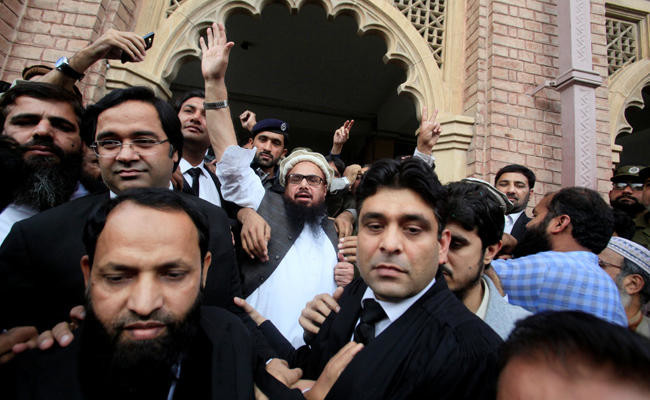
Saeed’s followers hailed the decision and distributed sweets.
No official response was issued by Pakistan. The Foreign Ministry directed any queries to the Interior Ministry, which declined to comment, as did the Punjab Advocate General’s office.
However, Pakistan’s former president and ex-Army chief Gen. Pervez Musharraf has called for Hafiz Saeed’s release in interviews with local media.
“Hafiz Saeed should definitely be freed," he said. They (JuD) are not terrorists, they run a very fine NGO, they contribute to relief activities in post-earthquake and post-flood periods in Pakistan. They run great welfare organizations.”
Musharraf said that Saeed’s charity organization, Falah-e-Insaniat Foundation (FIF), encouraged religious youth to engage in welfare activities.
“In my opinion, they are against the Taliban (in Pakistan), they did not commit any terrorism in Pakistan or anywhere in the world,” he said.
The US has offered a $10 million reward for information leading to the Jamaat-ud-Dawa (JuD) chief’s arrest and conviction.
JuD spokesman Yahya Mujahid told Arab News that police are still stationed in and around Hafiz Saeed’s house. “The review board has passed its decision and the government has no option but to release him,” he said.
On Jan. 31 Saeed and four of his aides were detained on the orders of an Anti-Terrorism Court (ATC), initially for 90 days but the detainment period was extended several times by government request. Saeed has been placed under house arrest twice after the 2008 Mumbai attacks.
His aides, Professor Zafar Iqbal, Mufti Abdur Rehman Abid, Maulana Ubaidullah Obaid and Qazi Kashif Niaz, were released on Oct. 26.
While Saeed was under detention the JuD in September formed the political party Milli Muslim League (MML). It put up a candidate for the National Assembly constituency seat left vacant in Lahore after the judicial ousting of Nawaz Sharif on July 28.
The MML’s candidate did not win but secured a considerable 5,882 votes.
The Election Commission of Pakistan has rejected the registration of MML, which the Interior Ministry says is working under Saeed’s banned organizations. This didn’t stop the religious political party participating in last month’s by-elections in the northwestern city of Peshawar.