GAZA CITY: Talks between Palestinian factions in Cairo ended Wednesday evening without a breakthrough in reconciliation efforts.
Despite the announcement of elections for the presidency, the Legislative Council and the National Council of the Palestine Liberation Organization (PLO) by the end of 2018, the general mood was one of disappointment.
The head of the Fatah delegation, Azzam Al-Ahmad, said reconciliation cannot be advanced without enabling the Palestinian Authority (PA) to work freely in the Gaza Strip.
“The arrival of ministers at their headquarters in Gaza doesn’t mean everything was fine,” he told Arab News.
“They can’t issue decisions to staff working in Gaza. There’s no security to protect border crossings handed to the PA. The judicial sector is still unresolved,” he added.
“There’s still a parallel government in Gaza, and the PA doesn’t accept this. Solving Gaza’s problems, including electricity, water and trash collection, needs a ministry to govern.”
Aed Yaghi, head of the Palestinian Initiative movement who participated in the talks in Cairo, told Arab News that they “didn’t produce practical and clear results to end divisions.”
He added: “The concept of empowering the government hasn’t been defined... the issue of security hasn’t been addressed, and there has been no agreement on lifting PA sanctions imposed on Gaza.”
Salah Al-Bardawil, a Hamas leader, said the talks produced “no mechanisms of implementation.”
He added: “We haven’t been allowed to discuss the issue of the Rafah crossing, and the Palestinian people will (continue to) suffer... This is our destiny.”
An Egyptian security delegation will arrive in Gaza within two days to help the PA assume its governance of the territory, a source who participated in the talks told Arab News on condition of anonymity.
Hamas and Fatah are expected to meet in Cairo again in early December to assess the handover of government responsibilities, as agreed on Oct. 12.
According to AFP, the factions called on the electoral commission to prepare for presidential and legislative elections to be held by the end of next year at the latest.
They asked Palestinian President Mahmoud Abbas to set a date for the polls after consulting with all sides.
The statement said the reconciliation deal between Hamas and Fatah was a “realistic start to end divisions.”
UN special coordinator for the Middle East peace process, Nickolay Mladenov, told the UN Security Council on Monday that, despite the challenges, the reconciliation “must not be allowed to fail”.
“If it does, it will most likely result in another devastating conflict,” he was quoted as saying by AFP.


![]()
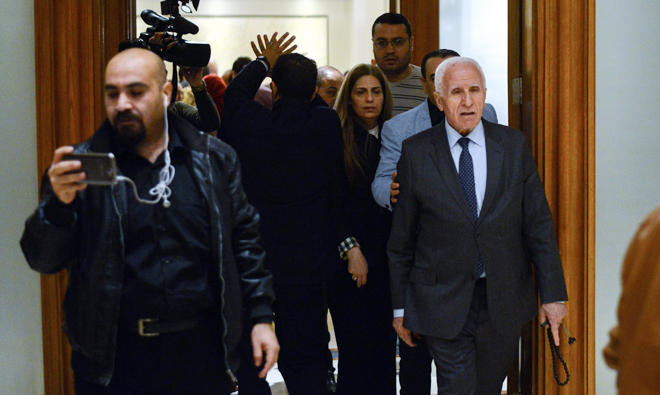
Palestinian reconciliation talks in Cairo fail
Palestinian reconciliation talks in Cairo fail

Latest updates


© 2026 SAUDI RESEARCH & PUBLISHING COMPANY, All Rights Reserved And subject to Terms of Use Agreement.