MAR DELA PLATA, Argentina: Argentina’s navy said Wednesday it was investigating an unusual noise detected in the South Atlantic hours after it last communicated with a missing submarine, but refused to confirm whether it indicated an explosion.
The development came as the clock was ticking down on hopes of finding alive the 44 crew members now missing for a week despite a massive search of surface and seabed, amid fears their oxygen had run out.
The ARA San Juan would have had enough oxygen for its crew to survive underwater in the South Atlantic for seven days since its last contact, according to officials. At 0730 GMT Wednesday, that time had elapsed.
Navy spokesman Enrique Balbi told reporters a “hydro-acoustic anomaly” was detected in the ocean almost three hours after the last communication with the vessel on November 15, 30 miles (48 kilometers) north of its last known position.
Asked if the noise could have been an explosion, the spokesman declined to speculate, saying only: “It has to be corroborated and looked into.”
Balbi added: “We are in a very dangerous situation, and one that is getting worse.”
Information about the unusual noise became available Thursday after being relayed by the United States and “after all the information from all agencies reporting such hydroacoustic events was reviewed, Balbi explained.
“It would have been a very loud noise” and one that could have been an explosion, a former sub commander told AFP privately.
High seas and poor visibility in the South Atlantic have hampered the search since it began, around 200 miles (320 kilometers) off the Argentine coast. Waves have towered as high as six meters (20 feet).
The conditions have fed hopes that the vessel may be on the surface undetected.
Despite the mechanical problems it reported during its last contact last Wednesday, the crew could survive indefinitely if the sub retained the ability to rise to the surface to “snort” or replenish its air.
Conditions improved Tuesday, but the forecast for Thursday is once again poor.
The 34-year-old German-built diesel-electric submarine that was refitted between 2007 and 2014 had flagged a breakdown and said it was diverting to the navy base at Mar del Plata, where most of the crew members live.
It didn’t issue a distress call, however.
Jessica Gopar posted a moving letter to her husband, San Juan crewman Fernando Santilli, father of their one-year-old baby, on Facebook.
“Hi, Fernando. I don’t know if this finds you calm or desperate. Every day here becomes harder. There are moments of hope and great distress.”
“I am surrounded by family, your colleagues, acquaintances and friends, there is not moment that we do not pray for your rescue. Today has to be that day,” she wrote.
The sub’s disappearance has gripped the nation, and President Mauricio Macri visited the relatives — who have endured days of false hopes — and prayed with them.
US President Donald Trump offered his support Wednesday, tweeting: “May God be with them and the people of Argentina!“
Underwater sounds detected by two Argentine search ships were determined to originate from a sea creature, not the vessel.
Satellite signals were also determined to be false alarms.
“A light begins to shine, and then it goes out,” said Maria Morales, the mother of one of the missing sailors.
“There is a curtain of smoke, we don’t know anything,” said Elena Alfaro, whose brother is aboard the submarine.
“It doesn’t make sense that so much time has passed without anyone knowing anything,” she added.
“The hours go by. We’re hoping for a miracle. I don’t want to bury my brother, I want him with me. I feel he’ll come back, but I am aware of time passing.”
Argentina is leading an air-and-sea search with help from several countries including Brazil, Britain, Chile, Colombia, France, Germany, Peru, the United States and Uruguay.
The defense ministry said the search area could be expanded sevenfold, though it was already large.
The incident has recalled recent submarine disasters, perhaps most prominently that of the Kursk, a Russian nuclear sub that caught fire and exploded underwater in 2000, killing all 118 on board — some instantly, others over several days.
An accident aboard a Chinese sub in 2003 killed 70 crew, apparently suffocated after what Beijing termed “mechanical problems.”
Among the ARA San Juan’s crew is Argentina’s first female navy submariner: Eliana Krawczyk, 35.
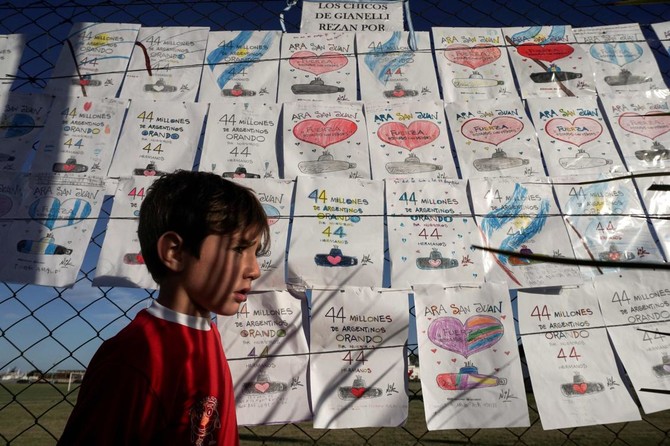
Cards, banners with slogans and placards have been strung up on the outside of the Mar del Plata base’s wire fence, expressing solidarity with the families tensely waiting for any news.
“There’s a mix of feelings: pain, helplessness, at times hope,” Morales said.
“The feeling is that they will come back, that we will tell ourselves today, ‘They are back.’”


Argentina says abnormal noise heard after submarine’s last contact as hopes fade
Argentina says abnormal noise heard after submarine’s last contact as hopes fade

Carney says Canada has no plans to pursue free trade agreement with China as Trump threatens tariffs

Carney says Canada has no plans to pursue free trade agreement with China as Trump threatens tariffs
TORONTO: Canadian Prime Minister Mark Carney said Sunday his country has no intention of pursuing a free trade deal with China. He was responding to US President Donald Trump’s threat to impose a 100 percent tariff on goods imported from Canada if America’s northern neighbor went ahead with a trade deal with Beijing.
Carney said his recent agreement with China merely cuts tariffs on a few sectors that were recently hit with tariffs.
Trump claims otherwise, posting that “China is successfully and completely taking over the once Great Country of Canada. So sad to see it happen. I only hope they leave Ice Hockey alone! President DJT”
The prime minister said under the free trade agreement with the US and Mexico there are commitments not to pursue free trade agreements with nonmarket economies without prior notification.
“We have no intention of doing that with China or any other nonmarket economy,” Carney said. “What we have done with China is to rectify some issues that developed in the last couple of years.”
In 2024, Canada mirrored the United States by putting a 100 percent tariff on electric vehicles from Beijing and a 25 percent tariff on steel and aluminum. China had responded by imposing 100 percent import taxes on Canadian canola oil and meal and 25 percent on pork and seafood.
Breaking with the United States this month during a visit to China, Carney cut its 100 percent tariff on Chinese electric cars in return for lower tariffs on those Canadian products.
Carney has said there would be an initial annual cap of 49,000 vehicles on Chinese EV exports coming into Canada at a tariff rate of 6.1 percent, growing to about 70,000 over five years. He noted there was no cap before 2024. He also has said the initial cap on Chinese EV imports was about 3 percent of the 1.8 million vehicles sold in Canada annually and that, in exchange, China is expected to begin investing in the Canadian auto industry within three years.
Trump posted a video Sunday in which the chief executive of the Canadian Vehicle Manufacturers’ Association warns there will be no Canadian auto industry without US access, while noting the Canadian market alone is too small to justify large scale manufacturing from China.
“A MUST WATCH. Canada is systematically destroying itself. The China deal is a disaster for them. Will go down as one of the worst deals, of any kind, in history. All their businesses are moving to the USA. I want to see Canada SURVIVE AND THRIVE! President DJT,” Trump posted on social media.
Trump’s post on Saturday said that if Carney “thinks he is going to make Canada a ‘Drop Off Port’ for China to send goods and products into the United States, he is sorely mistaken.”
“We can’t let Canada become an opening that the Chinese pour their cheap goods into the U.S,” US Treasury Secretary Scott Bessent said on ABC’s “This Week.”
“We have a , but based off — based on that, which is going to be renegotiated this summer, and I’m not sure what Prime Minister Carney is doing here, other than trying to virtue-signal to his globalist friends at Davos.”
Trump’s threat came amid an escalating war of words with Carney as the Republican president’s push to acquire Greenland strained the NATO alliance.
Carney has emerged as a leader of a movement for countries to find ways to link up and counter the US under Trump. Speaking in Davos before Trump, Carney said, “Middle powers must act together because if you are not at the table, you are on the menu” and he warned about coercion by great powers — without mentioning Trump’s name. The prime minister received widespread praise and attention for his remarks, upstaging Trump at the World Economic Forum.
Trump’s push to acquire Greenland has come after he has repeatedly needled Canada over its sovereignty and suggested it also be absorbed into the United States as a 51st state. He posted an altered image on social media this week showing a map of the United States that included Canada, Venezuela, Greenland and Cuba as part of its territory.


