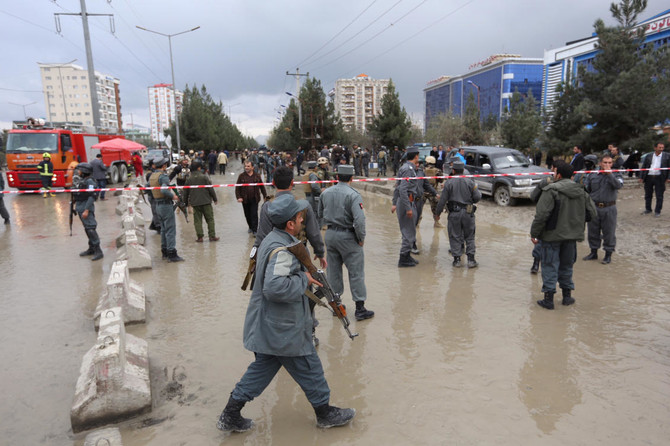
KABUL: A leaked Afghan government document that bars inclusion of an ethnic group in an anti-riot force has led to allegations of ethnic discrimination in the fragile administration and sparked deep anger in the country.
In the letter which appeared days ago on social media — allegedly written by Abdul Fattah Frogh, commander of the Afghan Public Protection Forces (APPF) of the Interior Ministry — Farogh tells officials to recruit other tribes in the new force, excluding Tajiks, the second largest ethnic group in Afghanistan.
Frogh states in the letter that President Ashraf Ghani in a decree had demanded formation of the force, but had not specified if the exclusion of Tajiks was also part of the decree or not.
A spokesman for President Ghani, Shah Hussien Murtazawi, confirmed the issuance of the decree by the president but said the former Interior Minister Taj Mohammad Jahid had months earlier proposed formation of the force which was approved by the president. He insisted the president had made no mention of any ethnic group.
He alleged that Frogh added in the letter the names of ethnic groups and demanded the exclusion of Tajiks.
“There is a need for investigation into this (incident) to find out if it was a deliberate act or not,” Murtazawi told Arab News.
Meanwhile, the leaked memo received strong reaction from parliamentarians and former government officials alike.
“Shame on those who are dragging Afghanistan toward dictatorship, isolation, ethnic division and diverse crisis …” Rahmatullah Nabil, a former head of Afghanistan’s spy agency, said in a statement.
The parliamentarians demanded the government probe the matter and release the content of the presidential decree.
“First those who have signed this should be exposed before the legal and judicial institutions. Secondly, we want to see the presidential decree to know what is written in it,” Ghulam Farooq Majrooh, an MP, said.
“If such things have been written in the president’s order, I see it equal to treason,” said Parliament’s First Deputy Speaker Humayoun Humayoun.
The leaked memo states: “On the basis of an order of the president, a 500-member of anti-riot unit has been established under the Kabul 101 commandant; hereby it is directed that within 24 hours the identities of officers belonging to Hazara, Uzbek, Pashtun — except Tajik ethnicity — must be sent.”
The Interior Ministry has confirmed the authenticity of the document but said there has been a spelling mistake in it.
“The majority of our APPF members are currently ethnic Tajiks,” Interior Ministry spokesman Najib Danesh was quoted as saying in a statement.
“This is a typing error. We have adequate numbers of ethnic Tajik police officers within this unit. There is therefore a need in the unit for members from other ethnic groups so that the unit’s ethnic composition is balanced.”
The new controversy comes as ethnic tension seemingly is running high since the creation over three years of a joint government under a US brokered deal that divides the power between Ghani and Chief Executive Abdullah Abdullah, who draws political support from the Tajik community.
Ghani, a Pashtun, has been dogged by claims of favoritism and stoking tensions, allegations he vehemently denies.
The document is the second to have been leaked in months, and part of the wave of suspicions about Ghani’s commitment to balancing government appointments among ethnic groups.
Weeks ago, a memo from the administrative office of the president appeared to show positions being handed out with the intention of keeping power in the hands of Pashtuns while giving the appearance of diversity.
The government has suspended an official in connection to the leaked document and the attorney general’s office is investigating the issue.
Bashir Bezhen, a political analyst, said the “government leaders were all after weaving a crisis and managing it to increase their power and to benefit themselves and their team.
“Neighboring governments like Iran and Pakistan see their interests in such a situation because they benefit from ethnic discord here,” he told Arab News.