Afghanistan orders frontier forces to retaliate to Pakistani shelling

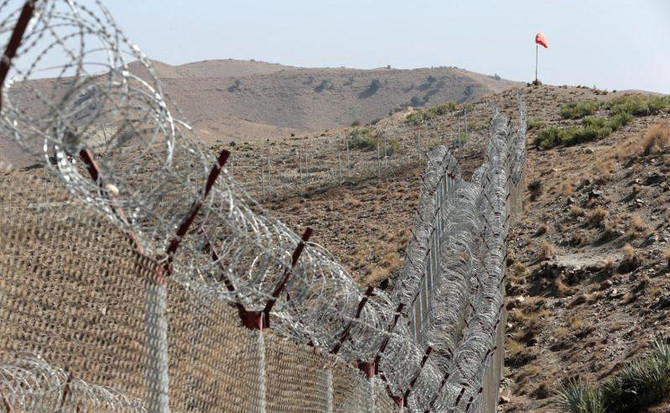
A view of the border fence outside the Kitton outpost on the border with Afghanistan in North Waziristan, Pakistan on October 18, 2017. (File photo by Reuters)
Updated 20 November 2017
Follow

Afghanistan orders frontier forces to retaliate to Pakistani shelling

KABUL/ISLAMABAD: Afghanistan’s government said on Monday that it has ordered its border forces to respond to the wave of shelling on its eastern areas by Pakistan, which Kabul says has displaced over 300 families since last week.
Afghanistan Defense Ministry spokesman Gen. Dawlat Waziri said Kabul was also pushing through diplomatic channels, including the UN and the US-led coalition force in Afghanistan, to halt the shelling.
“People’s houses have been destroyed, their livestock killed, and over 300 families have been displaced since Pakistan resumed the shelling, this shameless act, last week. Some people have been hurt and the shelling continues. We have instructed the frontier force to fire on any target that (fires) shells,” Waziri told Arab News.
Pakistan has been repeatedly accused by locals and government officials of firing rockets at targets in Afghanistan over the past several years. This latest wave of attacks has taken place in several districts situated on the disputed border area of the Durand Line in eastern Kunar province.
“People face a lot of difficulties in the extreme winter weather conditions, and the central government has not taken any action so far,” Saleh Mohammed Saleh, an MP from Kunar, told Arab News.
He said the government is consumed by its internal divisions, adding that the focus of President Ashraf Ghani’s administration is on the parliamentary elections slated for next year and the 2019 presidential poll when he is expected to run for office again.
The US-reliant Afghan government has mostly tried to exercise restraint as it lacks the resources for retaliation and fears any tit-for-tat move could result in a humiliating and drawn-out war with its nuclear-armed neighbor with which it has a long-running border dispute.
Afghan forces have clashed with Pakistani troops on numerous occasions along the ill-defined and disputed border region, with both sides suffering losses.
Some Afghans have demanded the cancelation of the Bilateral Security Agreement (BSA) which Ghani signed with Washington when he assumed power in 2014.
The BSA allows US troops an indefinite presence in Afghanistan in return for a guarantee that the coalition will respond to any act of aggression from outside in consultation with the Afghan government. Both the Afghan government and the US and its allies have accused Pakistan of harboring militants who pose a threat to Afghanistan.
Pakistan claims the shelling is aimed at Pakistani insurgents living in Afghan villages.
Pakistan’s Foreign Ministry spokesman Dr. Muhammad Faisal told Arab News: “Pakistani troops never initiate fire and only respond when they are fired upon; more than 43 percent of Afghan territory remains ungoverned.
“Terrorist sanctuaries are there (in ungoverned areas of Afghanistan) from where they fired on Pakistani posts. It’s important to eliminate terrorist sanctuaries on Afghan soil.”
Last week, Capt. Junaid Hafeez and Sepoy Raham were killed by terrorists firing from the Afghan side of the border in Bajaur tribal region.
After the attack Pakistan’s Ministry of Foreign Affairs summoned the Afghan charge d’affaires and lodged a formal protest over the “use of Afghan soil” by terrorists.
However, Waziri said the reason behind the latest wave of shelling by Pakistan is to avoid pressure from the US and NATO over its continued alleged backing of Afghan insurgents


House Republicans barely defeat Venezuela war powers resolution to check Trump’s military actions

Updated 23 January 2026
Follow

House Republicans barely defeat Venezuela war powers resolution to check Trump’s military actions

WASHINGTON: The House rejected a Democratic-backed resolution Thursday that would have prevented President Donald Trump from sending US military forces to Venezuela after a tied vote on the legislation fell just short of the majority needed for passage.
The tied vote was the latest sign of Republican House Speaker Mike Johnson’s tenuous hold on the majority, as well as some of the growing pushback in the GOP-controlled Congress to Trump’s aggressions in the Western Hemisphere. A Senate vote on a similar resolution was also tied last week until Vice President JD Vance broke the deadlock.
To defeat the resolution Thursday, Republican leaders had to hold the vote open for more than 20 minutes while Republican Rep. Wesley Hunt, who had been out of Washington all week campaigning for a Senate seat in Texas, rushed back to Capitol Hill to cast the decisive vote.
On the House floor, Democrats responded with shouts that Republican leaders were violating the chamber’s procedural rules. Two Republicans — Reps. Don Bacon of Nebraska and Thomas Massie of Kentucky — voted with all Democrats for the legislation.
The war powers resolution would have directed Trump to remove US troops from Venezuela. The Trump administration told senators last week that there are no US troops on the ground in the South American nation and committed to getting congressional approval before launching major military operations there.
But Democrats argued that the resolution is necessary after the US raid to capture Venezuelan leader Nicolás Maduro and since Trump has stated plans to control the country’s oil industry for years to come.
The response to Trump’s foreign policy
Thursday’s vote was the latest test in Congress of how much leeway Republicans will give a president who campaigned on removing the US from foreign entanglements but has increasingly reached for military options to impose his will in the Western Hemisphere. So far, almost all Republicans have declined to put checks on Trump through the war powers votes.
Rep. Brian Mast, the Republican chair of the House Armed Services Committee, accused Democrats of bringing the war powers resolution to a vote out of “spite” for Trump.
“It’s about the fact that you don’t want President Trump to arrest Maduro, and you will condemn him no matter what he does, even though he brought Maduro to justice with possibly the most successful law enforcement operation in history,” Mast added.
Still, Democrats stridently argued that Congress needs to assert its role in determining when the president can use wartime powers. They have been able to force a series of votes in both the House and Senate as Trump, in recent months, ramped up his campaign against Maduro and set his sights on other conflicts overseas.
“Donald Trump is reducing the United States to a regional bully with fewer allies and more enemies,” Rep. Gregory Meeks, the top Democrat on the House Foreign Affairs Committee, said during a floor debate. “This isn’t making America great again. It’s making us isolated and weak.”
Last week, Senate Republicans were only able to narrowly dismiss the Venezuela war powers resolution after the Trump administration persuaded two Republicans to back away from their earlier support. As part of that effort, Secretary of State Marco Rubio committed to a briefing next week before the Senate Foreign Relations Committee.
Yet Trump’s insistence that the US will possess Greenland over the objections of Denmark, a NATO ally, has alarmed some Republicans on Capitol Hill. They have mounted some of the most outspoken objections to almost anything the president has done since taking office.
Trump this week backed away from military and tariff threats against European allies as he announced that his administration was working with NATO on a “framework of a future deal” on Arctic security.
But Bacon still expressed frustration with Trump’s aggressive foreign policy and voted for the war powers resolution even though it only applies to Venezuela.
“I’m tired of all the threats,” he said.
Trump’s recent military actions — and threats to do more — have reignited a decades-old debate in Congress over the War Powers Act, a law passed in the early 1970s by lawmakers looking to claw back their authority over military actions.
The war powers debate
The War Powers Resolution was passed in the Vietnam War era as the US sent troops to conflicts throughout Asia. It attempted to force presidents to work with Congress to deploy troops if there hasn’t already been a formal declaration of war.
Under the legislation, lawmakers can also force votes on legislation that directs the president to remove US forces from hostilities.
Presidents have long tested the limits of those parameters, and Democrats argue that Trump in his second term has pushed those limits farther than ever.
The Trump administration left Congress in the dark ahead of the surprise raid to capture Maduro. It has also used an evolving set of legal justifications to blow up alleged drug boats and seize sanctioned oil tankers near Venezuela.
Democrats question who gets to benefit from Venezuelan oil licenses
As the Trump administration oversees the sale of Venezuela’s petroleum worldwide, Senate Democrats are also questioning who is benefiting from the contracts.
In one of the first transactions, the US granted Vitol, the world’s largest independent oil broker, a license worth roughly $250 million. A senior partner at Vitol, John Addison, gave roughly $6 million to Trump-aligned political action committees during the presidential election, according to donation records compiled by OpenSecrets.
“Congress and the American people deserve full transparency regarding any financial commitments, promises, deals, or other arrangements related to Venezuela that could favor donors to the President’s campaign and political operation,” 13 Democratic senators wrote to White House Chief of Staff Susie Wiles Thursday in a letter led by Democratic Sen. Adam Schiff of California.
The White House has said it is safeguarding the South American country’s oil for the benefit of both the people of Venezuela and the US