Group calls for Indonesian forces to stop virginity tests

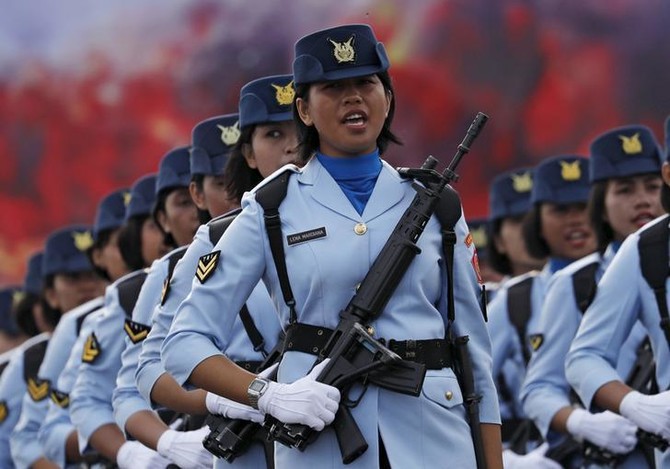
Members of the Indonesian Air Force parade during celebrations marking the 70th anniversary of the Air Force at Halim Perdanakusuma air base in Jakarta, Indonesia on April 9, 2016. (Reuters)
Updated 22 November 2017
Follow

Group calls for Indonesian forces to stop virginity tests

JAKARTA: Indonesia’s military and police continue to perform abusive virginity tests on female recruits three years after the World Health Organization declared they had no scientific validity, an international human rights group said Wednesday.
Human Rights Watch said that senior Indonesian police and military officers have told it that security forces still impose the “cruel and discriminatory tests,” which are carried out under the guise of psychological examinations for mental health and morality reasons.
“The Indonesian government’s continuing tolerance for abusive ‘virginity tests’ by the security forces reflects an appalling lack of political will to protect the rights of Indonesian women,” said Nisha Varia, women’s rights advocacy director at Human Rights Watch.
The group called for President Joko “Jokowi” Widodo to order the national police chief and military commander to ban the practice.
The testing includes the invasive “two-finger test” to determine whether female applicants’ hymens are intact, which WHO in its 2014 clinical guidelines for health care of sexually abused women said lacks any scientific basis.
Human Rights Watch said it found that applicants who were deemed to have “failed” the test were not necessarily penalized but all of the women it spoke with described the test as painful, embarrassing, and traumatic.
Human Rights Watch has also documented the use of virginity tests by security forces in Egypt, India and Afghanistan and criticized calls for virginity tests for Indonesian school girls.
It said all three branches of the Indonesian military have imposed the tests for decades and in some circumstances also extended the requirement to the fiancees of military officers.


Kosovo, Serbia ‘need to normalize’ relations

Updated 5 sec ago
Follow

Kosovo, Serbia ‘need to normalize’ relations

  • Kosovo, which hopes to join NATO, has also been cultivating relations with Washington in recent months, by removing tariffs on American products

PRISTINA: Kosovo and Serbia need to “normalize” their relations, Kosovo’s Prime Minister Albin Kurti said, several days before legislative elections where he is seeking to extend his term with more solid backing.

Kurti has been in office since 2021 and previous accords signed with Serbia — which does not recognize the independence of its former province — have yet to be respected.

“We need to normalize relations with Serbia,” said Kurti. “But normalizing relations with a neighboring authoritarian regime that doesn’t recognize you, that also doesn’t admit to the crimes committed during the war, is quite difficult,” he added.

Tensions between the two neighbors are regularly high.

“We do have a normalization agreement,” Kurti said, referring to the agreement signed under the auspices of the EU in 2023.

“We must implement it, which implies mutual recognition between the countries, at least de facto recognition.”

But to resume dialogue, Serbia “must hand over Milan Radoicic,” a Serb accused of plotting an attack in northern Kosovo in 2023, Kurti asserted, hoping that “the EU, France, and Germany will put pressure” on Belgrade to do so.

Kosovo, which hopes to join NATO, has also been cultivating relations with Washington in recent months, by removing tariffs on American products and agreeing to accept up to 50 migrants from third countries extradited by the US. So far, only one has arrived.

“We are not asking for any financial assistance in return,” Kurti emphasized. “We are doing this to help the US, which is a partner, an ally, a friend,” added the prime minister, who did not rule out making similar agreements with European countries.

Unable to secure enough seats in the February 2025 parliamentary elections, Kurti was forced to call early elections on Sunday, after 10 months of political deadlock during which the divided parliament failed to form a coalition.

“We need a decisive victory. In February, we won 42.3 percent, and this time we want to exceed 50 percent,” he said.