

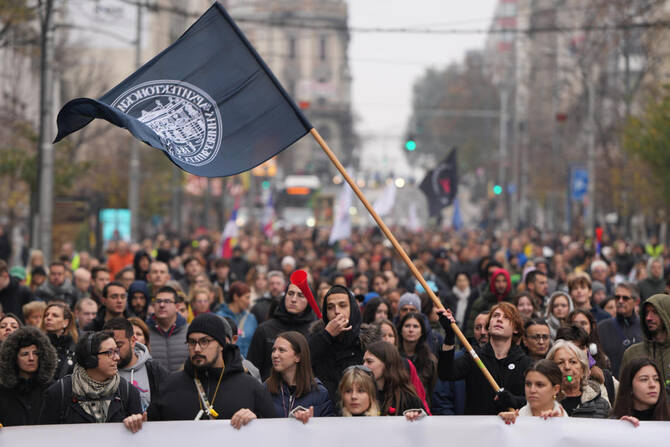

Youth-led protesters drew a red line as they encircled the sprawling buildings in the capital
The $500-million project to build a high-rise hotel, offices and shops at the site has met fierce opposition
BELGRADE: Thousands of protesters in Serbia symbolically formed a human shield Tuesday around a bombed-out military complex, vowing to protect it from redevelopment as a luxury compound by a company linked to US President Donald Trump’s son-in-law Jared Kushner.
Youth-led protesters drew a red line as they encircled the sprawling buildings in the capital, Belgrade that were partially destroyed in a 1999 NATO bombing campaign. The site faces demolition and redevelopment under a plan backed by the populist government of President Aleksandar Vucic.
The $500-million project to build a high-rise hotel, offices and shops at the site has met fierce opposition from experts at home and abroad, as well as the Serbian public. But last week Serbian lawmakers passed a special law clearing the way for the construction despite legal hurdles.
Vucic’s pro-Trump government says the project would boost the economy and ties with the US administration, which has imposed tariffs of 35 percent on imports from Serbia. It has also sanctioned Serbia’s monopoly oil supplier, which is controlled by Russia.
However, critics say the building is an architectural monument, seen as a symbol of resistance to the US-led NATO bombing that remains widely viewed in the Balkan country as an unjust “aggression.”
Serbia’s government last year stripped the complex of protected status and signed a 99-year-lease agreement with Kushner-related Affinity Global Development in the US But the redevelopment project came into question after Serbia’s organized crime prosecutors launched an investigation into whether documents used to remove that status were forged.
The buildings are seen as prime examples of mid-20th century architecture in the former Yugoslavia. The protesters demanded that the protected heritage status for the complex be restored, and the buildings rebuilt.
“This is a warning that we will all defend these buildings together,” one of the students said. “We will be the human shield.”
The issue has become the latest flashpoint in yearlong street protests that have shaken Vucic’s firm grip on power. Protesters have accused his government of rampant corruption in state projects. The protests started after a concrete canopy collapsed at a train station in the northern city of Novi Sad after renovation, killing 16 people.
Tens of thousands of people marked the tragedy’s anniversary on Nov. 1 in Novi Sad.
Serbia was bombed in 1999 for 78 days to force then-President Slobodan Milosevic to end his crackdown on separatist ethnic Albanians in Kosovo. Anti-NATO sentiment remain strong in Serbia, and the US role in revamping the military buildings is particularly sensitive among many Serbians.
Earlier this year, the government in Albania, another Balkan country, approved a $1.6 billion plan from Kushner’s company for a project to develop a luxury resort on a communist-era fortified island on the Adriatic coast.


